Practice of Politics
Learning outcomes
- When one country's politics looks unlike another's (one has two big parties and another has thirty; one passes laws fast and another stalls; one is consensual and another tears at itself), you'll know to compare them on five axes before reaching for cultural explanations: institutions (electoral, executive, federal), state capacity, regime type, social cleavages (religion, ethnicity, class, language), and the shape of the political economy. The differences that look cultural are usually traceable to one or more of these.
Why countries differ
The UK has two large parties. Italy's parliament is fragmented across many. Switzerland has seven parties that have shared coalitions since 1959. The United States has had two parties for over a century, despite vast social and economic upheaval.
The variation is not random and not really cultural. Most of it traces to institutions, state capacity, regime type, social cleavages, and the political economy of who pays whom. Comparative politics is the field that catalogues that variation and tries to explain it.
The basic move is comparison. "The British two-party system results from first-past-the-post voting" is a causal claim, and the only way to test it is to look at countries that vary on the input and see whether the output varies as predicted.
John Stuart Mill formalised the two strategies in 1843. Most-similar systems holds as much constant as possible, varies the input of interest, and watches whether the outcome moves. To test whether FPTP causes two-party systems, compare countries close to the UK in language, development, and historical inheritance but differing on the electoral system.
Most-different systems finds a shared outcome across very dissimilar settings and asks what they nonetheless share. To explain why almost no oil-rich state is a stable democracy, compare countries with little in common except oil dependence. Modern practice supplements these with large-N statistical comparison and sub-national designs that exploit institutional variation within a single country.
Comparing institutions
Duverger's law
Single-member-district plurality elections (first-past-the-post) tend to produce two-party systems; proportional representation tends to produce many parties. Maurice Duverger proposed the regularity in 1951 and gave it two mechanisms.
The mechanical effect: under FPTP, geographically diffuse third parties get badly under-represented because they win pluralities almost nowhere, so their seat share falls well below their vote share. The psychological effect: voters anticipate this and defect from their first preference to one of the two viable parties, which entrenches the two-party result.
The pattern is visible in any cross-country snapshot of parliaments. Effective number of parties (ENPP) is a single weighted count that treats two evenly-matched parties as 2 and a hundred tiny parties beside one giant one as little above 1.
The law is a tendency, not an iron rule. India in 2024 sits at 2.1 only because the BJP currently dominates an electorate that has been more fragmented in earlier elections, and Italy's 2.4 reflects a 2017 reform that pushed its mixed system toward majoritarianism. Canada and the UK with the SNP both maintain regionally-concentrated third parties under FPTP, because the mechanical effect inverts where a small party is locally first.
To predict what would happen if the UK adopted PR: expect the Liberal Democrats' seat share to rise close to their vote share, expect new parties to enter parliament because the psychological barrier is gone, and expect coalition government to become the norm.
Patterns of democracy
Arend Lijphart, comparing thirty-six democracies since 1945, found that institutional choices come in correlated bundles. The majoritarian bundle concentrates power: plurality elections, single-party majority cabinets, executive dominance over the legislature, a unitary state, a weak second chamber, a flexible constitution, an executive-controlled central bank. The UK is the canonical case.
The consensus bundle disperses power: proportional elections, coalition cabinets, executive-legislative balance, federalism, strong bicameralism, a rigid constitution requiring supermajorities to amend, an independent central bank. Switzerland is the canonical case; Belgium, the Netherlands, and most continental democracies cluster at the consensus end.
Lijphart's central empirical claim is that consensus democracies produce more egalitarian outcomes (lower income inequality, higher female representation, more generous welfare states) without sacrificing growth or stability. The strong form of the claim is contested; the weaker version is widely accepted.
The bundles correlate over time as well. A country that adopts PR tends to drift toward the rest of the consensus features, because PR yields coalition governments, which in turn require institutional protections for coalition partners.
Presidentialism versus parliamentarism
In a parliamentary system, the executive sits only as long as it commands a legislative majority. If the legislature loses confidence in the cabinet, a new government forms or an early election is called; the deadlock-breaker is built in.
In a presidential system, the executive and the legislature each have a separate fixed-term popular mandate, and the constitution provides no comparable procedure for resolving an impasse between them. Juan Linz argued in 1990 that this dual legitimacy is the source of presidential instability.
When the two branches disagree, each can claim a popular mandate against the other, neither can dissolve the other, and the resulting deadlock has historically been broken in unstable democracies by extra-constitutional means: military intervention, judicial coups, or constitutional crisis.
The strongest counterexample is the United States, which has run on a presidential system for over two centuries without breakdown. The current synthesis softens Linz: presidentialism does not cause breakdown on its own, but it amplifies two background conditions, weak political parties (so the legislature lacks coherent partners for the executive) and high social inequality (which intensifies distributive conflict).
Where parties are strong and inequality is moderate, as in the US, dual legitimacy is survivable. Where neither holds, as in much of twentieth-century Latin America, the system buckles.
States and regimes
State capacity
A democracy on paper requires a state apparatus that can run fair elections, enforce the law, and deliver public goods. Many states fall short. A comparison between two countries that differ wildly in state capacity mostly measures the capacity gap, not the institutional one.
Daron Acemoglu and James Robinson, in Why Nations Fail, draw the central institutional distinction. Extractive institutions concentrate political power in a narrow elite and use that power to extract resources from the rest of society; they discourage productive investment because the elite can expropriate the returns. Inclusive institutions disperse political power, secure property rights, and create incentives for investment, innovation, and broad participation.
Their thesis is that the long-run divergence in national prosperity is mostly explained by which kind of institutions a country ends up with, often through historical contingencies: colonial settlement patterns, the Black Death, the disease environment that killed early European colonisers. The thesis is contested in its strongest form, but the underlying point holds. Comparing party systems in two countries tells you little if one of them does not really have a functioning state.

Korean Peninsula at night, 2016. Same people, same language, broadly similar geography; the line of darkness runs along the institutional border between an inclusive and an extractive regime. Source: NASA Earth Observatory (Joshua Stevens, Suomi NPP VIIRS data), public domain.
Regime type, on a spectrum
The Cold War habit of sorting countries into "democracies" and "autocracies" misses where most contemporary variation lies. Full liberal democracies are rarer than the post-1989 mood assumed, and the share has been declining.
Competitive-authoritarian regimes (Steven Levitsky and Lucan Way's coinage) hold real elections that the opposition is allowed to contest, but the playing field is so skewed by incumbent control of the media, courts, and state resources that the incumbent is unlikely to lose. Russia, Hungary in the 2010s, and Turkey under the late-period AKP are canonical cases. Electoral autocracies allow contested elections within tighter constraints.
Within the autocratic family, comparative work distinguishes military regimes (junta rule, often short-lived), single-party regimes (China, Vietnam, Cuba), and personalist regimes (the late Mugabe Zimbabwe, Putin's Russia). They survive on different bases (force, party discipline, patronage) and break down in different ways.
Measuring this variation precisely is itself a research programme. The Varieties of Democracy (V-Dem) Institute scores every country since 1789 on hundreds of indicators across five conceptions of democracy (electoral, liberal, participatory, deliberative, egalitarian), with an explicit Bayesian model for inter-rater disagreement, and the dataset is open. V-Dem's annual democracy report has tracked a sustained decline in liberal-democratic quality since the mid-2010s, with most of the world's population now living in regimes the project codes as autocratic.
Cleavages and identity
A democracy is not a blank slate. The conflicts that organise its politics, religion, ethnicity, language, class, region, predate the parties. Seymour Lipset and Stein Rokkan's 1967 analysis held that western European party systems were frozen around four cleavages from the early industrial era: church versus state (the Reformation aftermath), centre versus periphery (national elite versus regional cultures), land versus industry (the agricultural-industrial revolution), and owners versus workers (the industrial revolution proper). Half a century later the frame still mostly holds.
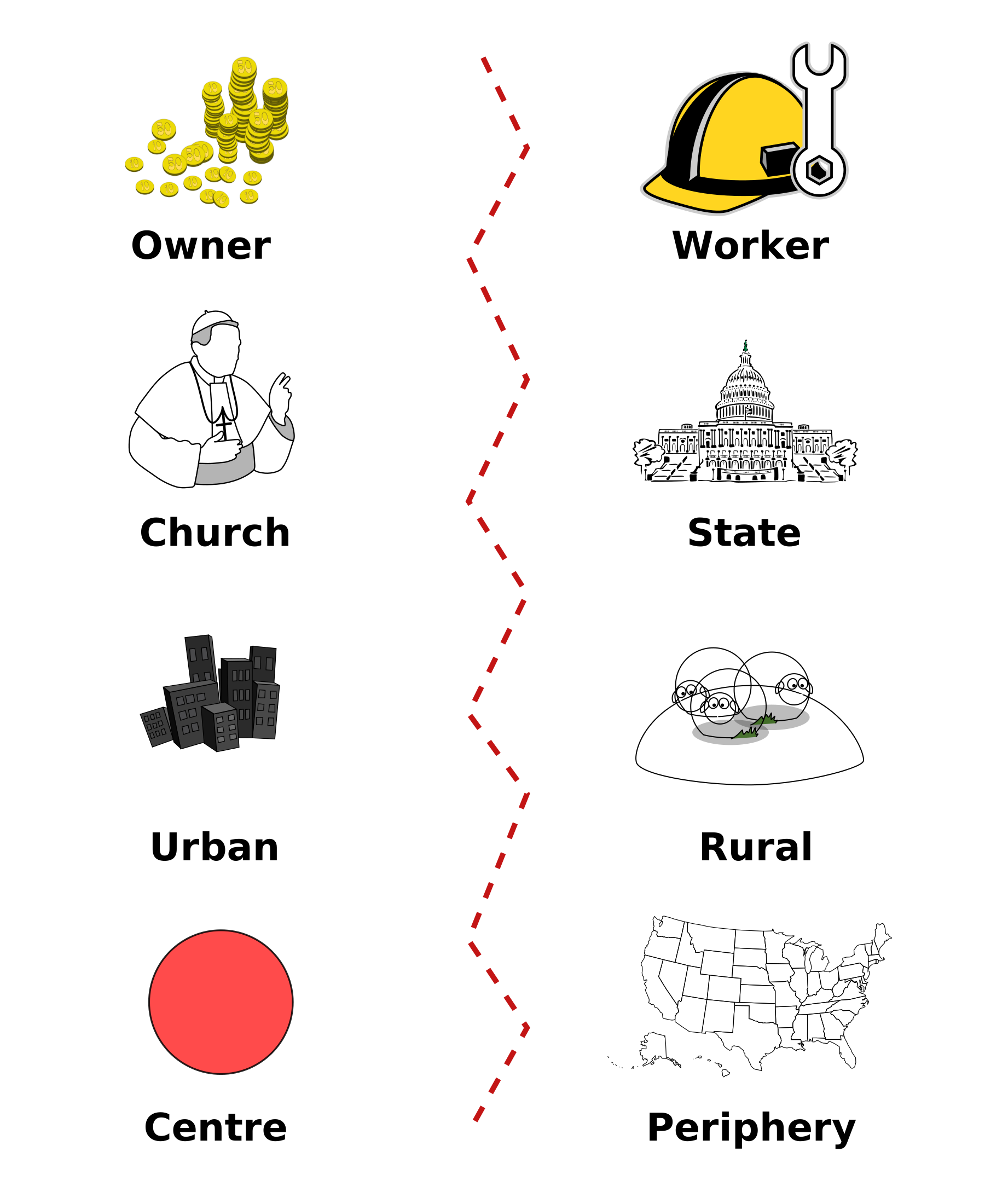
The four cleavages as Lipset and Rokkan stack them: each axis is a historical conflict that survived the era that produced it and ended up structuring later party competition. Source: Cleavage_english.svg, Wikimedia Commons (Nikolas Becker, CC BY-SA 3.0).
The cases are vivid. Belgium's Flemish-Walloon linguistic split runs through every major institution and produced a 541-day government formation crisis in 2010-11. Northern Ireland's politics is structured by sectarian identity (Unionist versus Nationalist) more than by left versus right. India's politics partitions on caste, region, and religion in ways that defy a single national axis.
The United States is the recent comparator. Over fifty years its partisan cleavage has steadily realigned along race, religion, and education, eroding the older class-based one. The same parties survive in name; what they stand for, and who votes for them, has substantially flipped.
Identity also concerns who counts as a member of the political community at all. Nationalism is a modern phenomenon, not a primordial one: Benedict Anderson's Imagined Communities argued that print capitalism let strangers in distant towns imagine themselves into a single people, the necessary substrate for the modern nation-state. Theories of citizenship explain why some states extend membership broadly (jus soli, France) and others narrowly (jus sanguinis, historical Germany), and why those choices persist across generations.
Identity-based politics is not in tension with institutional politics. The two interact: PR systems amplify cleavage representation by giving small identity-defined parties a path to seats, while FPTP suppresses them outside their geographic strongholds. Federalism offers institutional accommodation for territorially concentrated identity groups (Quebec, Catalonia, Scotland); failure to provide it where the demand is strong is one of the standard recipes for separatist conflict.
Political economy
Wealthy democracies differ enormously in how their economies are organised, how much they redistribute, and how they govern firms. Peter Hall and David Soskice's Varieties of Capitalism (2001) sorted rich democracies into liberal market economies (LMEs: US, UK, Canada, Australia, Ireland), where firms coordinate via arms-length markets, and coordinated market economies (CMEs: Germany, Japan, Sweden, Austria), where firms coordinate via dense relationships with banks, unions, employers' associations, and the state.
The two clusters produce systematically different outcomes. LMEs see more radical innovation in services and software; CMEs see more incremental innovation in engineering and manufacturing. LMEs have weaker unions and higher wage inequality; CMEs have stronger unions and more compressed wages. The institutional complementarities matter: deregulating the labour market in a CME does not produce LME-style flexibility, because the rest of the institutional bundle resists.
Redistribution is the central political question. Why do similarly rich democracies arrive at very different post-tax-and-transfer inequality levels? The standard answer combines institutional complementarities (PR plus coalition cabinets plus strong unions tend together, and tend to redistribute more), historical sequencing (countries that built welfare states before capital became globally mobile kept them; latecomers struggled), and political coalitions (cross-class alliances protected redistribution where they formed and eroded it where they did not).
For developing economies the questions are different but adjacent. Why does a similar resource endowment produce a stable institutional environment in one country (Botswana) and chronic instability in another (Nigeria)? Why does industrial policy succeed in some catch-up economies (South Korea, Taiwan) and fail in others (post-war Argentina)? The answers run through the same machinery: political coalitions, institutions, state capacity, and the historical sequence in which these were built.
Contention and political violence
Politics also happens outside the formal institutions. Comparative work on social movements, ethnic conflict, civil war, and revolution asks why grievance translates into mobilisation in some places and not others, and why some movements topple regimes while others fizzle.
The starting point for movements is that grievance alone is too common to explain anything. What varies is the political opportunity structure: how open the state is to challenge, how divided its elites are, how willing it is to repress, whether powerful allies are available. The US civil rights movement of the 1950s and 1960s built on Cold War embarrassment over Jim Crow and on splits between northern and southern Democrats; the same grievances had been there for decades without the same traction.
Theda Skocpol's States and Social Revolutions (1979) argued that the great revolutions, France in 1789, Russia in 1917, China in 1949, succeeded not because of revolutionary ideology but because the prior state had been weakened by international pressure (war, fiscal crisis) before the revolutionary movement struck. The revolution exploited the state's vulnerability as much as it caused it. The book reset the field by showing that structure mattered more than ideology in explaining when revolutions succeed.
Civil war and ethnic conflict are the subject of large empirical literatures since the 1990s. Ethnic diversity by itself does not predict civil war once state weakness and per-capita income are controlled for; what matters is whether ethnic groups are politically excluded from central state power, the finding Andreas Wimmer, Lars-Erik Cederman, and Brian Min established with the Ethnic Power Relations dataset in 2009. Where excluded groups are large enough to be threatened and small enough not to capture the state, the conflict trap is acute.
Repression is the other side. Authoritarian regimes survive longer when they can selectively repress opposition (target leaders rather than mass-mobilise the public against the state) and when they can buy compliance through patronage. The 2010-12 Arab uprisings showed both extremes: Tunisia's small army declined to fire on protesters and the regime fell within weeks; Syria's regime fired and the result was a decade of civil war.
References
- Dino Bozonelos, Julia Wendt, and Charlotte Lee, Introduction to Comparative Government and Politics (2022). Open textbook covering scope, methods, regimes, identity, political economy, collective action, and political violence in twelve chapters. https://open.umn.edu/opentextbooks/textbooks/introduction-to-comparative-government-and-politics
- John Stuart Mill, A System of Logic, Ratiocinative and Inductive (1843). The original statement of the most-similar and most-different comparative designs. https://www.gutenberg.org/ebooks/27942
- Maurice Duverger, Political Parties: Their Organization and Activity in the Modern State (1954). The source of Duverger's law on electoral systems and party counts. https://archive.org/details/politicalparties0000duve
- Arend Lijphart, Patterns of Democracy: Government Forms and Performance in Thirty-Six Countries, 2nd ed. (2012). The book that established the majoritarian-versus-consensus typology. https://yalebooks.yale.edu/book/9780300172027/patterns-of-democracy/
- Juan J. Linz, "The Perils of Presidentialism", Journal of Democracy 1, no. 1 (1990). The classic case against presidential systems on dual-legitimacy grounds. https://www.journalofdemocracy.org/articles/the-perils-of-presidentialism/
- Steven Levitsky and Lucan A. Way, "Elections Without Democracy: The Rise of Competitive Authoritarianism", Journal of Democracy 13, no. 2 (2002). The article that named and analysed competitive authoritarian regimes. https://www.journalofdemocracy.org/articles/elections-without-democracy-the-rise-of-competitive-authoritarianism/
- Daron Acemoglu and James A. Robinson, Why Nations Fail: The Origins of Power, Prosperity, and Poverty (2012). The extractive-versus-inclusive institutions framework, with a long historical case base. https://archive.org/details/whynationsfailor0000acem
- Seymour M. Lipset and Stein Rokkan (eds.), Party Systems and Voter Alignments: Cross-National Perspectives (1967). The introductory chapter is the source of the four-cleavage account of European party systems. https://archive.org/details/partysystemsvote0000lips
- Benedict Anderson, Imagined Communities: Reflections on the Origin and Spread of Nationalism (1983; rev. 1991). The standard account of nationalism as a modern, constructed phenomenon. https://archive.org/details/imaginedcommunit00ande
- Peter A. Hall and David Soskice (eds.), Varieties of Capitalism: The Institutional Foundations of Comparative Advantage (2001). The book that established the LME-CME typology and the institutional-complementarities frame. https://en.wikipedia.org/wiki/Varieties_of_Capitalism
- Theda Skocpol, States and Social Revolutions: A Comparative Analysis of France, Russia, and China (1979). The structural account of why some revolutions succeed. https://archive.org/details/statessocialrevo0000skoc
- Andreas Wimmer, Lars-Erik Cederman, and Brian Min, "Ethnic Politics and Armed Conflict: A Configurational Analysis of a New Global Data Set", American Sociological Review 74, no. 2 (2009). The Ethnic Power Relations dataset and the political-exclusion finding on civil war. https://doi.org/10.1177/000312240907400208
- V-Dem Institute, Varieties of Democracy: Project, Methodology, and Datasets. The leading public dataset on democratic quality, scoring every country since 1789. https://www.v-dem.net/about/v-dem-project/