215. Political Thought: Plato to Rousseau
Learning outcomes
- When a contemporary argument turns on justice, legitimate authority, individual rights, or the right relation between citizens and rulers, you'll know which classical or early-modern thinker first made the move, what they actually argued (often unlike the cartoon), and the standard objection their position invites.
Most contemporary positions in Theory of Politics and 203 are specifications of moves first made by the nine thinkers below.
| Thinker | Key text(s) | Central question | Distinctive answer |
|---|---|---|---|
| Plato (c. 424-348 BCE) | Republic, Statesman, Laws | What is justice, and what political order produces it? | A polis ruled by philosopher-kings whose education has prepared them to know the good. Democracy decays into tyranny because it cultivates appetite over reason. |
| Aristotle (384-322 BCE) | Politics, Nicomachean Ethics | What is the best regime that is achievable for human beings as we are? | A mixed regime (politeia) combining elements of democracy and oligarchy, sustained by a large middle class. Politics is the practice of living together as moral agents. |
| Aquinas (1225-1274) | Summa Theologiae (II-II, qq. 90-105), political writings | How should Christian revelation and Aristotelian political philosophy be reconciled? | Natural law: rational principles accessible to all human beings, distinct from but consistent with divine law. Tyranny may justly be resisted under specifiable conditions. |
| Machiavelli (1469-1527) | The Prince, Discourses on Livy | How should political leaders actually act, and what makes a republic durable? | Politics is its own ethical domain; rulers cannot afford the personal virtues of private life. Republics last when their citizens have civic virtue and contested institutions check ambition. |
| Hobbes (1588-1679) | Leviathan | What can ground political authority once we abandon teleology and inherited authority? | Voluntary surrender to an absolute sovereign in exchange for security. The state of nature is a war of all against all; any peace is preferable. |
| Locke (1632-1704) | Second Treatise of Government | What grounds legitimate political authority, and what limits does it have? | Consent of the governed. Government's purpose is to protect natural rights to life, liberty, and property; serious failure on this score justifies revolution. |
| Montesquieu (1689-1755) | The Spirit of the Laws | What political institutions preserve liberty across different societies and climates? | Separation of powers (executive, legislative, judicial) and intermediate bodies. Different "spirits" suit different regimes; no single design is universal. |
| Hume (1711-1776) | Treatise of Human Nature, political essays | What is the actual basis for political obligation, given that consent fails? | Convention and utility. Justice is an artificial virtue that emerges from coordination on rules that benefit everyone in the long run. |
| Rousseau (1712-1778) | Discourse on Inequality, The Social Contract | How can people enter political society without losing their natural freedom? | Submission to the general will: a collective sovereign of which each citizen is part. Legitimacy requires direct, ongoing self-governance, not representation. |
The four arguments that ran across the period
The justice argument runs from Plato's Republic (justice as the right ordering of the soul and of the city, defended in Book IV through the analogy between the three parts of the soul and the three classes of the city) through Aristotle (justice as proportionality: equals treated equally, unequals unequally in proportion to their relevant difference) and Aquinas (justice as conformity to natural law, which practical reason can grasp without revelation). Hobbes interrupts the conversation: in the state of nature there is no justice or injustice, only force, because "where there is no common power, there is no law" (Leviathan ch. 13). Locke restores justice on a different footing: natural rights to life, liberty, and property exist prior to the state and constrain what any sovereign may do. The argument resumes in the modern period with Rawls, Nozick, and Sen, and is the subject of Theories of Justice (Advanced) and 203.
The legitimacy argument runs from Aquinas's natural-law account (rulers are legitimate when they govern in accordance with reason; tyrannical commands oblige no one) through Hobbes's contractarian rupture (legitimacy is whatever covenant rational individuals would accept to escape the state of nature, even if it commits them to an absolute sovereign) and Locke's consent-based reformulation (legitimacy depends on the consent of the governed, with tacit consent inferred from accepting the benefits of life under the law). Rousseau then refuses representation altogether: a sovereign people that delegates its will has alienated its freedom. The four legitimacy theories in contemporary work (consent, fair play, associative duty, natural duty) all descend from one or another of these positions.
The stability argument runs through Aristotle (a large middle class blunts the conflict between rich and poor that wrecks pure oligarchies and pure democracies), Machiavelli (a republic lasts when its citizens have civic virtue and its institutions, like the Roman tribunate, channel ambition into mutual checks rather than civil war), Hobbes (peace requires undivided sovereignty; any divided power slides back toward the state of nature), Hume (justice and political allegiance are conventions that hold because everyone benefits from the rule, not because anyone freshly consents), and Rousseau (a republic stays free only if it is small, customs are shared, and property is roughly equal). Each answer follows from a different premise about what human beings are like once nothing forces them to cooperate.
The democracy argument runs through Plato (democracy decays into tyranny because it cultivates appetite over reason; the demagogue rises by flattering the appetites the regime has already legitimised) and Aristotle (a mixed regime, the politeia, combines democratic and oligarchic elements so that no single class can capture the state). Hobbes treats democracy as one possible form of the sovereign but warns that divided sovereignty is the real danger. Locke makes representative government the practical form of consent. Montesquieu identifies separation of powers as the structural preventive against tyranny in any regime. Rousseau closes the period by insisting that representation is itself a betrayal: the moment a people lets others legislate for it, it ceases to be free. Almost every modern position in democratic theory inherits one or more of these moves.
The seam between natural law and voluntarism
The single most consequential fault line in the canon is whether right and obligation exist before the sovereign or only because the sovereign commands them. Aristotle and Aquinas sit on the natural-law side: there are standards of justice that human reason can grasp without any positive enactment, and an unjust law "is no law at all" (Summa Theologiae I-II, q. 95, a. 2). Hobbes flips this: in the state of nature, "nothing can be unjust", because covenants without the sword are mere words. Justice begins when the sovereign exists to enforce the covenant, not before.
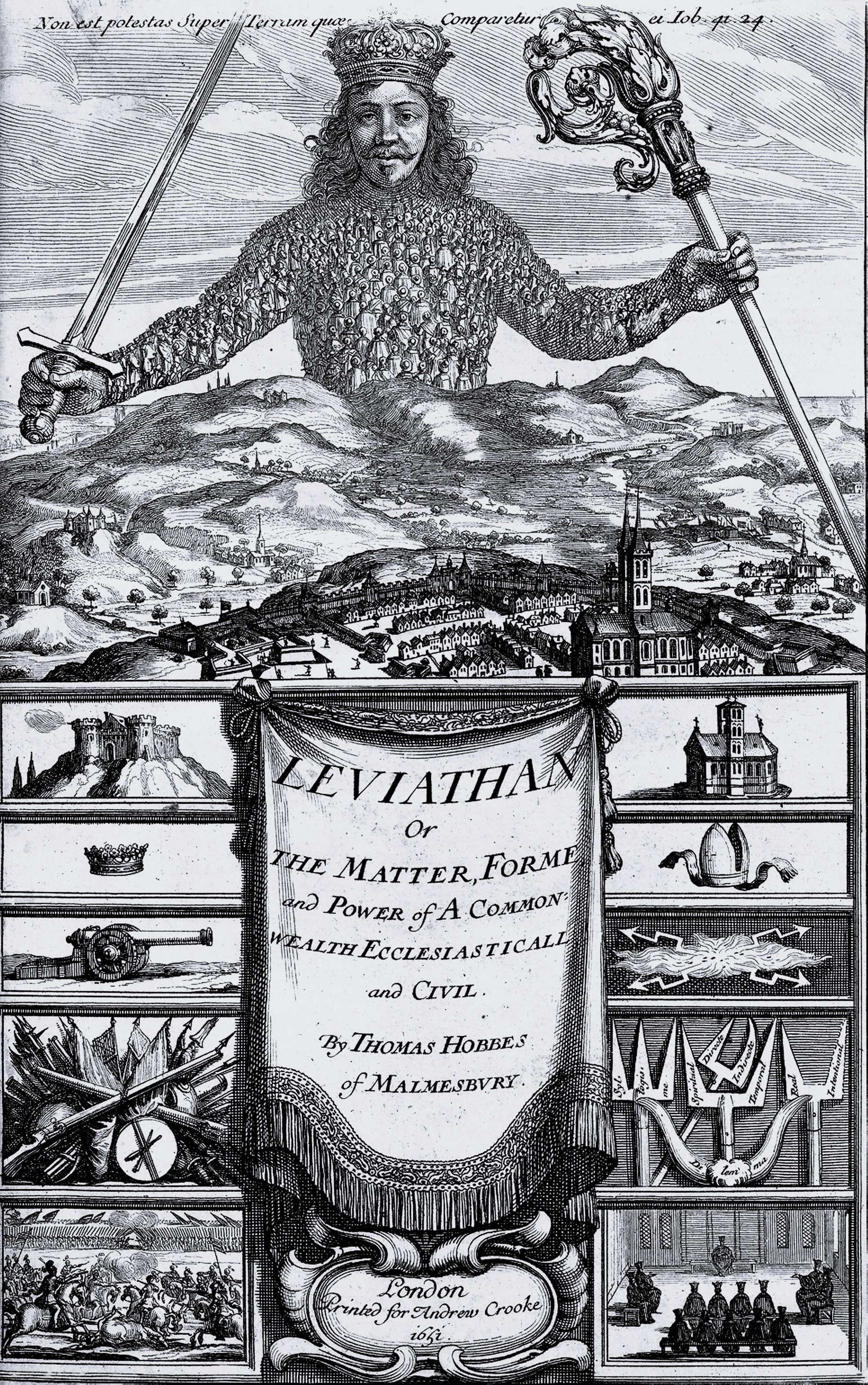
Frontispiece, Thomas Hobbes, Leviathan (1651), engraved by Abraham Bosse with Hobbes's input. The body politic is the citizens themselves, arranged into one artificial man by their covenant; without that arrangement they fall back into the war of all against all. Source: British Library scan, Wikimedia Commons, public domain.
Locke partly restores natural law (rights to life, liberty, and property bind the sovereign) while keeping the contractarian framing. Hume drops natural law altogether: justice is a useful convention that humans converge on because the alternatives are worse. Rousseau revives a quasi-natural standard, the general will, but locates it inside the political community rather than outside it. The three contractarians (Hobbes, Locke, Rousseau) ask different questions about consent, but they share Hobbes's starting move: political authority needs an argument that does not appeal to a pre-political moral order.
For Rousseau's argument worked through step by step, from the founding problem of the social contract to the rejection of representation in Book III ch. 15: Steven Smith, "Democracy and Participation: Rousseau's Social Contract, I-II", Open Yale Courses PLSC 114 Lecture 20 (about 45 minutes). Watch when you want the inference from "alienation of will = loss of freedom" to "representation betrays sovereignty" laid out as an argument rather than a paragraph.
Tracking which side a contemporary argument sits on usually clarifies what is actually at stake. A natural-rights argument in a Supreme Court brief is on the Aquinas-Locke side. A purely procedural defence of legitimacy ("whatever the legislature enacts is law") is on the Hobbes-Hume side.
References
- Plato, The Republic (trans. Benjamin Jowett, Project Gutenberg edition). https://www.gutenberg.org/ebooks/1497
- Aristotle, Politics (Project Gutenberg edition). https://www.gutenberg.org/ebooks/6762
- Niccolò Machiavelli, The Prince (1532; Project Gutenberg edition). https://www.gutenberg.org/ebooks/1232
- Thomas Hobbes, Leviathan (1651; Project Gutenberg edition). https://www.gutenberg.org/ebooks/3207
- John Locke, Second Treatise of Government (1689; Project Gutenberg edition). https://www.gutenberg.org/ebooks/7370
- Charles de Secondat, baron de Montesquieu, The Spirit of the Laws (1748; archive.org English edition). https://archive.org/details/spiritoflaws01montuoft
- David Hume, A Treatise of Human Nature, Book III (1740; Project Gutenberg edition). https://www.gutenberg.org/ebooks/4705
- Jean-Jacques Rousseau, The Social Contract and Discourses (1762; trans. G. D. H. Cole, Project Gutenberg edition). https://www.gutenberg.org/ebooks/46333
- Thomas Aquinas, Summa Theologiae (trans. Fathers of the English Dominican Province, 1920; New Advent online edition). https://www.newadvent.org/summa/
- Fred Miller, "Aristotle's Political Theory", Stanford Encyclopedia of Philosophy (substantive entry on the Politics). https://plato.stanford.edu/entries/aristotle-politics/
- Christopher Bertram, "Jean Jacques Rousseau", Stanford Encyclopedia of Philosophy (definitive overview, including the general will). https://plato.stanford.edu/entries/rousseau/