206. Politics in Europe
Learning outcomes
- When a European election produces a result that looks alien from a UK or US frame (a seven-party coalition, a populist party in government, a country renegotiating its place in the EU), you'll know to read it through three layers: the rules of the system (how votes become seats, how a government forms), the cleavages the parties are competing over, and the EU politics sitting above the national one.
A continent of consensus democracies
The defining institutional feature of European politics is proportional representation with coalition government. Almost every Continental European democracy uses some form of PR; almost every government is a coalition, often a multi-party one; and the institutional bundles described in Lijphart's Patterns of Democracy (covered in Practice of Politics) tend to cluster at the consensus end. The UK is the prominent exception, treated separately in 204.
The PR-plus-coalition pattern produces a distinctive politics. Coalitions need post-electoral negotiation, so government formation can take weeks (Germany), months (Italy, Belgium), or fail entirely and force a re-election (Spain, the Netherlands at points). Once formed, coalition governments produce centrist policy compromises that move slowly. The political-economy consequence: stronger unions, more compressed wages, larger welfare states, and lower income inequality than majoritarian democracies achieve.
Within this broad pattern, important variation persists. The Nordic model combines high redistribution with active labour-market policy and gender-egalitarian institutions. The Mediterranean model has weaker state capacity, more clientelism, and more political instability. Continental social-market economies sit between. The post-1989 Central European democracies have institutionally converged on the EU model with significant variation in democratic quality.
The Lipset-Rokkan cleavages and their evolution
Seymour Lipset and Stein Rokkan's 1967 thesis held that Western European party systems froze around four cleavages laid down by the early industrial era: church vs. state, centre vs. periphery, land vs. industry, owners vs. workers. The party families that emerged (Christian democrats, secular liberals, agrarian and regional parties, socialists, communists) tracked these cleavages closely enough that the same parties dominated most countries for decades.
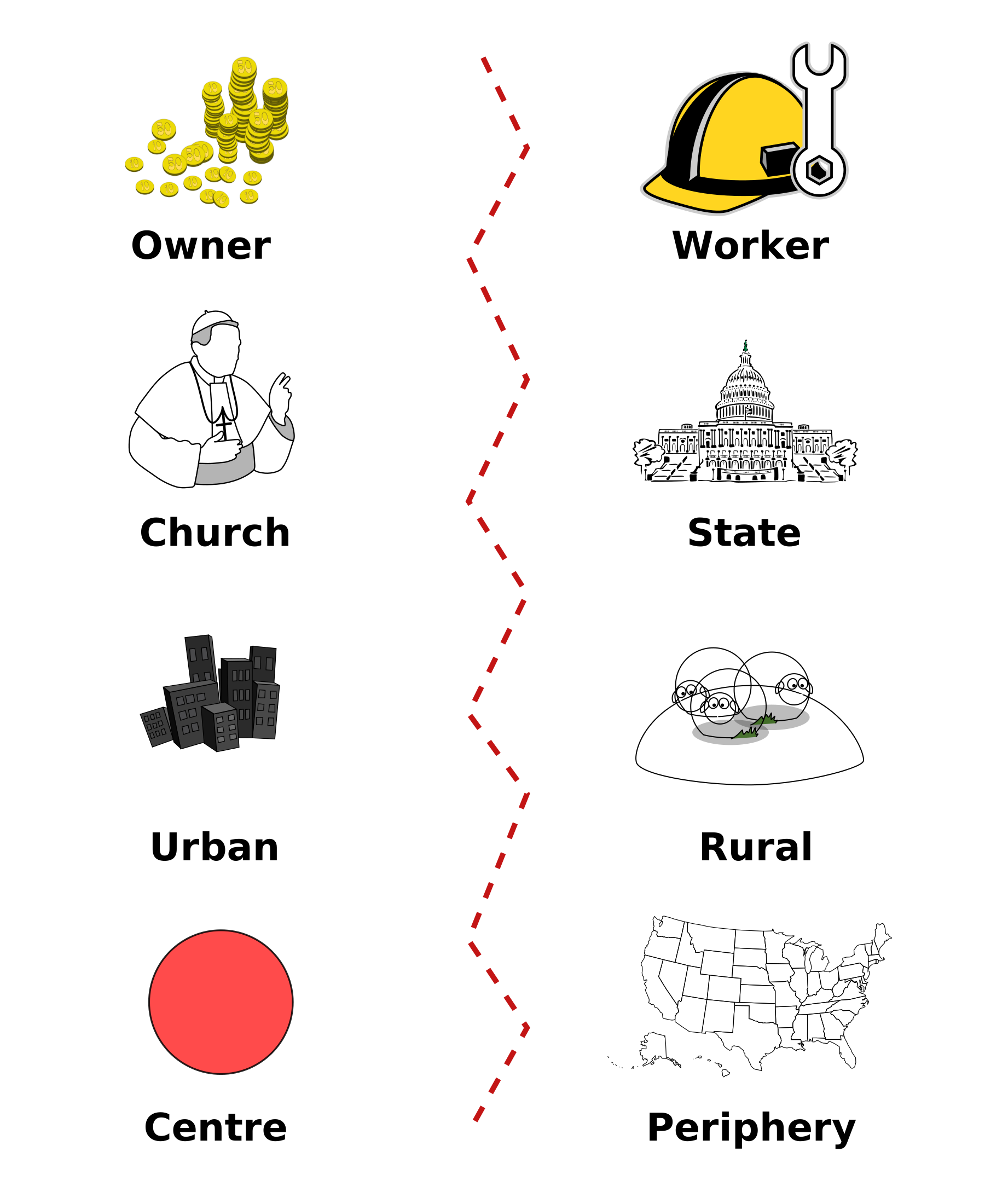
Cleavages in society according to Lipset and Rokkan (1967). Diagram by Nikolas Becker, Wikimedia Commons, CC BY-SA 3.0.
What broke the freeze was a new cleavage. Hanspeter Kriesi and colleagues call it the winners and losers of globalisation divide: educated, urban, mobile workers in cosmopolitan industries on one side; less-educated, rural, immobile workers in declining industries on the other. The cleavage maps imperfectly onto attitudes toward European integration, immigration, and cultural liberalism. It cuts across the older class line and has produced new party families: green parties on one end and right-wing populist parties on the other, often at the expense of the older social-democratic and Christian-democratic centres.
The pattern is uneven. Hungary and Italy now have populist-led governments. France's Rassemblement National competes for first place in presidential elections. Germany's AfD polls in the high teens but remains in opposition because other parties refuse to coalition with it (the cordon sanitaire). Spain and Portugal saw populism on the left (Podemos, Bloco) ahead of, and largely in place of, a right-wing variant.
A separate territorial cleavage cuts through several states. Catalonia held an unauthorised independence referendum in 2017, and the Spanish state prosecuted its organisers. Scotland's 2014 referendum lost 45 to 55, and the Scottish National Party has competed for a second vote ever since. Belgium has run governments dominated by Flemish-Walloon bargaining for half a century.
These are not the old centre-periphery cleavage settling down. They are live questions about which unit a citizen belongs to.
The European Union and multilevel politics
EU membership, for the 27 member states, is now the decisive constraint on what national politics can do. EU directives shape consumer protection, environmental rules, market regulation, and labour rights, and the European Court of Justice ranks above national courts in EU-law areas. The eurozone removes monetary policy from national hands. The four freedoms (goods, services, capital, labour) shape trade and migration.
The institutional design is hybrid. The European Council (heads of government) sets strategic direction, the Commission initiates legislation and enforces EU law, and the Parliament, directly elected since 1979, co-legislates with the Council of the EU (national ministers) on most matters. National parliaments scrutinise their governments' positions but rarely override them.
The classic worry is the democratic deficit: voters punish or reward national governments for outcomes that EU institutions partly determined. Greek voters who rejected austerity terms in the 2015 bailout referendum then watched their government accept harsher terms days later, because the eurogroup, not the Greek electorate, held the bargaining power. Standard reform proposals (a stronger Parliament, transnational party lists, an elected Commission president) have advanced piecemeal. The eurozone crisis (2010 to 2015) deepened fiscal coordination; the 2015 migration crisis pushed border control toward Frontex; Brexit (2016 to 2020) showed exit was costly and not contagious.
Eastern Europe's trajectory
The post-1989 transitions were the third wave of democratisation's largest single batch. The Czech Republic, Poland, Hungary, the Baltic states, Slovakia, and Slovenia joined the EU in 2004, with Romania and Bulgaria in 2007 and Croatia in 2013. The accession process (the Copenhagen criteria) demanded substantial institutional reform, locked in market reforms, and provided large structural funds.
Two decades on, the bloc has bifurcated. The Visegrád four (especially Hungary and, between 2015 and 2023, Poland) saw democratic backsliding under elected populist-conservative governments that attacked the courts, the public broadcaster, and civil society. The Baltic states, in contrast, have remained robust democracies despite Russian military pressure. Romania's 2024 to 2025 presidential crisis, in which the Constitutional Court annulled an election round amid allegations of Russian interference, shows that even a previously stable case can wobble.
The 2022 security shock
Russia's full-scale invasion of Ukraine in February 2022 ended a long European bet that economic interdependence would manage the security relationship with Russia. Germany's Zeitenwende committed 100 billion euros to defence and reversed decades of post-war restraint. Finland and Sweden abandoned non-alignment and joined NATO in 2023 and 2024. The EU sanctioned Russia, weaned itself off Russian gas at high economic cost, and granted Ukraine candidate status in June 2022.
The political effects ripple inward. Defence spending and energy policy have moved from technocratic margins to the centre of national politics. Populist parties that had built ties with the Putin government (Le Pen, AfD, Salvini, Orbán) face a harder argument; some have softened, others have doubled down on opposition to Ukrainian aid. Enlargement is back on the agenda for the first time since 2013, with Ukraine, Moldova, and the Western Balkans queued.
References
- Stefano Bartolini and Peter Mair, Identity, Competition, and Electoral Availability (Cambridge, 1990; reissued ECPR 2007). The authoritative empirical extension of Lipset-Rokkan to post-1968 Europe. https://www.cambridge.org/core/books/identity-competition-and-electoral-availability/9D27CE7B92BAC0D3A50EBBB7AE3193A8
- Hanspeter Kriesi et al., West European Politics in the Age of Globalization (Cambridge, 2008). The "winners and losers of globalisation" cleavage thesis. https://www.cambridge.org/core/books/west-european-politics-in-the-age-of-globalization/2B9D67BD90AB2BCE93B6C39C87DECD4D
- Cas Mudde, Populist Radical Right Parties in Europe (Cambridge, 2007). The standard reference on the European far right. https://www.cambridge.org/core/books/populist-radical-right-parties-in-europe/E25F7AAFC2DB59334E8D3F5B89D27A95
- The PopuList, Database of Populist, Far Right, Far Left, and Eurosceptic Parties in Europe. https://popu-list.org/
- European Parliament, About the European Parliament. The official institutional reference. https://www.europarl.europa.eu/about-parliament/en
- Arend Lijphart, Patterns of Democracy, 2nd ed. (Yale, 2012). Treats Switzerland, Belgium, the Netherlands as canonical consensus cases. https://yalebooks.yale.edu/book/9780300172027/patterns-of-democracy/