214. International Relations
Learning outcomes
- When you read an analyst making a claim about an international event (a great-power crisis, a treaty negotiation, a humanitarian intervention, a sanctions regime), you'll know which tradition the claim assumes, what it would take to falsify it, and the standard objection the tradition has to answer for.
The discipline's question
International Relations is the study of politics where there is no central authority. Inside a state, the police, courts, and tax authority enforce rules. Between states there is no equivalent. The discipline asks how cooperation, conflict, and order emerge under that condition, and what difference particular institutions (alliances, regimes, international organisations, international law) make.
The field is pulled between two impulses. One is theoretical: to identify structural features of the international system that make outcomes (war, peace, hegemony, balance) more or less likely, in the way comparative politics treats institutional features inside states. The other is historical: to understand specific events (the origins of the world wars, the Cold War's end, the rise of China) on their own terms.
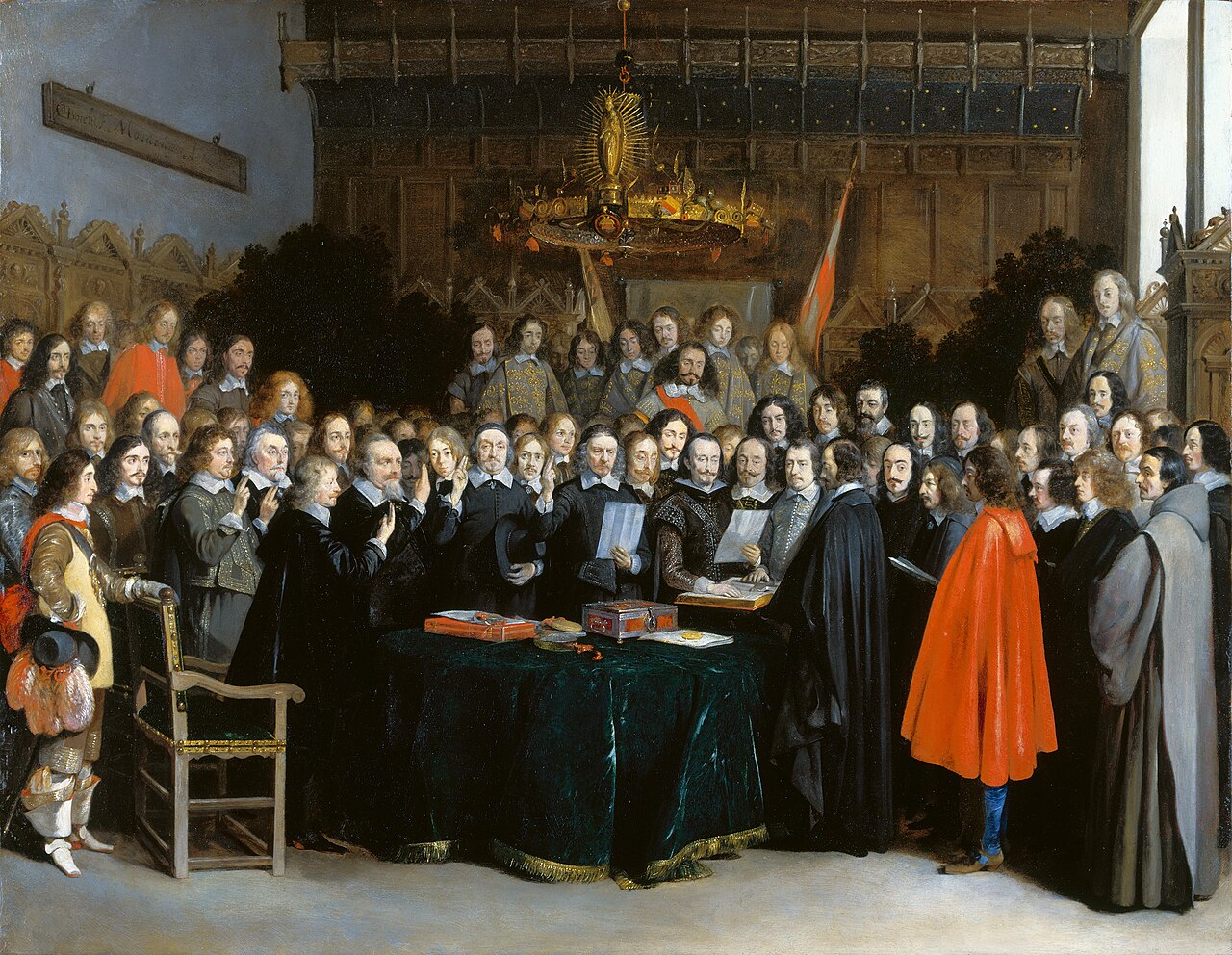
The sovereign-state order IR studies is a historical settlement, not a permanent fact. Gerard ter Borch, The Ratification of the Treaty of Münster, 15 May 1648 (Rijksmuseum, SK-C-1683). Public domain via Wikimedia Commons.
The major traditions
| Tradition | Core claim | Standard objection |
|---|---|---|
| Realism (Morgenthau, Waltz, Mearsheimer) | The international system is anarchic; states pursue power and security; structural pressures dominate state preferences | Cannot explain why states cooperate beyond what self-interest requires; ignores domestic politics; treats anarchy as more determinate than it is |
| Liberal institutionalism (Keohane) | Anarchy is real but states still have strong incentives to build cooperative institutions; international institutions reduce transaction costs and lengthen time horizons | Institutions matter when major powers want them to; cannot explain great-power conflict where institutions fail |
| Constructivism (Wendt) | The international system's "structure" is partly constituted by the meanings actors give it; "anarchy is what states make of it"; ideas, norms, identities are causally important | Hard to operationalise; risks describing change without explaining it; underweights material constraints |
| English School (Bull) | International society is a thin but real institution: states observe rules of recognition, diplomacy, war and peace, treaty fidelity, even without a sovereign | Is "international society" really doing causal work, or is it a description of what powerful states permit? |
| Postcolonial / decolonial | Mainstream IR is a Eurocentric account that treats the post-1648 European state system as universal; colonial and imperial history is constitutive, not background | Critique sometimes outpaces alternative theory; debates over how much "non-Western IR" is empirically distinct |
| Marxist / world-systems | The international system is structured by global capitalism into core, semi-periphery, and periphery; state behaviour reflects positions in the world economy | Treats states too instrumentally; struggles with cases where state autonomy is high |
| Feminist IR | Gender is constitutive of war, security, and the state; "high politics" depends on gendered hierarchies usually treated as background | Pluralism inside the tradition makes a single causal claim hard to test; engagement with mainstream methods has been uneven |
The 1980s-90s grand debate, neorealism against neoliberal institutionalism, has given way to a working consensus: these traditions are tools to deploy as the case warrants, not rival total theories. The constructivist turn made the field more pluralist about what counts as evidence (norms, rhetoric, identity) without dislodging the structural questions that realists ask.
War, peace, and the democratic-peace finding
The single best-replicated empirical finding in international politics is the democratic peace: established democracies do not fight wars with each other. The result is robust across coding schemes, time periods, and operationalisations. Whether it is a peace among democracies, with some causal property of democratic government doing the work, or a peace among states with aligned preferences, with the democracy correlation incidental, is the long-running debate (Russett and Oneal pull together the strongest version of the causal case).
Two other regularities matter. The commercial peace: pairs of states with deeper trading relationships go to war with each other less often, though whether trade causes peace, peace causes trade, or both is contested. The nuclear peace: the great powers have not fought a direct war since 1945, and most IR scholars credit nuclear deterrence with at least part of the absence (developed in Cold War IR).
Each finding cuts against the realist picture of an unchanging anarchic system. Regime type, economic interdependence, and military technology each appear to constrain outcomes in identifiable ways, which is why the post-2000 mainstream is empirical and middle-range rather than grand-theoretical.
Power, hierarchy, and the unipolar to multipolar transition
The post-1991 unipolar moment, in which the United States was the only superpower, was historically unusual. Most international systems have been multipolar (eighteenth-century Europe), bipolar (the Cold War), or hierarchically organised under a hegemon (Pax Britannica, Pax Romana). What happens at transitions between these structures is the central concern of contemporary realism.
The current transition is from unipolarity to contested multipolarity, with China as the principal challenger and Russia, India, and others as secondary powers. Graham Allison's Destined for War (2017) revived Thucydides' framing: a rising power (Athens, Germany pre-1914, China now) facing an established power (Sparta, Britain, the United States) often ends in war. Allison's headline tally (12 of 16 cases since 1500) is contested on case selection, but the underlying mechanism, the security dilemma in which each side's defensive moves look offensive to the other, is older than the framing and not in dispute.
Allison sets out the framing in his own voice in Is war between China and the US inevitable? (TED 2018, 21 min); the talk shows which parts of the framing he himself foregrounds, including the mechanism rather than the count.
Live questions: how durable are the post-1945 institutions (UN, IMF, WTO, NATO) under multipolar pressure? How do plurilateral arrangements (BRICS, RCEP, AUKUS) reshape the institutional landscape? How does climate change as a global commons problem fit (or fail to fit) into existing IR frameworks?
Security and strategic studies
A large part of post-war IR is the study of how states use, threaten, and resist the use of force. Thomas Schelling's The Strategy of Conflict (1960) treated deterrence and bargaining under threat as a problem of credible commitment, and gave the field much of its working vocabulary (signalling, focal points, escalation). Robert Jervis's Perception and Misperception in International Politics (1976) showed how cognitive bias and the security dilemma can drive states to war neither side wants. The contemporary security agenda has widened beyond inter-state war to terrorism, cyber operations, hybrid conflict, civil wars with great-power involvement, and the security implications of climate disruption, but the bargaining-and-credibility frame still anchors most of it.
Globalisation and global governance
The post-1980 wave of trade and capital integration produced a denser global governance landscape: the WTO, the IMF, the BIS, the G7/G20 process, the Paris climate framework, and a thicker NGO and corporate transnational layer. The post-2008 retreat (financial-crisis re-regulation, the post-2016 trade-policy turn in the United States and Europe, the Covid-era supply-chain shock) reset some of this without dismantling it.
Two debates dominate. First, who actually governs? International institutions are formally state-based, but practical influence often runs through expert networks, large firms, and rich-country bureaucracies, which postcolonial scholars and developing-country governments call neocolonial governance. Second, can global commons be managed at all? Climate change is the central case: every state has an incentive to free-ride on others' mitigation, and the Paris framework's voluntary national contributions are an institutional acknowledgement that hard targets cannot be enforced. Whether soft frameworks plus social pressure can deliver collective action on the timescale climate requires is the live empirical question.
References
- Hans J. Morgenthau, Politics Among Nations: The Struggle for Power and Peace (1948; many editions). The classical statement of post-war realism. https://archive.org/details/politicsamongnat0000morg
- Kenneth Waltz, Theory of International Politics (McGraw-Hill, 1979). The neorealist structural account. https://archive.org/details/theoryofinternat00walt
- Robert O. Keohane, After Hegemony: Cooperation and Discord in the World Political Economy (Princeton, 1984). The neoliberal-institutionalist response. https://press.princeton.edu/books/paperback/9780691122489/after-hegemony
- Alexander Wendt, "Anarchy Is What States Make of It: The Social Construction of Power Politics", International Organization 46, no. 2 (1992): 391-425. The constructivist statement. https://doi.org/10.1017/S0020818300027764
- Hedley Bull, The Anarchical Society: A Study of Order in World Politics (Columbia, 1977). The English School statement. https://archive.org/details/anarchicalsociet0000bull
- John Mearsheimer, The Tragedy of Great Power Politics (Norton, 2001). The offensive-realist case. https://archive.org/details/tragedyofgreatpo0000mear
- Thomas C. Schelling, The Strategy of Conflict (Harvard, 1960). Foundational text on deterrence and bargaining under threat. https://archive.org/details/strategyofconfli0000sche
- Robert Jervis, Perception and Misperception in International Politics (Princeton, 1976). Cognition and the security dilemma. https://archive.org/details/perceptionmisper0000jerv
- Bruce Russett and John Oneal, Triangulating Peace: Democracy, Interdependence, and International Organizations (Norton, 2001). The empirical case for the democratic and commercial peace. https://wwnorton.com/books/9780393976847
- Graham Allison, Destined for War: Can America and China Escape Thucydides's Trap? (Houghton Mifflin Harcourt, 2017). On power-transition risks. https://www.belfercenter.org/thucydides-trap/overview-thucydides-trap