220. Political Sociology
Learning outcomes
- When you read about why a particular group voted the way it did, why a protest succeeded or failed, or why some rich democracies built large welfare states and others did not, you'll know to look first at the social structure underneath (which lines of division got organised into politics, who had the resources and the opening to act, whose preferences the institutions track) before reaching for explanations about individual character or national mood.
What political sociology asks
Political sociology asks how societies and politics shape each other. The discipline overlaps with comparative politics on questions of regime and institution, and with sociological theory on the underlying frameworks. Its distinctive concerns are the social basis of political alignment, the social basis of mobilisation and protest, the social basis of political institutions, and the social basis of legitimate authority: who is recognised as a leader, by whom, on what grounds.
Concretely: who votes for whom and why, when people come into the streets, why some welfare states are large and others small, why some elites bend to popular pressure and others do not.
Cleavages, parties, and political competition
Lipset and Rokkan's 1967 cleavage framework, covered in Practice of Politics, is the canonical political-sociology contribution to comparative politics. Their thesis was that western European party systems froze around four cleavages laid down by the National Revolution and the Industrial Revolution: church versus state, centre versus periphery, land versus industry, owners versus workers. Each cleavage produced a characteristic family of parties, and once the franchise widened those families locked in.
The contemporary programme treats cleavages as both structural (the underlying social conflict) and politicised (some structural cleavages get organised into political competition, others do not). Whether a cleavage gets activated depends on elite mobilisation choices, electoral institutions, and which alternative cleavages are already organised. The Hispanic versus non-Hispanic division in the United States is structurally available but only patchily politicised. The urban-rural divide in many European countries is structurally available and increasingly politicised under the post-2000s populist wave.
The post-2000s globalisation cleavage, Hanspeter Kriesi et al.'s winners and losers framework, cuts across the older class line. Educated, urban, mobile workers in cosmopolitan industries align differently from less-educated, rural, immobile workers in declining industries. This new cleavage explains a lot about the rise of green parties, populist-right parties, and the realignment of the centre-left away from working-class strongholds.
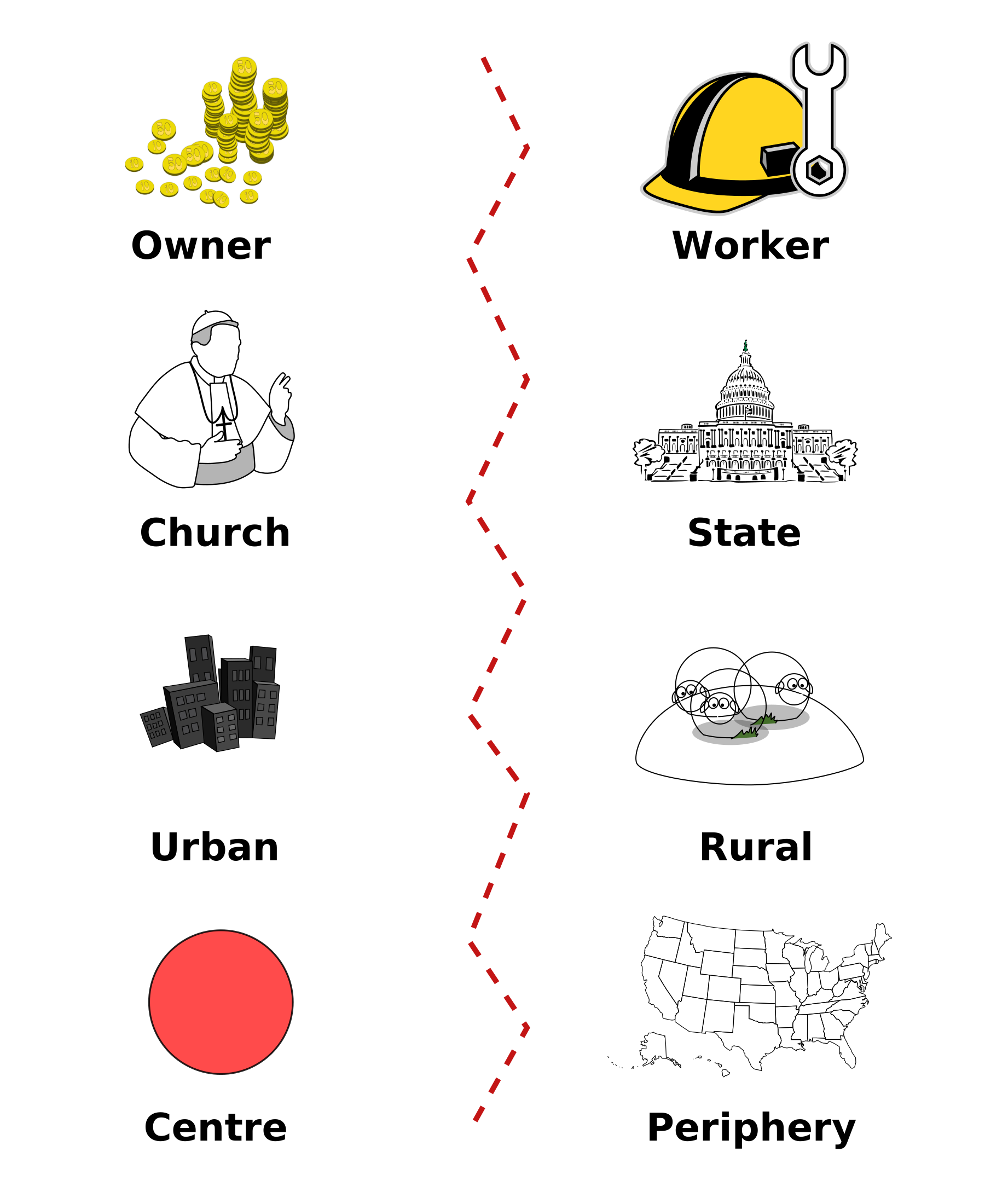
The two revolutions and the four cleavages they laid down. Source: Nikolas Becker, Cleavage_english.svg, Wikimedia Commons, CC BY-SA 3.0.
Mobilisation and protest
The study of protest developed three competing frameworks before being partly synthesised. Grievance theories held that movements form when material conditions are bad enough. The empirical record undercut this: many movements fail despite acute grievances, and many succeed without them. Resource-mobilisation theory (McCarthy and Zald) treated movements as organisations that need money, leaders, and infrastructure to convert grievance into action. Political-opportunity theory (Tarrow, McAdam, Kitschelt) emphasised that movements succeed when the political system opens: elites split, allies become available in government, repression weakens.
The synthesis in McAdam, Tarrow, and Tilly's Dynamics of Contention (2001) treats movements as combinations of mechanisms that recur across very different empirical cases. Brokerage, for instance, is the linking of two previously unconnected sites: a Polish dockworker contacting a Hungarian dissident in 1989 turns two local protests into one regional wave. Scale-shift is the jump from a local fight to a national one, as the Montgomery bus boycott did for civil rights. The 1989 Eastern European wave, the 2010 to 2012 Arab uprisings, the 1960s civil-rights movement, and contemporary climate activism share more mechanism-level structure than their substantive differences would suggest.
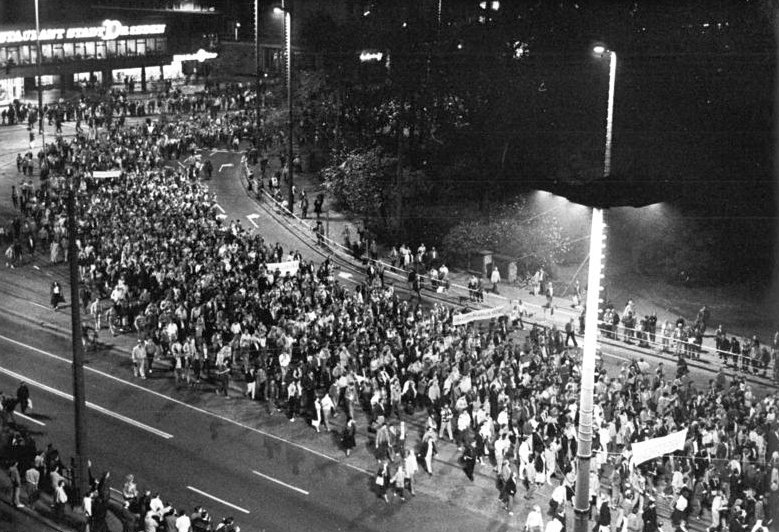
Leipzig, Monday 23 October 1989. Over 100,000 demonstrators on the Karl-Marx-Platz, a fortnight after a similar Leipzig protest had passed off without the feared crackdown. Scale-shift in progress: a local prayer-meeting rhythm became a national wave that reached Berlin on 9 November. Photograph: Friedrich Gahlbeck, Bundesarchiv Bild 183-1989-1023-022, CC-BY-SA 3.0 DE.
Power, elites, and the elite-pluralist debate
Mid-twentieth-century American political sociology was structured around the power-elite debate. C. Wright Mills's The Power Elite (1956) argued that political, economic, and military elites in the postwar United States overlapped institutionally and personally, producing a small unaccountable group that effectively governed through the formally democratic institutions. Robert Dahl's Who Governs? (1961), studying decision-making in New Haven, Connecticut, found instead a pluralist pattern: different elites won on different issue areas, and no single coordinated power group ran everything.
Contemporary work tests the question with data rather than fieldwork. Gilens and Page (2014) coded around 1,800 US federal policy questions surveyed between 1981 and 2002 and asked whose preferences predicted the policy outcome. Average citizens' preferences had near-zero independent effect once economic elites' and organised business groups' preferences were held constant. The picture is less the integrated power-elite of Mills than a structurally tilted pluralism in which the wealthy disproportionately shape what gets onto the agenda and what passes. Whether this is "democracy" in any robust sense is a live political-philosophical question.
Behind both pictures sits Max Weber's older question of legitimate authority: why are commands obeyed? Weber's three pure types (charismatic, traditional, legal-rational) still organise much of the empirical literature on what changes when a regime stops being recognised as authoritative, from the collapse of the Shah in 1979 to the legitimacy crises of contemporary European parliaments. Antonio Gramsci's notion of hegemony, rule by consent secured through everyday institutions of culture and education, sits alongside Weber as the standard reference when the puzzle is why the unequal distribution of power keeps being accepted as normal.
The social basis of welfare states
Why do similarly rich democracies have very different welfare states? Power-resources theory (Walter Korpi, Esping-Andersen) locates the answer in the strength of organised labour and its political party. Where unions were strong and a social-democratic party could win government with cross-class coalitions, large redistributive welfare states were built (Sweden, Denmark). Where unions were weaker and political institutions were more federalist or veto-rich, smaller welfare states emerged (the United States, Switzerland).
Esping-Andersen's Three Worlds of Welfare Capitalism (1990) systematised this into a typology that still organises the field. The key concept is decommodification, the degree to which a worker can maintain a livelihood without selling their labour on the market.
| Regime | Logic | Decommodification | Examples |
|---|---|---|---|
| Liberal | Means-tested, residual, market-favouring | Low | United States, United Kingdom, Australia |
| Conservative-corporatist | Status-preserving, contribution-based, family-centred | Medium | Germany, France, Italy |
| Social-democratic | Universal, citizenship-based, redistributive | High | Sweden, Denmark, Norway |
The typology has been criticised for missing the Mediterranean and East Asian developmental cases and for downplaying the role of gender (women's unpaid care work is what makes the conservative regime "family-centred"), but it remains the field's main reference.
Political culture and political-economic outcomes
The political-culture tradition (Almond and Verba's The Civic Culture, 1963) tried to identify the cultural conditions that supported democracy. The contemporary version, building on Putnam's Making Democracy Work (1993) and Bowling Alone (2000), focuses on social capital: dense networks of voluntary association produce trust, which in turn supports both democracy and economic performance.
Putnam's Making Democracy Work compared the regional governments Italy created in 1970, holding the formal institutions constant. Northern regions, with centuries of dense civic association (choirs, mutual-aid societies, cooperatives), produced markedly more effective regional governments than southern regions where vertical patronage networks dominated. The same institutional shell, two outcomes, the difference accounted for by what people had been doing together for hundreds of years.
The methodological worry is real. Social capital is measured indirectly through membership counts and generalised trust questions, and these may not capture the underlying construct. The causal direction (does civic life cause good government, the other way around, or both) remains debated. Bowling Alone argued that American social capital declined from the 1960s through the 1990s; later work suggests the decline reshaped rather than reduced civic life, with online communities, professional associations, and identity-based organisations partly replacing the bowling leagues and Rotary clubs.
References
- Seymour Lipset and Stein Rokkan (eds.), Party Systems and Voter Alignments: Cross-National Perspectives (Free Press, 1967). The volume opens with their "Cleavage Structures" chapter, the canonical statement of the four-cleavage thesis. https://archive.org/details/partysystemsvote0000unse
- C. Wright Mills, The Power Elite (Oxford University Press, 1956). https://archive.org/details/powerelite0000mill
- Robert A. Dahl, Who Governs? Democracy and Power in an American City (Yale University Press, 1961). https://archive.org/details/whogovernsdemocr0000dahl
- Gøsta Esping-Andersen, The Three Worlds of Welfare Capitalism (Princeton University Press, 1990). The canonical typology of welfare states. https://archive.org/details/threeworldsofwel0000espi
- Robert Putnam, Bowling Alone: The Collapse and Revival of American Community (Simon & Schuster, 2000). The social-capital framework applied to the US. https://openlibrary.org/works/OL4291077W/Bowling_Alone
- Doug McAdam, Sidney Tarrow, and Charles Tilly, Dynamics of Contention (Cambridge University Press, 2001). The mechanism-based unification of social-movements research. https://openlibrary.org/works/OL25675176W/Dynamics_of_Contention
- Martin Gilens and Benjamin Page, "Testing Theories of American Politics: Elites, Interest Groups, and Average Citizens", Perspectives on Politics 12, no. 3 (2014): 564 to 581. The contemporary statistical case on whose preferences shape US policy. https://www.cambridge.org/core/journals/perspectives-on-politics/article/testing-theories-of-american-politics-elites-interest-groups-and-average-citizens/62327F513959D0A304D4893B382B992B
- Hanspeter Kriesi et al., West European Politics in the Age of Globalization (Cambridge University Press, 2008). On the contemporary cleavage realignment. https://openlibrary.org/works/OL16937506W/West_European_politics_in_the_age_of_globalization
- Stefano Bartolini and Peter Mair, Identity, Competition, and Electoral Availability: The Stabilisation of European Electorates 1885 to 1985 (Cambridge University Press, 1990). The systematic test and extension of the Lipset-Rokkan freezing hypothesis. https://archive.org/details/identitycompetit0000bart