225. Comparative Demographic Systems
Learning outcomes
- When a country's birth rate, ageing, or population projections are in the news, you'll know to ask where the country sits in the demographic transition, what is driving fertility (the cost of children to households, women's wages, expectations relative to upbringing), and what follows for its workforce, public finances, and migration politics.
What demography studies
Demography is the formal study of population: its size, structure, and dynamics. Today's population is yesterday's population plus births and immigrants minus deaths and emigrants. The substantive questions concern what drives each component, what the resulting age and household structure means for a society, and why societies differ in the path they take.
The discipline has two layers. Demographic analysis is the technical apparatus: life tables, age-specific fertility rates, the total fertility rate (TFR), stable-population models, projections. The TFR (children per woman over her reproductive life) is the most-cited summary statistic. Replacement TFR (the rate at which population stays constant in a closed population) is roughly 2.1; below that, populations shrink absent immigration.
Demographic theory is the explanatory apparatus: why fertility, mortality, and migration take the values they do, and how they change as societies develop.
Malthus and the long shadow
Modern demographic theory begins with Thomas Malthus. In the Essay on the Principle of Population (1798), he argued that population, when unchecked, grows geometrically while subsistence grows arithmetically, so population will always press against the food supply. Equilibrium is restored by positive checks (famine, disease, war) or preventive checks (delayed marriage, abstinence). The grim implication: living standards above subsistence cannot persist, because population will rise to meet them.
Two centuries of evidence have falsified the strong claim. Agricultural productivity has outpaced population, child mortality has collapsed, and fertility has fallen far below the biological maximum without famine doing the work. But the framework left a durable inheritance: every later theory of fertility is, at root, an account of why people have fewer children than they could. Ester Boserup's The Conditions of Agricultural Growth (1965) reversed the direction of causation, arguing that population pressure induces innovation in agriculture rather than collapse. The Boserup-Malthus axis is still the template for population-environment debates, with carrying capacity, food security, and ecological footprint as the new variables.
The demographic transition
The demographic transition is the empirical regularity that has structured the field since Frank Notestein's "Population: The Long View" (1945) named the pattern. Pre-industrial societies had high fertility and high mortality, with population roughly stable around the Malthusian ceiling. Industrialisation (or its absorbing equivalents) produces, in sequence:
- Mortality decline, especially infant and child mortality, driven first by sanitation, public health, and food security; later by medicine. Population grows rapidly because births stay at pre-industrial levels.
- Fertility decline, lagging mortality decline by decades to a century, as families adjust to lower child mortality and changing economic circumstances.
- Stabilisation at low fertility and low mortality, with longer life expectancy and ageing populations.
Most rich countries completed the transition in the twentieth century. Many middle-income countries completed it recently and faster (Bangladesh fell from a TFR of 6.9 in 1970 to 2.0 today). Sub-Saharan Africa is in mid-transition: mortality has dropped substantially, fertility is still high in many countries, and the resulting demographic momentum will produce most of the world's population growth this century.
Why fertility falls
Three theoretical traditions answer the question of why fertility declines.
Caldwell's wealth-flows theory holds that pre-industrial households were net economic beneficiaries of additional children: children worked the farm and supported parents in old age. Modernisation reverses the flow: children consume more than they produce, especially as schooling extends. Once the flow reverses, parents have strong incentives to limit fertility. The theory explains why fertility decline lags economic transformation.
The New Home Economics (Becker, Mincer) treats fertility as the outcome of household optimisation: children are produced with parental time and money, and their "quality" (education, lifestyle support) competes with their quantity. Rising women's wages raise the opportunity cost of childbearing; rising returns to child quality shift parents from many low-investment children to few high-investment ones.
Easterlin's relative-income hypothesis argues that fertility depends on whether a couple's income meets the standards they grew up expecting, not on absolute income. Easterlin used this to explain the post-1960 fertility crash in the US: the baby-boom cohort entered an oversupplied labour market, could not match parental living standards on a single income, and had fewer children.
The contemporary very-low-fertility puzzle (East Asia and southern Europe) does not fit any of these neatly. South Korea's TFR fell to 0.7 in 2024, the lowest ever recorded for a country. Leading hypotheses combine high housing costs, intense educational competition, gender norms that put a much larger child-rearing burden on women than men, and precarious employment for young workers. Pro-natal policy in the lowest-fertility countries has so far failed to reverse the trend.
For the convergence in motion, watch Hans Rosling, "Global population growth, box by box" (TED@Cannes 2010, around 10 minutes), where the world's countries slide across the income-fertility plane in real time and the simultaneity of the global TFR fall becomes legible in a way prose cannot reproduce.
Household formation systems
Fertility responds to economic incentives, but it does so through the institution of marriage and the household. John Hajnal's 1965 study identified a sharp east-west divide running through Europe roughly along a Trieste to St Petersburg line. To the west: late marriage (women in their mid-twenties), high celibacy rates, neolocal residence (couples set up their own household), and a substantial fraction of the population in service before marriage. To the east and south: early and near-universal marriage, multi-generational households, and lower autonomy of the conjugal unit.
The European marriage pattern held marital fertility down by raising the age at first birth and excluding many women from childbearing entirely, without contraception. It is one of the best non-trivial answers to why pre-modern Europe was richer per capita than its Malthusian ceiling would predict, and why fertility decline began earlier in some places than others. Modern parallels exist: countries where adult children remain in the parental household longer (Italy, Japan) sit at the bottom of the contemporary fertility distribution, suggesting the household-formation channel still matters.
Mortality, ageing, and the demographic dividend
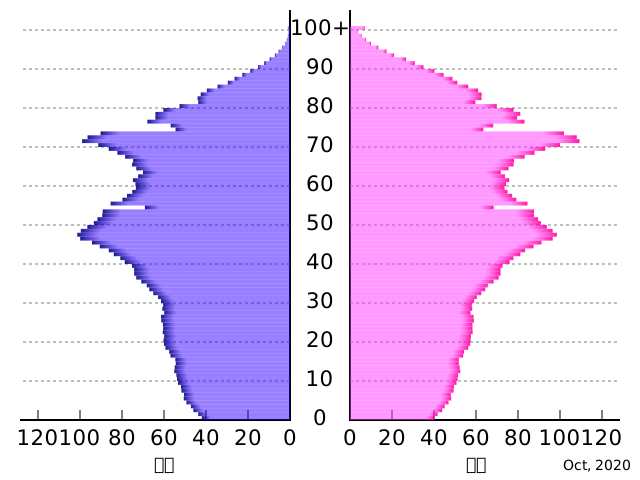
Mortality decline drives the other side of the transition. Life expectancy at birth in Britain rose from about 40 in 1870 to 81 in 2024; in Japan, from 51 in 1947 to 84 today. Abdel Omran's "The Epidemiologic Transition" (1971) named the companion pattern: the cause of death shifts from infectious disease and famine in early stages to chronic and degenerative disease (heart disease, cancer, dementia) once life expectancy is high, which in turn reshapes health systems and pension liabilities. The age pyramid inverts: societies that once had many children and few elderly now have the opposite.
The transitional middle window has a name: the demographic dividend. For a generation or two after fertility falls but before the population ages, the working-age share is at its highest and the dependency ratio (working-age to non-working-age) is most favourable. Countries that captured the dividend with policy investment (Korea, Singapore, China for a time) saw rapid growth; those that miss it (most of sub-Saharan Africa now) face a harder development path.
The closing window matters as much. Japan and Italy have the world's oldest populations and the corresponding fiscal pressures: pension and health-care costs, a declining tax base, labour shortages. China's population peaked in 2022 and entered structural decline; the country is ageing before it has grown rich, inverting the sequence that worked for Korea and Japan.
Migration
Migration completes the population identity. In rich-country contexts it is increasingly the difference between growth and shrinkage: Germany's population has only grown since 2011 because net migration has offset natural decrease. Unlike fertility and mortality, it is also a policy lever governments can pull on a year-to-year horizon, which is why it dominates the political fight.
The selection of migrants matters. Skill-selective policies (Canada, Australia, increasingly the UK and US for some categories) tend to produce migrants whose labour-market and fiscal effects are net-positive. Family-reunification and humanitarian flows shape the demographic balance differently and produce more mixed fiscal effects. The political economy of this distinction is what most contemporary immigration debate is actually about, even when it is conducted in cultural language.
Internal migration also shapes the demography of countries that look settled in aggregate. China's hukou system formally separates rural and urban populations and has produced one of the largest internal labour migrations in history; the demography of the receiving cities and the sending villages differ as sharply as the demography of any two countries. Ethnic-minority populations within rich-country borders, often the descendants of earlier migration cohorts, have distinct fertility and mortality profiles, and the convergence (or non-convergence) of those profiles is itself a research field.
Population policy
Governments try to influence demographic outcomes, with mixed success. Pro-natal policies in low-fertility countries (Hungary's tax credits, France's family allowances, Korea's housing subsidies) have produced modest fertility responses at considerable fiscal cost; they do not return countries to replacement. Anti-natal policies have done more visible work. China's one-child policy (1980 to 2015) accelerated a fertility decline already underway and produced a sex ratio at birth distorted by sex-selective abortion; the policy was reversed too late to avert ageing. India's coercive sterilisation campaign during the 1975 to 1977 Emergency discredited heavy-handed family planning for a generation.
Voluntary family-planning programmes, especially when paired with female education, have a stronger record. Bangladesh's fertility decline owes much to a community-based contraception programme combined with rising girls' schooling; the contrast with Pakistan, which began the same period at similar fertility, is the canonical natural experiment. The lesson the field draws: policy works when it removes constraints on choices people are already inclined to make, and fails when it tries to override the underlying economic and social structure.
References
- Thomas Robert Malthus, An Essay on the Principle of Population (1798). The originating Malthusian frame. https://www.gutenberg.org/ebooks/4239
- Ester Boserup, The Conditions of Agricultural Growth (Allen & Unwin, 1965). The reverse-causation rebuttal to Malthus. https://archive.org/details/conditionsofagri0000bose
- Frank W. Notestein, "Population: The Long View", in Theodore W. Schultz, ed., Food for the World (Chicago, 1945). The original demographic transition framing. https://archive.org/details/foodforworld0000schu
- John Hajnal, "European Marriage Patterns in Perspective", in D. V. Glass and D. E. C. Eversley, eds., Population in History (Arnold, 1965). The household-formation argument. https://archive.org/details/populationinhist0000unse
- John Caldwell, "Toward a Restatement of Demographic Transition Theory", Population and Development Review 2, no. 3/4 (1976). The wealth-flow framework. https://doi.org/10.2307/1971615
- Abdel R. Omran, "The Epidemiologic Transition: A Theory of the Epidemiology of Population Change", Milbank Memorial Fund Quarterly 49, no. 4 (1971). The mortality-side companion to demographic transition. https://www.milbank.org/quarterly/articles/the-epidemiologic-transition-a-theory-of-the-epidemiology-of-population-change/
- Gary S. Becker, A Treatise on the Family (Harvard, 1981; enlarged 1991). The New Home Economics framework. https://archive.org/details/treatiseonfamily00beck
- Richard A. Easterlin, Birth and Fortune: The Impact of Numbers on Personal Welfare, 2nd ed. (Chicago, 1987). The relative-income framework. https://archive.org/details/birthfortunei00east
- UN Population Division, World Population Prospects 2024. The standard global demographic dataset. https://population.un.org/wpp/
- Our World in Data, Population Growth. Open-access summary visualisations of global demographic trends. https://ourworldindata.org/population-growth
- Massimo Livi-Bacci, A Concise History of World Population, 6th ed. (Wiley, 2017). The standard historical-demographic textbook. https://www.wiley.com/en-gb/A+Concise+History+of+World+Population%2C+6th+Edition-p-9781119029274
- Wolfgang Lutz, William P. Butz, and Samir KC, eds., World Population and Human Capital in the Twenty-First Century (Oxford, 2014). The IIASA-Vienna projections that integrate education with fertility and mortality. https://academic.oup.com/book/25338