217. Marx and Marxism
Learning outcomes
- When someone deploys Marx (for or against) to explain a strike, a recession, an election, or an ideology, you'll know how to separate the claim being made (descriptive about how capitalism works, normative about its injustice, predictive about its trajectory) from the part of Marx it depends on (the early-humanist, the mature-economic, the political-strategist), and you'll know which parts the Marxist tradition itself has since dropped or rebuilt.
Marx's actual argument
Marx's argument is harder to summarise than its slogans suggest, partly because his position changed over forty years of writing. The mature core, in roughly the form of Capital (1867) and The Communist Manifesto (with Engels, 1848), runs through three connected claims.
The historical-materialist claim. Human history is structured by changes in the forces of production (technology, organisation of labour, raw materials) that bring into being characteristic relations of production (slavery, feudal tenure, wage labour). When the forces grow beyond what the relations can accommodate, an epoch of social revolution opens and the old relations are swept away.
The capitalist mode of production followed feudalism in this sequence, and will, Marx argued, be followed by socialism and eventually communism through the same logic.
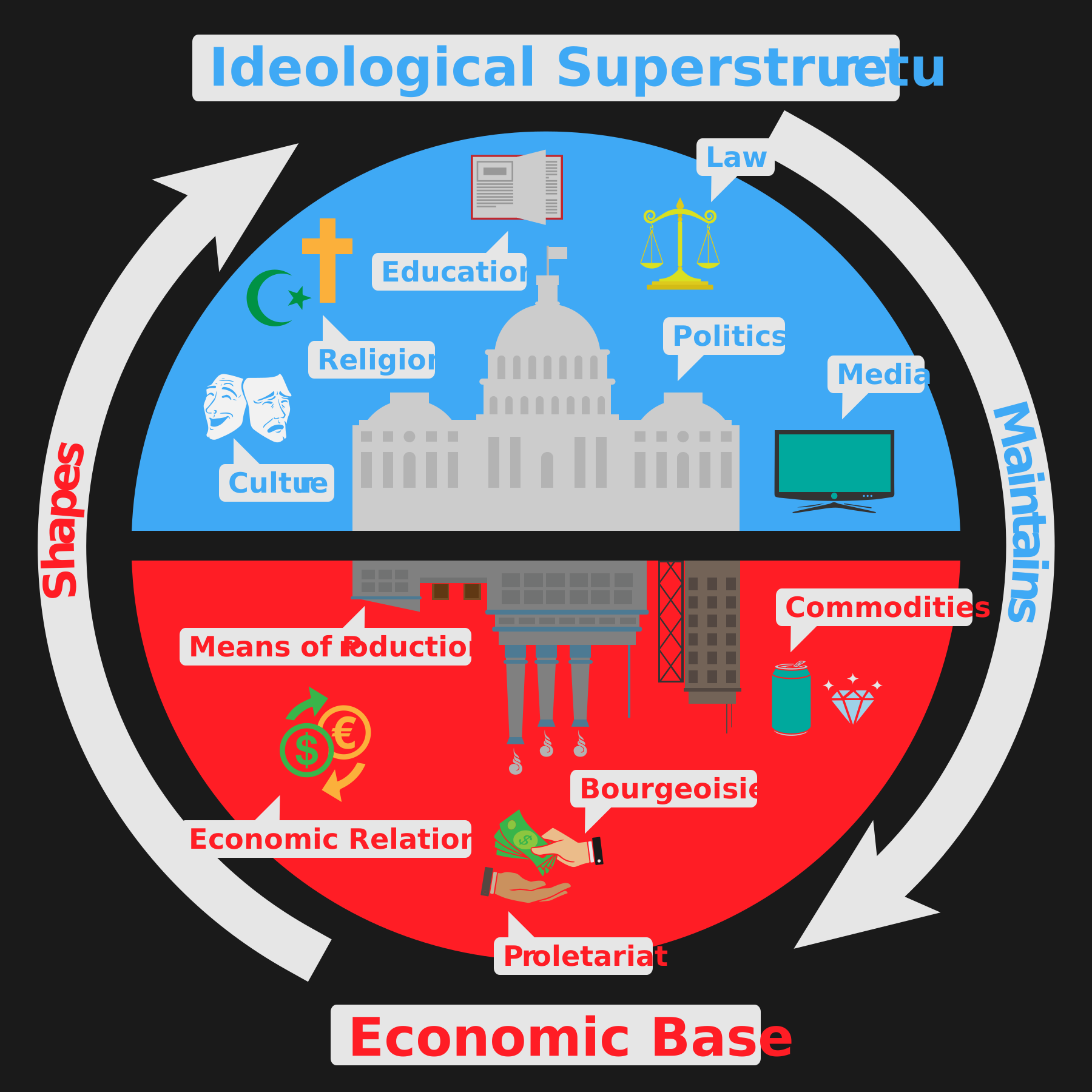
The base shapes the superstructure; the superstructure maintains the base. The image is the Base and superstructure diagram by Afreudian on Wikimedia Commons, CC BY-SA 4.0.
The economic claim. Capitalism is uniquely productive but contains tensions that drive its own crises. The labour theory of value, Marx's inheritance from Smith and Ricardo, holds that the value of a commodity reflects the socially necessary labour time embodied in producing it. Surplus value is the difference between what workers are paid (the value of their labour-power, set by the cost of subsistence) and the value their labour adds to the commodities they produce. This surplus is the source of profit.
Competition drives capitalists to accumulate, mechanise, and lower wages where they can. The result is recurrent crises of overproduction and underconsumption, and a long-run tendency for the rate of profit to fall.
For a close reading of how Marx builds this argument across the chapters of Capital, see David Harvey's open lecture series, Class 01 of Reading Marx's Capital Vol I (about two hours, 2007); the full thirteen-class course is on the same channel.
The political claim. Capitalism produces both the unprecedented social wealth that makes a post-scarcity future thinkable and the proletariat (the class of workers who have nothing to sell but their labour-power) whose collective interest, organisational capacity, and concentration in the production process give it both the motive and the means to abolish the system. The state is not neutral; in capitalist conditions, it is "but a committee for managing the common affairs of the whole bourgeoisie" (Manifesto).
Reading Marx, three ways
The Marxist tradition has read its founder in three importantly different registers, and most contemporary debates can be located within them.
The young Marx, of the Economic and Philosophic Manuscripts (1844), centres on alienation. Under capitalism, the worker is alienated from the product of their labour (which is owned by another), from the act of working (which is degrading), from species-being (the human capacity to produce freely and creatively), and from other humans. The young Marx is humanist, normative, and Hegelian; he argues that capitalism is wrong because of what it does to workers as human beings.
The mature Marx, of Capital, centres on the systemic logic of accumulation, exploitation, and crisis. The mature Marx is more theoretically austere; he treats capitalism's wrongness as flowing from its objective tendencies (immiseration, crisis, war, environmental destruction) rather than from a humanist account of what work should be like.
The famous "Marx without ethics" reading (Allen Wood's Karl Marx, 1981) takes this further: Marx never directly says capitalism is unjust, because justice for Marx is a juridical category internal to a mode of production, and capitalist exchange is just by the standards of capitalism. G. A. Cohen replied that Marx's condemnation only makes sense if it appeals to a standard of justice external to capitalist norms. The dispute matters because it sets whether Marxism is an ethical critique of capitalism or only a predictive one.
The political Marx, of The Civil War in France (1871) and the Critique of the Gotha Program (1875), is a strategist of the workers' movement. He addresses concrete tactical questions: how should a workers' party form? Should it ally with the bourgeois democrats? What is the political form of working-class rule? The answers shaped the Second and Third Internationals and the divergent revolutionary strategies of the twentieth century.
What twentieth-century Marxists did with the inheritance
The most consequential split was between revolutionary and reformist strategies. Eduard Bernstein's Evolutionary Socialism (1899) argued that capitalism's crises were less severe than Marx predicted, the working class was integrating into the bourgeois state through universal suffrage, and the strategy should be parliamentary social democracy.
Lenin's What Is to Be Done? (1902) and The State and Revolution (1917) replied that this missed the structural point. The bourgeois state could not be peacefully captured, and a disciplined vanguard party was needed to lead the seizure of power.
The 1917 Russian revolution put Lenin's strategy in power and Stalin's later regime built around it. Marxism became identified with a particular state's official ideology, and Marxist debate inside the Soviet bloc was constrained accordingly.
Western Marxism (Lukács, Gramsci, the Frankfurt School: Adorno, Horkheimer, Marcuse) developed in roughly inverse proportion to the influence of communist parties in their countries. Antonio Gramsci's Prison Notebooks (1929-1935) reformulated the political Marx around hegemony: the bourgeoisie's rule rests not on direct coercion but on its capture of common-sense culture, schools, churches, mass media.
The young worker who treats wage labour as natural, or the voter who treats nation as the relevant political unit rather than class, is operating inside that captured common sense. Counter-hegemony, building alternative institutions and a counter-culture, is therefore part of revolutionary strategy.
Analytical Marxism (G. A. Cohen, John Roemer, Jon Elster, Adam Przeworski, Erik Olin Wright) emerged in the 1970s as an attempt to test classical Marxist claims with the methods of contemporary analytic philosophy and rational-choice social science. Cohen's Karl Marx's Theory of History: A Defence (1978) gave the strongest functionalist reconstruction of historical materialism. Roemer's work showed which exploitation claims survive without the labour theory of value (most of them; the LTV is dispensable).
Przeworski's Capitalism and Social Democracy (1985) explained why social democracy stuck at compromise: working-class parties that pursued full socialisation lost coalition partners, while those that accepted capitalism could win and govern but only at the price of stable labour-capital settlements.
Each branch keeps part of Marx and drops part. The diagram below shows which.
What survives, what does not
By the early twenty-first century, the Marxist tradition has settled into a pattern. The political-economy critique of capitalism (its tendencies toward inequality, instability, environmental damage, and political distortion) is accepted in much non-Marxist work too. The historical-materialist meta-narrative in its strong form (a sequence of modes of production with capitalism as the penultimate stage) is largely dropped. The labour theory of value is rejected by most economists, including most Marxist ones; the post-Sraffa neo-Ricardian and Roemer-style analytical-Marxist alternatives are usually preferred.
What remains, at minimum, is a set of standing questions that Marx put on the agenda and that political theory has not fully answered: how does economic structure shape political possibility; under what conditions is ideology a real force in politics; how is class consciousness produced and undermined; can democracy and capitalism coexist indefinitely without one transforming the other?
References
- Karl Marx and Friedrich Engels, The Communist Manifesto (1848; Project Gutenberg). https://www.gutenberg.org/ebooks/61
- Karl Marx, Capital, vol. 1 (1867; Marxists Internet Archive). https://www.marxists.org/archive/marx/works/1867-c1/
- Karl Marx, Economic and Philosophic Manuscripts of 1844 (Marxists Internet Archive). https://www.marxists.org/archive/marx/works/1844/manuscripts/preface.htm
- Karl Marx, Critique of the Gotha Programme (1875; Marxists Internet Archive). https://www.marxists.org/archive/marx/works/1875/gotha/
- Eduard Bernstein, Evolutionary Socialism (1899; Marxists Internet Archive). The classic statement of revisionist social democracy. https://www.marxists.org/reference/archive/bernstein/works/1899/evsoc/
- V. I. Lenin, The State and Revolution (1917; Marxists Internet Archive). The revolutionary reply to Bernstein. https://www.marxists.org/archive/lenin/works/1917/staterev/
- Antonio Gramsci, Selections from the Prison Notebooks (1929-1935; archive.org). https://archive.org/details/AntonioGramsciSelectionsFromThePrisonNotebooks
- G. A. Cohen, Karl Marx's Theory of History: A Defence, expanded ed. (Princeton, 2000). The leading analytical-Marxist reconstruction. https://press.princeton.edu/books/paperback/9780691070681/karl-marxs-theory-of-history
- Adam Przeworski, Capitalism and Social Democracy (Cambridge, 1985). The rational-choice analysis of why working-class parties make coalition compromises. https://doi.org/10.1017/CBO9781139171830
- Allen W. Wood, Karl Marx (Routledge & Kegan Paul, 1981; archive.org). The argument that Marx does not hold capitalism to be unjust by any cross-historical moral standard. https://archive.org/details/karlmarx0000wood
- Jonathan Wolff, "Karl Marx", Stanford Encyclopedia of Philosophy. The standard survey of Marx's philosophy. https://plato.stanford.edu/entries/marx/