209. Politics in Latin America
Learning outcomes
- When you read about a Latin American election or political crisis, you'll know to test it against the four frames the region is the running test case for: presidential constitutions stressed by weak parties, the elite-pact transitions of the 1980s, commodity-cycle politics, and the inequality that sits underneath all three.
A region built around presidentialism
Almost every Latin American state runs on a presidential constitution, modelled originally on the United States and reinforced by post-1980s redrafting. The region is therefore the largest test case for Juan Linz's Perils of Presidentialism thesis (covered in Practice of Politics).
The record is mixed. Latin American presidential democracies have had a worse survival rate than European parliamentary ones, but the United States has run on the same design for two centuries without breakdown. The going view, sharpened by Mainwaring and Shugart, is that presidentialism amplifies two background conditions: weak political parties and high social inequality. Latin America has historically had both.
Within the region the presidential design has been adapted in three recognisable ways. Coalitional presidentialism, especially in Brazil, governs multi-party legislatures by routinely sharing cabinet seats with coalition partners; the resulting gabinetes de coalizão make Brazilian government more parliamentary in practice than its constitution suggests. Hyperpresidentialism, especially in Argentina, gives the president strong decree authority and has produced cycles of dominant executives followed by economic and political crises. Mexico's three-decade single-party rule under the PRI was a presidentialist arrangement embedded in a hegemonic-party system whose weakening from the 1980s opened the door to alternation, completed when the PAN won the presidency in 2000.
The third-wave transitions and what came after
By the late 1970s, military dictatorships ruled most of South America and parts of Central America. The democratic transitions that followed (Argentina 1983, Brazil 1985, Uruguay 1985, Chile 1990) became O'Donnell and Schmitter's Transitions from Authoritarian Rule (1986) case base for the elite-pact model: openings as bargains between regime softliners and opposition moderates, with hardliners and radicals on both sides excluded. Chile's 1988 plebiscite and the negotiated retention of Pinochet-era senators is the textbook instance.
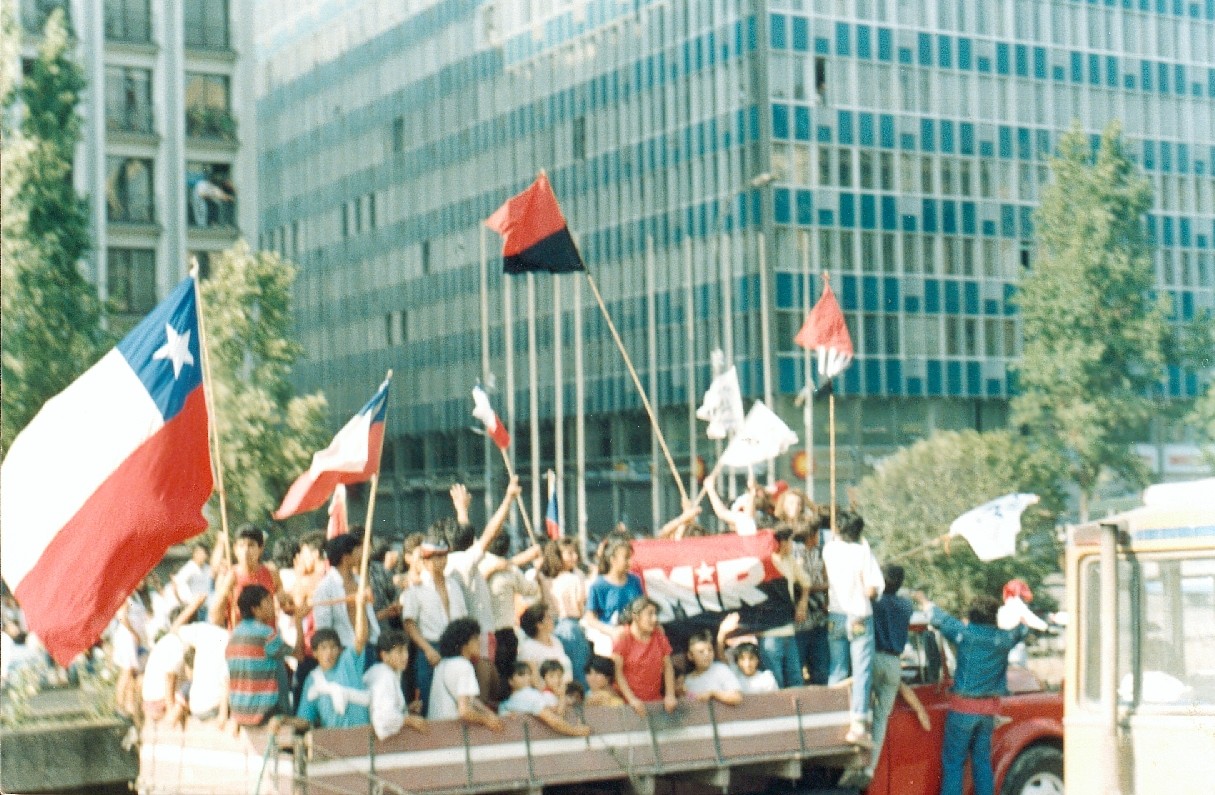 Santiago, October 6, 1988: the elite-pact transition's popular face. Photograph by Felipe Antonio Valdés, CC-BY 4.0.
The transitions stuck. Forty years on, no major South American country has reverted to military rule. The 2009 coup against Manuel Zelaya in Honduras and the disputed 2019 ouster of Evo Morales in Bolivia stand out as exceptions. What has happened instead is a different kind of stress: elected governments that erode constitutional constraints from inside (Chávez and Maduro in Venezuela; Ortega in Nicaragua; Bukele in El Salvador), and a churn of presidents impeached or forced from office in mid-term (Dilma Rousseff in Brazil in 2016, the serial collapses in Peru since 2016, Pedro Castillo's failed self-coup and removal in 2022).
The Pink Tide and its uneven outcomes
Beginning with Hugo Chávez's election in Venezuela in 1998, a wave of left-wing governments came to power across Latin America: Lula in Brazil (2003), Kirchner in Argentina (2003), Tabaré Vázquez in Uruguay (2005), Morales in Bolivia (2006), Correa in Ecuador (2007), Lugo in Paraguay (2008). The "Pink Tide" coincided with the 2003 to 2013 commodity boom, which gave fiscal room to expand social spending. Conditional cash transfers (Bolsa Família in Brazil, Oportunidades and its successor Prospera in Mexico) became the canonical poverty-reduction instrument: they paid mothers a small monthly transfer conditional on school attendance and health checks, reached tens of millions of households, and pulled headline Gini coefficients down across the region.
The wave fragmented as the commodity boom ended in 2014. Brazil's Workers' Party governments collapsed in the Lava Jato corruption scandal and Dilma Rousseff's impeachment. Argentina cycled to the centre-right under Macri, back to Peronism under Fernández, then to libertarian outsider Javier Milei in 2023. Venezuela slid into hyperinflation and authoritarianism under Maduro.
A "second pink tide" returned by 2022 (López Obrador in Mexico, Boric in Chile, Petro in Colombia, Lula again in Brazil) but on far thinner fiscal margins. The lesson is not that the Pink Tide failed everywhere; some of its welfare gains stuck. It is that commodity-led redistribution is captive to the cycle that funded it.
Populism and democratic erosion
Latin America is the original home of populism in political science. Argentine Peronism, Brazilian getulismo under Vargas, and Mexican cardenismo in the mid-twentieth century gave the field its founding cases: a charismatic leader, mass mobilisation that bypassed traditional party channels, and a redistributive coalition that pitted "the people" against an "elite".
The style has returned in different ideological garb. Chávez's chavismo combined oil rents with constitutional rewrites and barrio-level mobilisation; Jair Bolsonaro in Brazil ran a right-wing variant rooted in evangelical churches, the police, and the rural agribusiness bloc. Nayib Bukele in El Salvador locked up tens of thousands under a state of exception against the maras and won an unconstitutional second term with approval above 80 percent. Javier Milei in Argentina campaigned with a chainsaw against la casta: different programmes, the same structural move.
Democratic erosion runs through populism but is not exhausted by it. The pattern is incumbents using legitimate institutional levers (constitutional rewrites, appointment power, judicial restructuring) to weaken constraints on themselves while still holding elections. Levitsky and Ziblatt's How Democracies Die draws its template partly from Chávez's Venezuela. Bukele's El Salvador is the live test case: his New Ideas party took three-quarters of the legislature in 2024, the constitutional chamber was packed by the aligned majority, and the same chamber then read the constitution to permit his re-election.
The structural backdrop: inequality, the drug economy, the United States
Three structural facts colour every period of Latin American politics. First, the region has the highest income inequality in the world. Even after Pink Tide reductions, Gini coefficients above 0.45 remain common (Brazil, Colombia, Mexico). This conditions the politics of redistribution and the propensity for class-based mobilisation, and it is the background variable Mainwaring and Shugart point to when explaining why the same presidential design produces different outcomes north and south of the Rio Grande.
Second, the drug economy has reshaped politics in Mexico, Colombia, the Central American northern triangle, and Bolivia. The US-led prohibition regime created the high-rent illicit market that armed cartels finance and contest with the state. Mexico's drug war since President Calderón deployed the army in 2006 has produced over 350,000 confirmed homicides and missing persons; Colombia's 2016 peace agreement with the FARC closed one chapter of a 50-year insurgency, but dissident factions and the criminal economy outlived the deal. Cartel politics is an institutional fact in these countries, not an exogenous shock.
Third, US influence remains strong though contested. Cold War interventions (the CIA-backed coup against Árbenz in Guatemala in 1954, the 1973 Chilean coup, the 1980s contra war in Nicaragua and the Salvadoran civil war) shaped the regimes that followed. Current channels run through trade (USMCA, the Caribbean Basin Initiative), migration enforcement, and counter-narcotics. The post-2018 Chinese expansion in trade and infrastructure financing alters what had been a bilateral dynamic, most visibly in South America: China is the largest trading partner of Brazil, Chile, and Peru, and a significant lender to Venezuela and Ecuador.
Institutional weakness and informal politics
A separate strand of research, gathered in Levitsky and Murillo's Argentine Democracy, treats the region's recurring problem as institutional weakness: formal rules exist but are routinely unenforced, frequently rewritten, or bypassed by informal practice. Argentina is the canonical case, with constitutional rules on labour, property, and federal transfers that have changed faster than they have constrained anyone. Clientelism (the everyday exchange of state goods, jobs, or transfers for political loyalty) is the daily form this takes in much of the region, and it is what made Peronism durable across very different leaders. The presidential-fragility, populism, and erosion stories above sit on top of this layer; they are easier to write where institutions cannot resist them.
Gender and the politics of the body
Latin America is also where the cleanest break in women's political representation happened. Argentina's 1991 Ley de Cupos set a 30 percent legislative quota and started a regional cascade: by the 2010s most countries had quota or parity laws, and women's share of lower-house seats in the region passed 30 percent ahead of much of Europe. Mexico moved to full gender parity for federal candidacies in 2014 and elected its first woman president, Claudia Sheinbaum, in 2024. The mechanism is institutional, not cultural: closed-list PR with placement mandates produces representation; open-list and majoritarian systems without placement rules lag.
The same period saw the marea verde (green wave) on abortion rights, organised around the green bandana adopted by Argentine campaigners. Argentina legalised abortion in 2020, Mexico's Supreme Court decriminalised it federally in 2023, and Colombia's Constitutional Court did the same in 2022. The counter-current is the rise of evangelical-aligned right-wing politics (Bolsonaro in Brazil, Kast in Chile, Milei in Argentina) that mobilises against this agenda, so the cleavage is now an axis of competition rather than a settled question.
 The pañuelo verde, the literal symbol the paragraph names. Photograph by Ojota, CC-BY-SA 4.0.
References
- Guillermo O'Donnell and Philippe Schmitter, Transitions from Authoritarian Rule: Tentative Conclusions about Uncertain Democracies (Johns Hopkins, 1986). The elite-pact account of third-wave transitions. https://archive.org/details/transitionsfroma0000odon
- Scott Mainwaring and Matthew Soberg Shugart, eds., Presidentialism and Democracy in Latin America (Cambridge, 1997). The empirical re-examination of Linz with Latin American cases. https://archive.org/details/presidentialismd0000unse
- Steven Levitsky and Maria Victoria Murillo, eds., Argentine Democracy: The Politics of Institutional Weakness (Pennsylvania State, 2005). The institutional-weakness framework, with Argentina as the running case. https://archive.org/details/argentinedemocra0000unse
- Kurt Weyland, "Latin America's Authoritarian Drift: The Threat from the Populist Left", Journal of Democracy 24, no. 3 (2013). The framework on twenty-first-century left populism in the region. https://www.journalofdemocracy.org/articles/latin-americas-authoritarian-drift-the-threat-from-the-populist-left/
- Juan J. Linz, "The Perils of Presidentialism", Journal of Democracy 1, no. 1 (1990). The argument the region most directly tests. https://www.journalofdemocracy.org/articles/the-perils-of-presidentialism/
- Steven Levitsky and Daniel Ziblatt, How Democracies Die (2018). Uses Chávez's Venezuela as a template for elected authoritarianism. https://archive.org/details/howdemocraciesdi0000levi
- Daron Acemoglu and James A. Robinson, Why Nations Fail (2012). Latin American case material throughout. https://archive.org/details/whynationsfailor0000acem
- Mala Htun, Sex and the State: Abortion, Divorce, and the Family Under Latin American Dictatorships and Democracies (Cambridge, 2003). The reference work on gender, family law, and political institutions in the region. https://archive.org/details/sexstateabortion0000htun
- Latinobarómetro. The leading regional public-opinion survey since 1995. https://www.latinobarometro.org/