204. Modern British Government and Politics
Learning outcomes
- When you hear that something a UK government did is or isn't "constitutional", you'll know there's no single document to check, that the answer turns on statutes plus conventions held in place by political acceptance, and that an elected UK government with a Commons majority can change more law more quickly than the executive in almost any comparable democracy.
A constitution that isn't there
The United Kingdom has no codified constitution. What it has is a working set of statutes (the Bill of Rights 1689, the Acts of Union 1707, the Parliament Acts 1911 and 1949, the Human Rights Act 1998, the European Union (Withdrawal) Act 2018), conventions (the monarch acts on ministerial advice; the government resigns after losing the confidence of the Commons), prerogative powers (residual royal authority now exercised by ministers), and common law doctrines accreted by the courts. The whole assembly is held together by the doctrine of parliamentary sovereignty: Parliament can in principle make or unmake any law, and no body, including a future Parliament, can bind it.
This produces an unusually concentrated executive. Because the Prime Minister normally commands a majority in the Commons, and because Parliament's sovereignty is hard to constrain from outside, a UK government with a working majority can change very large amounts of law very quickly. Lijphart's Patterns of Democracy (covered in Practice of Politics) takes the UK as the canonical case of a majoritarian system: power concentrated, single-party government, executive dominance over the legislature, weak second chamber, flexible constitution.
Two recent forces have stretched this design. Devolution since 1998 has created Scottish, Welsh, and Northern Irish legislatures with their own competences; the union has become asymmetric and contested. EU membership between 1973 and 2020 partially constrained parliamentary sovereignty, because UK courts could disapply UK law that conflicted with EU law. Brexit was framed by its advocates as restoring full sovereignty; leaving showed how much the working constitution had quietly shifted in the meantime.
Elections and parties
UK general elections use first-past-the-post in single-member constituencies. The system rewards geographic concentration and punishes diffuse support. The 2024 result shows the pattern starkly.
Two large parties, Labour and Conservative, historically captured around 90% of the vote and the seats. Third-party support has grown since the 1970s but is filtered hard by the seat-conversion mechanism: Reform UK in 2024 won 14% of the vote and five seats, the kind of disproportionality that keeps electoral reform on the agenda.
The party landscape has visibly changed. The 2010-15 Conservative-Lib Dem coalition was the first peacetime coalition in over a generation. The SNP captured almost every Scottish seat from 2015 to 2019 by concentrating its vote regionally. The Conservatives' 2019 majority dissolved into the 2024 collapse partly because Reform split the right vote, FPTP's strategic-coordination problem in real time.
The executive: PM, Cabinet, civil service
Inside Westminster, real power sits with the Prime Minister and the Cabinet. The PM appoints, demotes, and dismisses ministers, sets the legislative agenda through the Cabinet Office, and chairs the Cabinet's business. Bagehot's English Constitution (1867) made the move that still anchors the debate: the visible "dignified" parts (monarch, ceremony) command public loyalty, while the "efficient" parts (the Cabinet fused into a Commons majority) actually rule. Later theorists ask whether the system is still genuinely Cabinet government, with collective decision by ministers, or prime ministerial government, with the PM a quasi-presidential figure restrained only by the convenience of consultation. The trend since Thatcher has been toward the latter.
The civil service is permanent, politically neutral, and recruited on merit. Its role is to advise ministers and implement decisions; it is one of the few large parts of the British state with significant institutional autonomy. The political-administrative line is policed by conventions (the Osmotherly rules, the Civil Service Code) rather than by hard law. Periodic worries about politicisation under both Conservative and Labour governments since 2010 sit on top of an underlying durability.
Parliament: Commons and Lords
The Commons is where the government is made and unmade, but most legislative work happens elsewhere. Select committees, strengthened by the 2010 Wright reforms (chairs elected by the whole House, not nominated by whips), conduct the substantive scrutiny of departments and produce the reports the press picks up. Backbench rebellions are more frequent than in the 1950s template: votes on Iraq (2003), Syria (2013), and successive Brexit deals (2018-19) showed that whipped majorities are not automatic.
The House of Lords is mostly appointed (life peers), partly hereditary (the 92 remaining after the 1999 reform), and contains the Lords Spiritual. It cannot block money bills and, under the Parliament Acts 1911 and 1949, can only delay other legislation by about a year.
Its real function is revision: amending bills line by line, often successfully, and forcing the Commons to think again. Because no party has a majority there, governments routinely lose Lords votes and accept many of the changes. Reform has been promised by every recent government and delivered by none, because no proposed replacement (an elected senate, a smaller appointed body) has commanded enough cross-party support to pass.
Devolution, courts, and the union question
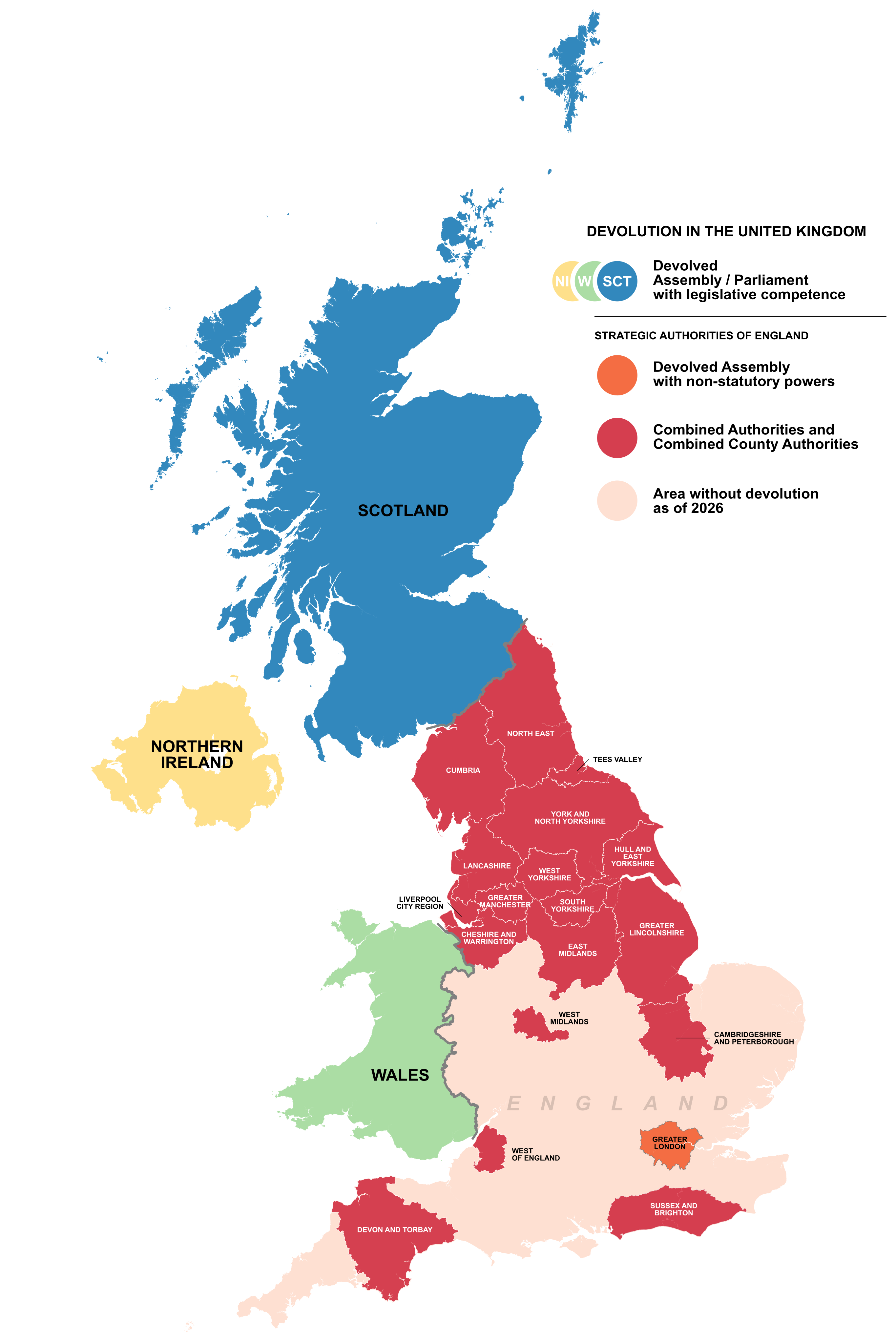
Asymmetric devolution as of 2026: three of the four nations have their own legislature; England does not, and English regions sit under Westminster directly. Source: Wikimedia Commons, CC BY-SA 4.0.
The post-1998 settlement created legislatures in Edinburgh, Cardiff, and Belfast with reserved powers in Westminster. Scotland has used its parliament to develop a distinct policy programme (free university tuition, no NHS prescription charges, different childcare provision), and the SNP government has campaigned for an independence referendum that the UK Supreme Court ruled in 2022 cannot be held without Westminster's consent. Northern Ireland's politics is structured by the 1998 Good Friday Agreement and the post-Brexit Protocol that complicates trade across the Irish Sea.
The Supreme Court of the United Kingdom, established in 2009, has become a more visible actor in constitutional disputes. The two Miller cases (2017 on whether the government could trigger Article 50 without Parliament; 2019 on whether the Prime Minister's prorogation of Parliament was lawful) tested how far the Court would go in policing the boundaries of executive authority. Both went against the government, continuing a longer drift away from the orthodox view that Parliament is the only meaningful constitutional check on the executive.
What Brexit revealed
The 2016 referendum and its aftermath stress-tested the unwritten constitution. There were no settled rules for major decisions taken outside Parliament; the prerogative-versus-statute boundary had to be litigated in the Miller cases. Devolution was exposed as incomplete: Scotland and Northern Ireland voted Remain by margins that the UK-wide majoritarian outcome overrode, with no formal mechanism for accommodation.
Parliamentary sovereignty was both obstacle and resource, blocking every version of Theresa May's deal while also forcing publication of legal advice and ruling out no-deal exit. Post-Brexit politics has been rebuilding regulatory autonomy and renegotiating the practical arrangements, in Northern Ireland especially.
References
- Walter Bagehot, The English Constitution (1867). The classical account of Cabinet government and the working constitution. https://www.gutenberg.org/ebooks/4351
- Vernon Bogdanor, The New British Constitution (Hart, 2009). Survey of the post-1997 changes (devolution, Human Rights Act, Supreme Court, executive reform). https://www.bloomsbury.com/uk/new-british-constitution-9781841137094/
- UK Parliament, "How Parliament works". Official reference for institutional rules and current procedure. https://www.parliament.uk/about/how/
- The Constitution Unit, University College London. Independent research centre on the UK constitution; tracks current constitutional questions. https://www.ucl.ac.uk/constitution-unit/
- Institute for Government, "Whitehall Monitor". Tracks the workings of UK government and the civil service. https://www.instituteforgovernment.org.uk/our-work/trackers/whitehall-monitor-list
- House of Commons Library, "General Election 2024 results". Vote and seat shares by party. https://commonslibrary.parliament.uk/research-briefings/cbp-10009/
- Arend Lijphart, Patterns of Democracy, 2nd ed. (Yale, 2012). Treats the UK as the paradigmatic majoritarian democracy. https://yalebooks.yale.edu/book/9780300172027/patterns-of-democracy/