205. Government and Politics of the United States
Learning outcomes
- When you read about a fight between Congress and a President, a Supreme Court ruling that resets a long-settled rule, or the latest evidence that "American democracy is in trouble", you'll know to trace the story to the constitutional design (separation of powers, federalism, judicial review) and to the post-1980 partisan realignment that has made every part of that design more polarised.
A constitution made for gridlock
The American constitution of 1787 was designed against monarchy, not for governance. Its three core ideas, separation of powers (Madison's "ambition must be made to counteract ambition", Federalist 51), federalism (a strong national government over and beside continuing state governments), and judicial review (the courts can strike down acts of Congress, established by Marbury v. Madison in 1803), share one impulse: prevent any single actor from accumulating enough power to be dangerous. The price is that getting anything done requires concurrent agreement between actors with separate mandates.
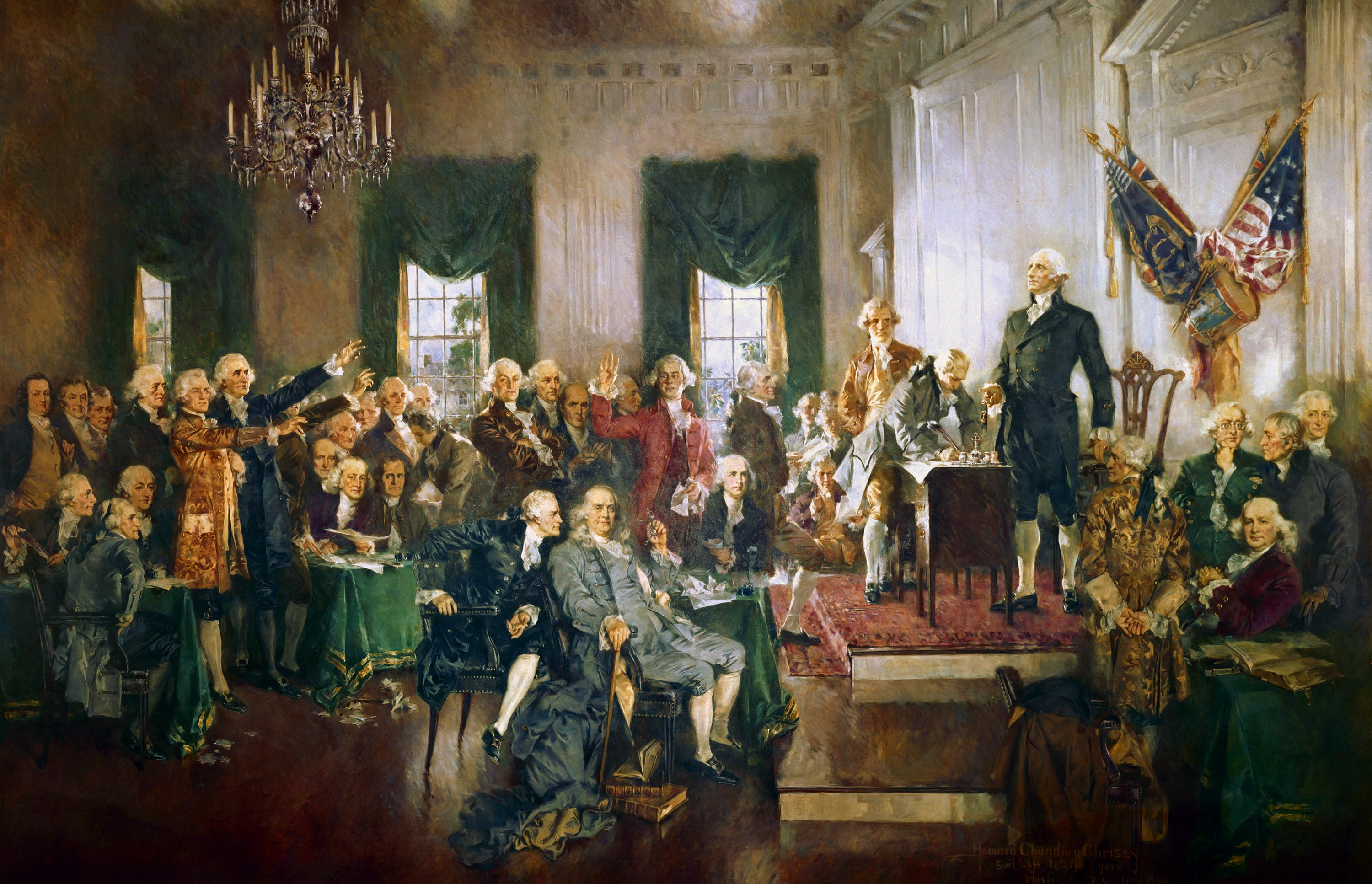
Howard Chandler Christy, Scene at the Signing of the Constitution of the United States (1940), East Stairway of the House wing, U.S. Capitol. Source: Wikimedia Commons. Public domain (work of an employee of the Architect of the Capitol).
Two centuries of stability made the United States the standing counter-example to Juan Linz's argument that presidentialism is structurally fragile (covered in Practice of Politics). The current synthesis: the US system survived on background conditions (strong parties before the 1990s, moderate inequality in the post-war decades, a deeply legalist civic culture) more than on the presidential design itself.
When those conditions weaken, the design's brittleness shows. Government shutdowns, debt-ceiling brinkmanship, near-impeachment of a President every few years, and a Supreme Court that operates as a third legislative chamber are all symptoms of a system whose veto points have outpaced the trust required to use them sparingly.
The polarisation story
Almost every contemporary feature of American politics traces to the realignment that began in the late 1970s and accelerated after 1994. Through the mid-twentieth century, both parties contained an ideological range. Conservative Southern Democrats and liberal Northeastern Republicans created cross-pressured coalitions that produced bipartisan majorities on most legislation. That ended.
The mechanism was a coalition swap. The civil-rights legislation of the 1960s and the Republican "Southern strategy" that followed moved white conservative Southerners from the Democratic to the Republican column over a generation. African American voters consolidated as Democrats. The educated suburban middle class shifted Democratic on cultural-issue grounds. The parties became sorted (each ideologically homogeneous) before they became polarised (separated from each other).
Sorted-and-polarised parties interact badly with the constitutional veto-point machinery. Where Congressional moderates would once have crossed party lines to break stalemates, there are now too few moderates left in either party to do it. Divided government, once productive, became dysfunctional.
The branches
The presidency. The job has expanded far beyond what Article II describes. Executive orders, agency rule-making, and the modern administrative state put policy-making power in the President's office that the framers did not contemplate. Unilateral action (executive orders, signing statements, reinterpretations of existing statutes) is now routine, and its scope is set mostly by the courts. Obama's 2012 DACA programme, Trump's 2017 travel ban, and Biden's 2022 student-loan forgiveness order each set major policy without legislation, and each was litigated to the Supreme Court.
Congress. The two-chamber design favours rural states (each gets two senators regardless of population) and creates supermajority hurdles (the Senate filibuster, requiring 60 votes for most legislation). Committee structures and seniority rules give individual senators large agenda-setting power. The combination, on top of polarised parties, has produced a Congress that legislates rarely and oversights weakly; most policy now happens in agencies or courts.
The federal bureaucracy. Agencies (the EPA, the FDA, the SEC, the dozens of others) write the regulations that put statutes into operation. Chevron deference (from Chevron v. NRDC, 1984) instructed courts to defer to agency interpretations of ambiguous statutes; Loper Bright v. Raimondo (2024) overturned it. The shift moves interpretive power from agencies to judges, which compounds with a polarised judiciary: regulatory politics is now litigation politics, and the partisan composition of the federal bench shapes outcomes in environmental, financial, and labour rule-making at least as much as Congress does.
Federal courts. The Supreme Court has moved from the back to the front of the political stage. Lifetime appointments, a six-three conservative majority since 2020, and a run of decisions overturning long-standing precedents (Roe v. Wade in 2022, Chevron in 2024) have made it the place where many of the country's biggest political fights are now decided. Confirmation battles for individual justices have become among the highest-stakes events in American politics.
Federalism, parties, and elections
State governments retain genuine authority, especially on criminal law, education, family law, and most regulatory areas. Where federal action is blocked, state-level variation produces a patchwork: California sets its own emissions standards, Texas its own immigration enforcement posture, roughly twenty states retain capital punishment while others have abolished it. Federalism also lets a national minority concentrated in particular states win at the state level even when it loses at the federal one.
Parties and elections inherit the same federal structure. There are 51 separate election administrations (one per state plus the District of Columbia), and the rules that turn votes into seats vary across them. Single-member districts with first-past-the-post in most of the House lock in two-party competition (Duverger's law) and give every redistricting cycle high stakes; gerrymandering (drawing district lines for partisan advantage) is harder to police federally after Rucho v. Common Cause (2019) ruled partisan-gerrymander claims non-justiciable in federal court. The Electoral College, in which each state's votes are mostly winner-take-all, has produced two split-decision elections in recent memory (Bush 2000, Trump 2016) where the popular-vote loser took the presidency.
Money flows to candidates through a near-deregulated channel since Citizens United v. FEC (2010), which struck down limits on independent corporate and union political expenditures. Super PACs now raise unlimited sums in parallel with candidates' own committees. Whether this materially shifts policy is contested; the most-cited recent finding (Gilens and Page, 2014) is that average-citizen preferences have near-zero independent effect on federal policy once economic elites and organised interest groups are controlled for.
Rights and civil liberties
The Bill of Rights (the first ten amendments, ratified 1791) constrained only the federal government as originally written. The incorporation doctrine, built up case by case under the Fourteenth Amendment's Due Process Clause through the twentieth century, extended most of those rights against the states; this is why state laws on speech, religion, search and seizure, and criminal procedure are now adjudicated in federal court.
The Reconstruction Amendments (the Thirteenth, Fourteenth, and Fifteenth, 1865 to 1870) abolished slavery and promised equal protection and the vote. The promise was systematically broken in the South for nearly a century. The civil-rights revolution of the 1950s and 1960s (Brown v. Board of Education 1954, the Civil Rights Act 1964, the Voting Rights Act 1965) restored federal enforcement, and recast American politics around race in a way that drove the coalition swap above. Shelby County v. Holder (2013) gutted the preclearance regime of the Voting Rights Act, and voting-access disputes have been a live front of state and federal litigation since.
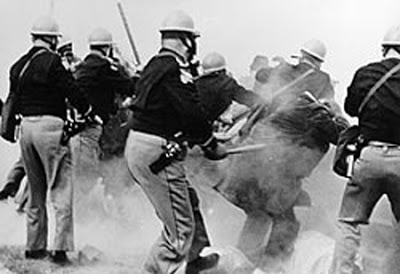
"Bloody Sunday", Selma, Alabama, 7 March 1965. Source: Wikimedia Commons (FBI). Public domain.
Contemporary rights fights cluster on speech (the First Amendment used by both left and right against state action they oppose), guns (the Second Amendment after District of Columbia v. Heller 2008 and NYSRPA v. Bruen 2022), and reproductive autonomy (after Dobbs v. Jackson Women's Health 2022 returned abortion regulation to the states). Each of these is a case where the constitutional text is short, the doctrinal interpretation has moved sharply with the Court's composition, and policy outcomes vary widely by state.
Democratic erosion
Recent comparative work (V-Dem, Levitsky and Ziblatt) classifies the United States as a backsliding democracy. The diagnostic features: an incumbent who refused to concede a lost election (2020-21); a partisan polarisation deep enough that one party's voters increasingly view the other as illegitimate; growing willingness to use legitimate institutional veto points (the Senate filibuster, judicial appointments, state-level electoral administration) for partisan ends rather than as restraints on excess; and a long-running but accelerating delegitimisation of the press and the courts.
The counter-argument is that the institutions held: courts ruled against Trump's 2020 election challenges, military leaders refused to participate in the transition crisis, state election officials of both parties certified results despite pressure. The system has not failed, but the conditions it rested on (strong norms across both parties, low willingness to weaponise the veto points) are weaker than they were, and several near-misses have already happened.
References
- Constitution Annotated, The Constitution of the United States (Library of Congress). The official annotated reference. https://constitution.congress.gov/
- Alexander Hamilton, James Madison, and John Jay, The Federalist Papers (1787-88). The contemporaneous defence of the constitutional design; Federalist 10 and 51 in particular. https://www.gutenberg.org/ebooks/1404
- Robert A. Dahl, Who Governs? Democracy and Power in an American City (Yale, 1961). The classic empirical refutation of strong elite-power theories of American politics. https://archive.org/details/whogovernsdemocr0000dahl
- Juan J. Linz, "The Perils of Presidentialism", Journal of Democracy 1, no. 1 (1990). The argument the United States most consistently disconfirms. https://www.journalofdemocracy.org/articles/the-perils-of-presidentialism/
- Steven Levitsky and Daniel Ziblatt, How Democracies Die (Crown, 2018). The comparative-politics framing of recent American erosion. https://www.penguinrandomhouse.com/books/562246/how-democracies-die-by-steven-levitsky-and-daniel-ziblatt/
- Martin Gilens and Benjamin I. Page, "Testing Theories of American Politics: Elites, Interest Groups, and Average Citizens", Perspectives on Politics 12, no. 3 (2014). The most-cited recent quantitative claim that majority preferences have near-zero independent effect on federal policy. https://www.cambridge.org/core/journals/perspectives-on-politics/article/testing-theories-of-american-politics-elites-interest-groups-and-average-citizens/62327F513959D0A304D4893B382B992B
- Krutz, Waskiewicz, et al., American Government 3e (OpenStax, 2021). Open-access introductory textbook; useful as a topical map of the field. https://openstax.org/books/american-government-3e/pages/preface
- Voteview / DW-NOMINATE (Lewis, Poole, Rosenthal). The canonical roll-call ideology dataset for the US Congress. https://voteview.com/
- V-Dem Institute, Varieties of Democracy. The cross-country dataset that places the US in comparative context, including recent backsliding scores. https://www.v-dem.net/about/v-dem-project/