212. International Relations in the Era of Two World Wars
Learning outcomes
- When someone tells you why a war started, a peace failed, or a post-war order held, you'll know how to pull the explanation apart into the three things it has to address (the balance of power between states, the ideologies driving the leaders, and the economic system holding the whole thing together) instead of accepting whichever cause the speaker reached for first.
The Bismarckian system and its breakdown
Otto von Bismarck built the European order the First World War destroyed. For forty years after German unification in 1871 it was held together by interlocking alliances designed to keep France isolated and the other great powers from fighting each other: the Triple Alliance (Germany, Austria-Hungary, Italy from 1882), the Franco-Russian alliance (1894), the Anglo-French Entente (1904), and the Anglo-Russian Entente (1907). After Bismarck's dismissal in 1890, the new German leadership let the Reinsurance Treaty with Russia lapse, and the flexible web stiffened into two rival blocs.
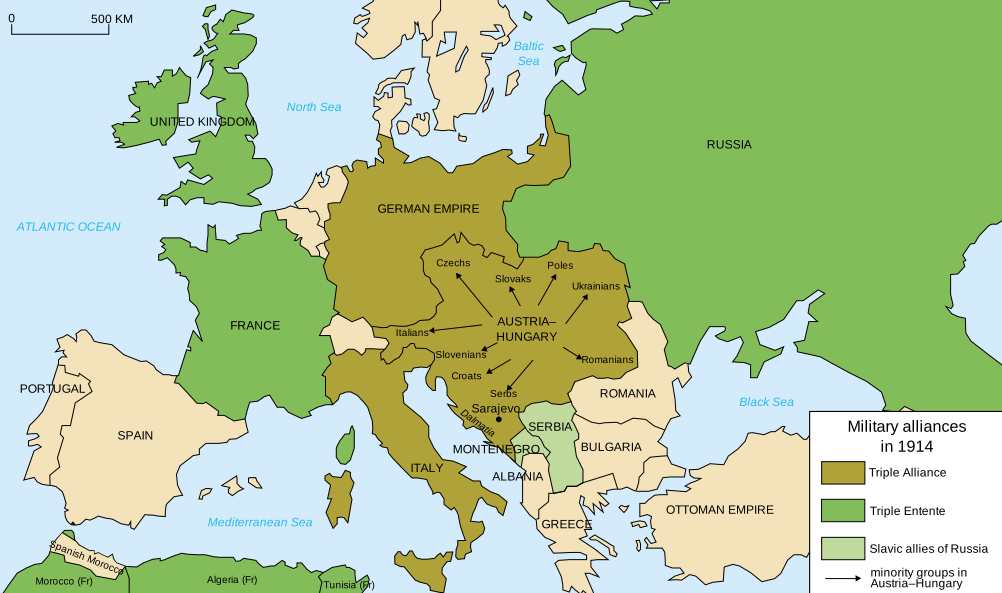
The 1914 alliance system, with the Central Powers (Germany, Austria-Hungary) ringed by France in the west and Russia in the east. The geometry is the explanation: any local crisis in the Balkans pulled both sides of the ring at once. Source: Wikimedia Commons, CC BY-SA 2.5.
The 1914 crisis is the standard case for structural versus agency explanations of war. The structural account stresses the great-power balance: Germany's industrial and military rise relative to Britain and France produced a power transition that, through fear, opportunity, and miscalculation, was likely to produce conflict.
The agency account stresses individual decisions. The Schlieffen Plan committed Germany to a fixed sequence (attack France through Belgium first, then turn east to Russia), so any Russian mobilisation forced a German attack on France within days. Statesmen who wanted to localise the Balkan crisis found the railway timetables had already decided for them. Christopher Clark's The Sleepwalkers (2012) reads the July Crisis as misperception and lock-in rather than long-laid German design.
For Clark's own walkthrough of the misperception case, see his Gresham College lecture Sleepwalkers: How Europe Went to War in 1914 (about one hour), which lays out why no statesman in July 1914 believed they were starting a continental war.
The interwar order
The 1919 Versailles settlement tried to combine three incompatible aims: punish Germany enough to prevent a war of revenge, leave enough German capacity to pay reparations, and build a collective-security order (the League of Nations) to replace the discredited alliance system. Each aim partly undermined the others. John Maynard Keynes's The Economic Consequences of the Peace (1919) gave the contemporary critique that became the standard reading: the reparations were both economically self-defeating and politically delegitimising.
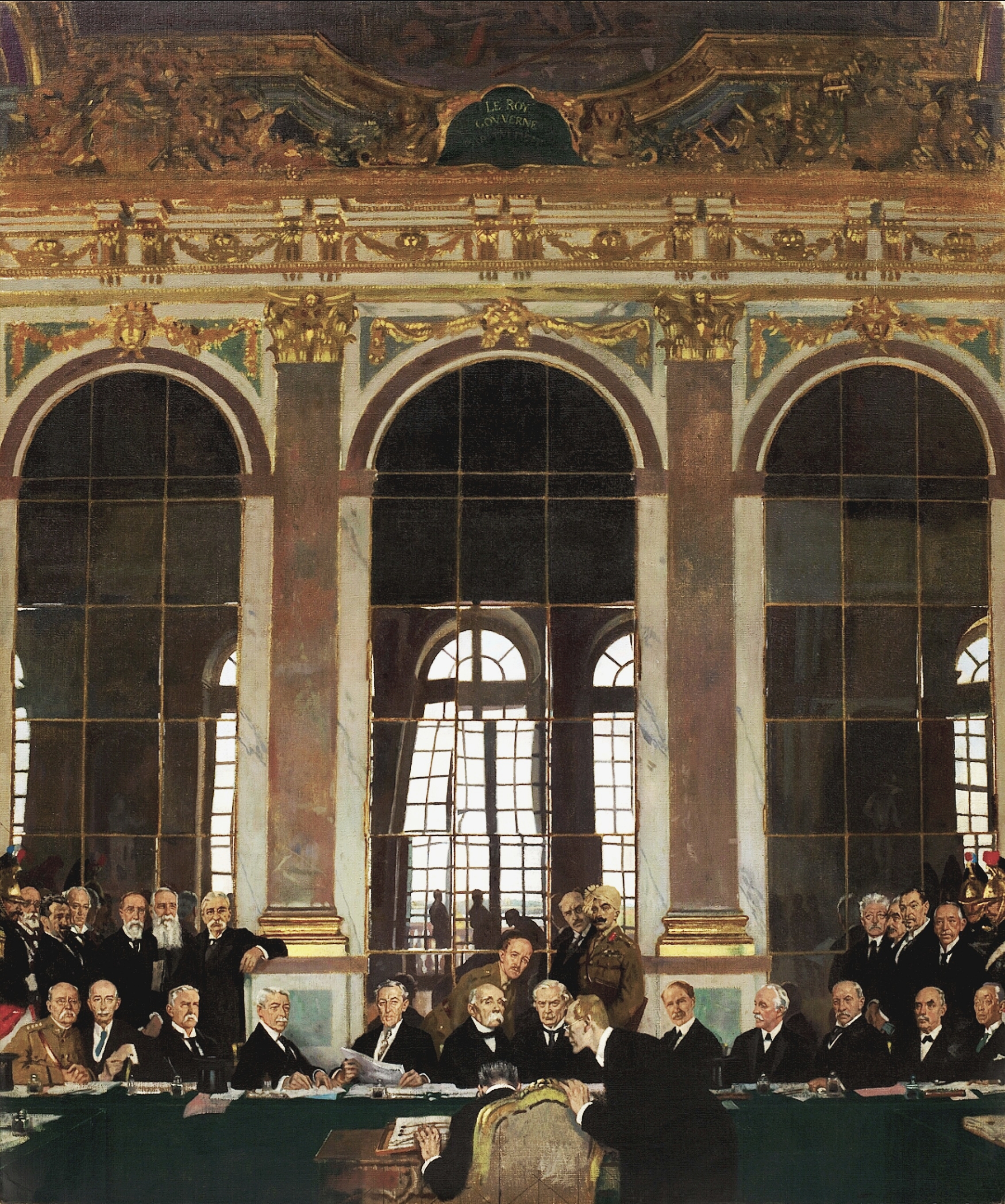
William Orpen, The Signing of Peace in the Hall of Mirrors (1919). Orpen was the British official war artist at the Paris conference. The pomp of the room is the data Keynes was attacking: the architecture of triumph made it hard for the participants to see that the peace they were signing was already structurally unstable. Source: Wikimedia Commons, public domain.
The League's collective-security promise was undercut by two facts. The United States Senate refused to ratify the Treaty, so the most powerful state in the system stayed out. Britain and France would not enforce League decisions against their own national interest, as the failures to respond to Japan's 1931 invasion of Manchuria and Italy's 1935 invasion of Ethiopia made plain.
The international economy compounded the political failure. Britain's 1925 return to the gold standard at the pre-war parity overvalued the pound by roughly 10%, forcing wages and prices down to restore competitiveness and locking in deflation. The 1929 crash and the 1930-32 banking crises produced national autarky responses (the 1930 Smoot-Hawley tariff in the United States, imperial preference in Britain, autarkic industrial policy in Germany under Hjalmar Schacht) that broke the pre-war commercial integration. Charles Kindleberger's The World in Depression (1973) argued that the slump became a world depression because no power was both willing and able to play the stabiliser role: Britain could not, the United States would not.
The road to 1939
Hitler's 1933 ascent and the rapid German rearmament that followed posed the central interwar question: appease or contain? Britain and France chose appeasement through 1938. The standard Cold War-era narrative blamed it on weak leaders failing to read Hitler's intentions.
Later historiography, including A. J. P. Taylor's controversial Origins of the Second World War (1961), emphasised the structural pressures: Western publics scarred by 1914-18, militaries not yet ready, and economies still recovering all argued against war at each stage. By the time the Munich agreement (September 1938) and the German occupation of the rump Czech lands (March 1939) showed the policy's failure, British and French rearmament was underway but the strategic position had deteriorated.
The Molotov-Ribbentrop Pact of August 1939 removed the last constraint on Hitler's invasion of Poland. Its secret protocol partitioned Eastern Europe between Germany and the USSR, so Hitler could attack Poland without facing a two-front war. The Western declaration of war followed within a week. The pact also prefigured the post-1945 split: Soviet annexations under its terms (the Baltic states, eastern Poland, Bessarabia) were preserved into the Cold War order.
The war that followed was global from 1941. Japan's earlier expansion in China (the 1931 Manchurian incident, the 1937 invasion proper) and its 1940 alignment with Germany and Italy in the Tripartite Pact connected the Asian and European theatres. Pearl Harbor (December 1941) and Hitler's gratuitous declaration of war on the United States days later turned a European war into the configuration that would produce the 1945 settlement: a coalition of the United States, the British Empire, and the Soviet Union against the Axis.
The 1945 settlement
The post-1945 design avoided the interwar mistakes deliberately. The United Nations replaced the League with great-power consent built in: the five permanent Security Council members each held a veto, recognising that international order required the willing participation of the strongest states rather than majority votes that could be ignored.
The Bretton Woods institutions (IMF, World Bank, the GATT trade framework) replaced the autarkic 1930s with a managed open economy under American leadership. The Marshall Plan (1948) inverted the reparations logic of 1919 by transferring resources to defeated Germany and exhausted European allies alike. NATO (1949) replaced collective security with a hard alliance commitment that an attack on one was an attack on all.
The settlement was not symmetric. The Soviet bloc was excluded from Bretton Woods and the Marshall Plan, and the Iron Curtain that Churchill named in 1946 hardened into the institutional split that defined the Cold War. The 1945-49 transition is therefore both the high point of post-war design and the start of the bipolar order the next 45 years would test.
The role of ideology
A purely realist reading of 1914-1945 misses something. The First World War destroyed the dynastic legitimacy of three great powers (the Habsburgs, Hohenzollerns, and Romanovs), and the political vacuum was filled by movements (Bolshevism, Fascism, Nazism) whose ideological programmes were inseparable from their international ambitions. The Soviet Union was committed to world revolution before settling into "socialism in one country" under Stalin.
Nazi Germany's foreign policy goals (Lebensraum in the East, racial reordering of conquered territory) ran past any cost-benefit balance a realist would compute. The 1941 invasion of the USSR opened a second front while Britain remained undefeated, a strategic choice intelligible only through the regime's ideology.
The interaction between ideology and material conditions is what makes the period a recurring touchstone for IR theory. Realists read it as the balance of power eventually correcting ideological adventures. Liberals read it as a case where economic interdependence and democratic institutions could have prevented war if better protected. Constructivists read it as evidence that the meaning the actors gave to their situations (national honour in 1914, racial mission in 1933) was as load-bearing as the material situations themselves.
References
- Christopher Clark, The Sleepwalkers: How Europe Went to War in 1914 (Allen Lane, 2012). The leading contemporary account of the July Crisis. https://www.penguin.co.uk/books/56305/the-sleepwalkers-by-christopher-clark/9780141027821
- John Maynard Keynes, The Economic Consequences of the Peace (1919). The contemporary critique of Versailles. https://www.gutenberg.org/ebooks/15776
- E. H. Carr, The Twenty Years' Crisis, 1919-1939 (Macmillan, 1939). The realist analysis of interwar diplomacy and the failure of liberal internationalism. https://archive.org/details/twentyyearscrisi0000carr
- Charles Kindleberger, The World in Depression, 1929-1939 (UC Press, 1973). The hegemonic-stability theory of the 1930s collapse. https://www.ucpress.edu/books/the-world-in-depression-1929-1939/paper
- A. J. P. Taylor, The Origins of the Second World War (Hamish Hamilton, 1961). The structural-pressures revisionism. https://archive.org/details/originsofsecondw0000tayl
- Margaret MacMillan, Peacemakers: The Paris Conference of 1919 and Its Attempt to End War (John Murray, 2001). The contemporary scholarly account of Versailles. https://www.johnmurraypress.co.uk/titles/margaret-macmillan/peacemakers/9780719562372/
- United Nations, History of the United Nations. The official institutional history. https://www.un.org/en/about-us/history-of-the-un