227. Politics in China
Learning outcomes
- When you read about China (a Politburo reshuffle, a tech crackdown, a Taiwan-Strait incident, a Hong Kong protest, a US-China deal or breakdown), you'll know to read it as a Party-led system: the Chinese Communist Party sits parallel to and above every formal state body, so what looks like a government decision is usually a Party decision being implemented.
- When you read about China's economy or its policy turns (Common Prosperity, the tech crackdown, the slowdown), you'll know to place them against the post-1978 reform bargain (decentralised local experimentation under central political control) and its closure under Xi.
The Party-state
The Chinese Communist Party is not just the dominant party in a multi-party system; it is a parallel structure that sits above every formal organ of the state. Almost every government institution (the ministries, the National People's Congress, the courts, the People's Liberation Army, the state-owned enterprises, large private firms above a threshold) has a Party committee inside it to which its leadership reports. In Chinese practice, the Party leads everything (dang ling yi qie); the government implements.
At the top sits the Politburo Standing Committee (currently seven members). The Politburo (about 25) sits below it; the Central Committee (about 200 full members and 170 alternates) is wider still. The General Secretary chairs the Standing Committee, and since 1993 has also held the state Presidency and the chairmanship of the Central Military Commission, consolidating Party, state, and military authority in one office. Xi Jinping has held all three since 2012-13.
The result is a disciplined organisation of about 99 million members running a continental state. Andrew Nathan's "China's Changing of the Guard: Authoritarian Resilience" (2003) named the post-1980s features that made the system durable past modernisation theory's predictions: institutionalised succession (two five-year terms for the General Secretary), meritocratic recruitment through a tournament-style cadre system, growing policy capacity, and performance legitimacy underwritten by sustained growth. Several of these features have weakened under Xi: the term limit was removed, succession is no longer norm-bound, and the talent system increasingly rewards loyalty over performance.
Center, locality, and how policy actually moves
China is unitary on paper but functions through a tall hierarchy of provinces, prefectures, counties, and townships. The centre sets goals; local cadres find ways to meet them. The cadre evaluation system, which scores officials on quantified targets (growth, fiscal revenue, social stability, more recently pollution and poverty reduction) and ties promotion to performance, is the mechanism that turns Beijing's priorities into local action. It also explains chronic pathologies: target inflation, statistical fraud, and the periodic over-reach of campaign-style implementation.
Fiscal centralisation in the 1994 tax-sharing reform pulled most revenue to Beijing while leaving expenditure responsibilities (schools, hospitals, basic infrastructure) with localities. Counties and cities closed the gap by selling land-use rights to developers, which fuelled both the property boom and the local-government debt overhang now visible in the post-2021 real-estate crisis.
Reform, growth, and the end of the reform era
Deng Xiaoping's 1978 reform-and-opening produced four decades of compounding growth. GDP per capita rose more than fiftyfold.
Yuen Yuen Ang's How China Escaped the Poverty Trap (2016) traced the mechanism: not technocratic central planning, but directed improvisation, in which Beijing set broad goals and local cadres, rewarded for delivering, found ways to meet them. Successful local experiments (township and village enterprises in the 1980s, special economic zones in Guangdong, urban land auctions in the 1990s) were scaled up through Party channels. The combination of decentralised innovation and centralised political control is sometimes called "experimentation under hierarchy".
The reform era is now over. Under Xi, the centre has reasserted control over previously autonomous local actors and the Party's role inside private firms has expanded (Party committees in firms above a size threshold are now near-universal). The 2020-22 regulatory crackdowns on tech platforms (the suspension of Ant Group's IPO in November 2020, antitrust action against Alibaba, the data-security review of Didi), after-school tutoring, and real-estate leverage marked a shift from growth-at-all-costs toward "Common Prosperity": redistribution within the existing structure, harder caps on capital, and tighter alignment of private business with state priorities. Growth has slowed, the population peaked in 2022, and the implicit bargain (loyalty in exchange for rising material standards) is under pressure.
Xi-era consolidation
The post-2012 changes amount to a regime shift inside the same constitutional shell. Term limits on the state presidency were removed in 2018, opening Xi's third (and presumably indefinite) term in 2022. The anti-corruption campaign has investigated more than four million cadres since 2012, serving both anti-graft and political-cleansing functions.
Ideological control over universities, media, and publishing has tightened, and surveillance and policing capacity in Xinjiang against the Uyghur population has expanded on a scale that the United States, the United Kingdom, and the European Parliament have variously characterised as crimes against humanity or genocide. Tibet sits inside the same minzu (ethnic) policy turn, with Mandarin-medium boarding schools displacing Tibetan-language schooling.
Foreign policy has become more assertive. The Belt and Road Initiative (announced 2013) reshaped Chinese economic relations with Asia, Africa, and Latin America. Land reclamation and militarisation in the South China Sea created new strategic facts. Wolf-warrior diplomacy and the post-2019 Hong Kong crackdown ended any plausibility of the previous "peaceful rise" framing.
Ideology, law, and civil society
It is tempting to treat Chinese ideology as decoration, but it does work. Xi Jinping Thought on Socialism with Chinese Characteristics for a New Era was written into the Party constitution in 2017 and the state constitution in 2018; it functions as the doctrinal frame inside which cadre training, university teaching, and policy slogans are organised. It is the vocabulary that Party documents are written in, and it sets which moves are sayable.
Law has been built up massively (a civil code, an administrative-litigation system, a much larger legal profession) without being placed above the Party. The official phrase is rule by law (yifa zhiguo) rather than rule of law: law is an instrument of governance and Party discipline, not a constraint on it. The 2015 "709 crackdown" on rights-defending lawyers and the 2017 Foreign NGO Law signalled the limits.
Civil society is denser than outside observers often assume but tightly bounded. Local protest is common (millions of "mass incidents" a year through the 2010s, mostly over land takings, factory closures, and pollution) and the Party often grants concessions on local issues to keep the lid on. Organised cross-regional or rights-based mobilisation is met with hard repression. The November 2022 "A4" or "white paper" protests against zero-COVID, which spread across cities for several days, were the clearest visible exception in a decade and were followed by a rapid reopening that the regime has not formally acknowledged was caused by the protests.
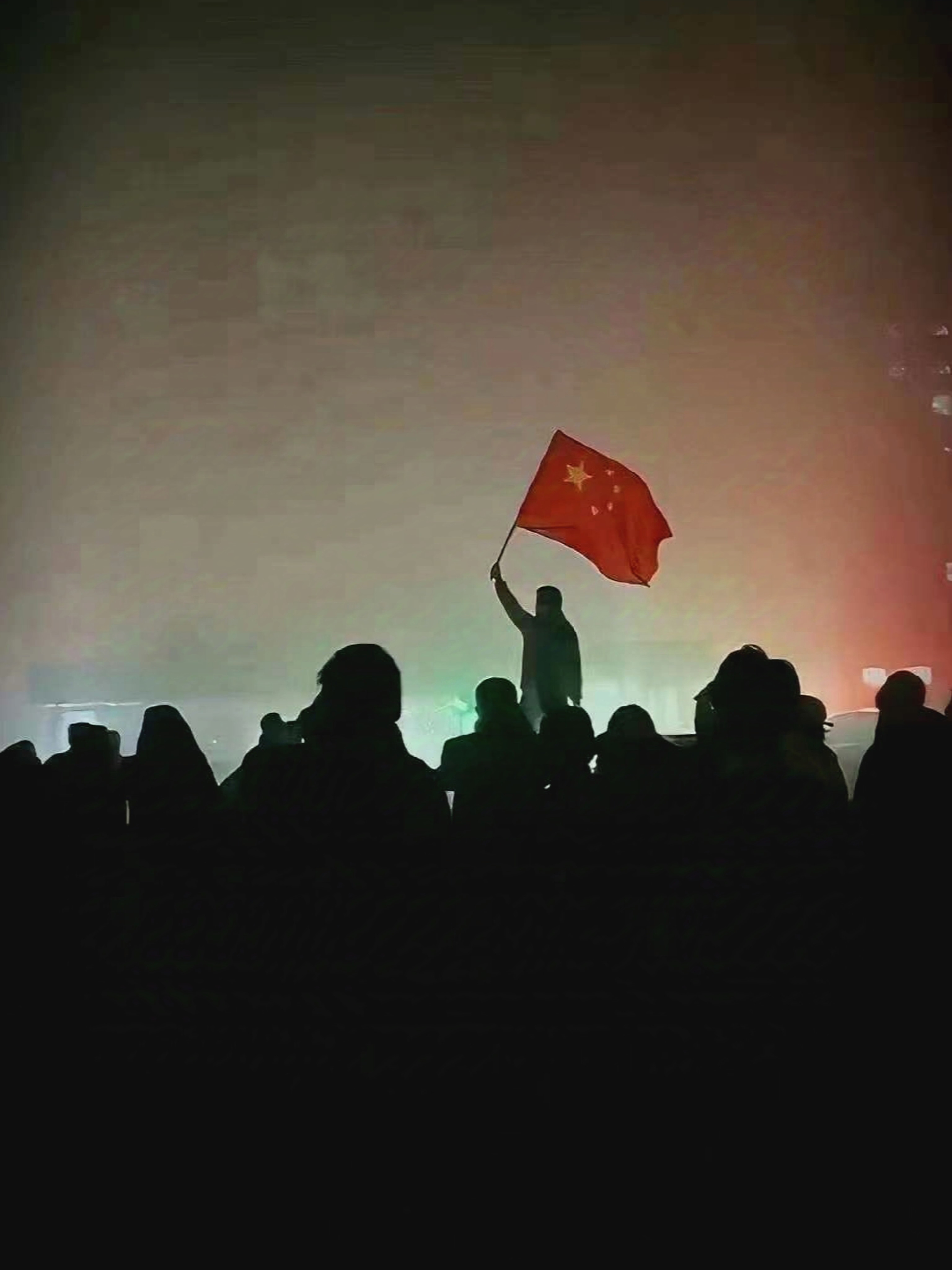
Urumqi, 25 November 2022. The blank A4 page was the entire vocabulary of the protest: nothing on it could be censored. Photograph by Wq9579 via Wikimedia Commons, CC BY-SA 4.0.
Hong Kong and Taiwan
Hong Kong was returned to Chinese sovereignty in 1997 under the "one country, two systems" formula, with a Basic Law guaranteeing rights and a high degree of autonomy until 2047. The 2014 Umbrella Movement and the 2019-20 protests exposed Beijing's rejection of further democratisation; the 2020 National Security Law functionally ended Hong Kong's distinct political space, and the 2024 Article 23 legislation completed the legal transformation. Hong Kong is now governed under formally-distinct but politically-aligned arrangements with the mainland.
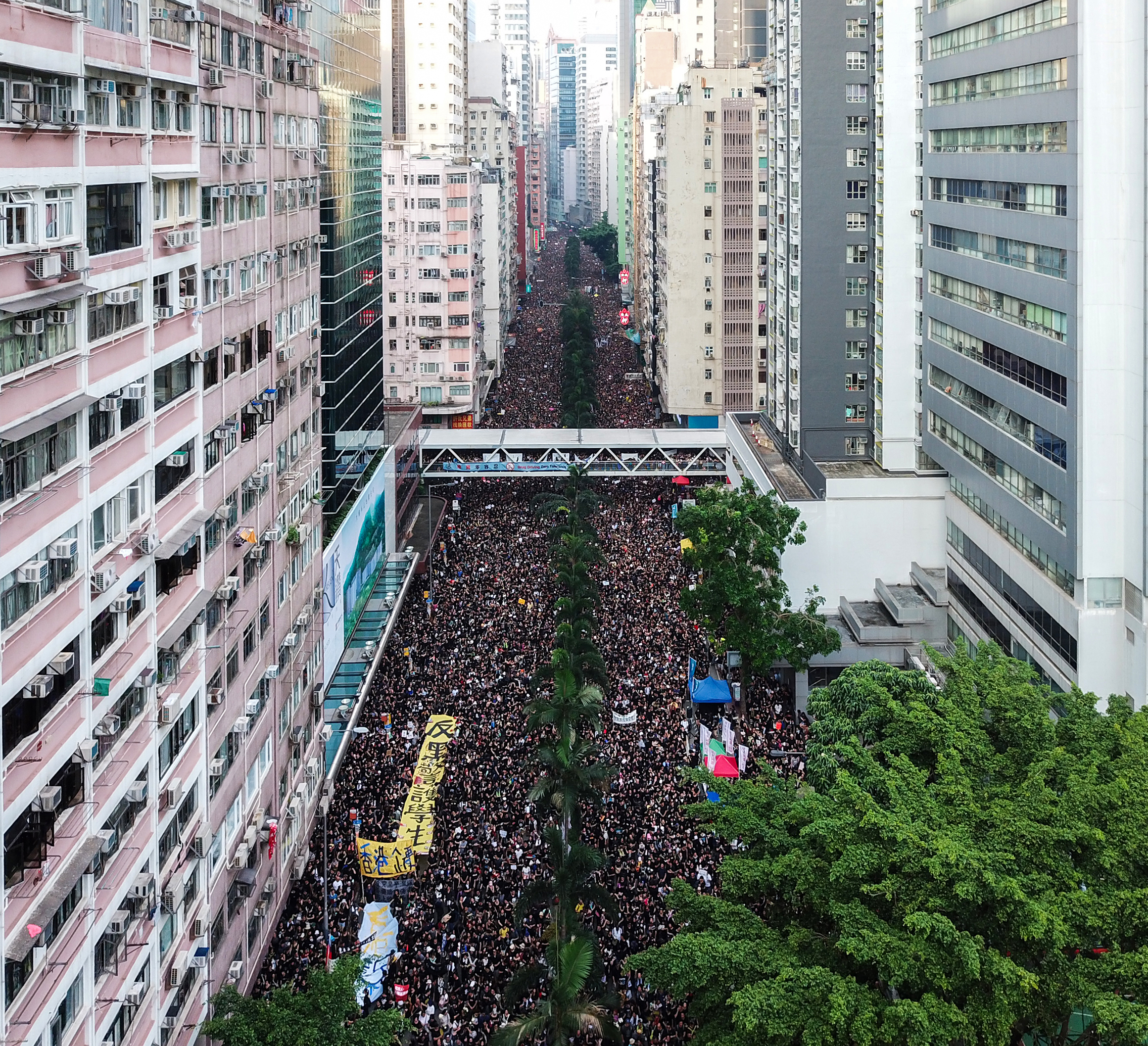
Hennessy Road, Hong Kong, 16 June 2019. Organisers estimated nearly 2 million marched; the 2020 National Security Law extinguished this scale of public dissent within a year. Photograph by Wpcpey via Wikimedia Commons, CC BY-SA 4.0.
Taiwan is the unresolved sovereignty question of contemporary China. Beijing insists Taiwan is a province of the PRC; Taiwan operates as the Republic of China with a fully democratic system since 1996, regular alternation in power, and no plausible domestic constituency for unification. The Tsai Ing-wen and Lai Ching-te presidencies have continued the pro-sovereignty trajectory. The strategic question is whether and when Beijing will use force, and what role the United States and the regional security architecture play.
The strategic competition with the United States
The post-2017 frame for the bilateral relationship is strategic competition. The Trump-era tariffs, the Biden-era industrial-policy and chip-export controls, and the parallel CHIPS Act and Inflation Reduction Act represent a US bipartisan turn from engagement to selective decoupling. Beijing's response has emphasised technological self-sufficiency, currency diversification, and Global South partnerships. The relationship is not a Cold War analogue (the economies are far more entangled than the US-USSR ever were) but the trajectory is in that direction.
References
- Andrew J. Nathan, "China's Changing of the Guard: Authoritarian Resilience", Journal of Democracy 14, no. 1 (2003). The framework that named the post-Deng durability puzzle. https://www.journalofdemocracy.org/articles/chinas-changing-of-the-guard-authoritarian-resilience/
- Yuen Yuen Ang, How China Escaped the Poverty Trap (Cornell, 2016). The political-economy account of the reform-era growth model. https://www.cornellpress.cornell.edu/book/9781501700200/how-china-escaped-the-poverty-trap/
- Susan L. Shirk, Overreach: How China Derailed Its Peaceful Rise (Oxford, 2022). On the post-2012 turn. https://global.oup.com/academic/product/overreach-9780190068516
- Elizabeth Economy, The Third Revolution: Xi Jinping and the New Chinese State (Oxford, 2018). The standard early-Xi-era account. https://global.oup.com/academic/product/the-third-revolution-9780190866075
- Minxin Pei, The Sentinel State: Surveillance and the Survival of Dictatorship in China (Harvard, 2024). On the Party's information-and-control infrastructure. https://www.hup.harvard.edu/books/9780674257832
- World Bank Open Data: China GDP per capita (PPP). The canonical macroeconomic dataset. https://data.worldbank.org/indicator/NY.GDP.PCAP.PP.KD?locations=CN
- V-Dem Institute, Varieties of Democracy. Comparative measures placing China at the closed-autocracy end of the regime spectrum. https://www.v-dem.net/about/v-dem-project/