Theory of Politics
Learning outcomes
- When someone defends a law because "we voted on it" or attacks a policy because it "restricts freedom", you'll know to ask which version of legitimacy, freedom, or democratic authority the argument depends on, and you'll know the standard reply each defender of those concepts owes.
The legitimacy question
A police officer arrests you. By what right? You did not personally agree to be governed by this state, and yet here you are, taxed, conscriptable, subject to laws you may have voted against or never voted on at all. Political legitimacy is the central question of political theory: what, if anything, gives a state the moral right to issue commands and the citizen the moral duty to obey them?
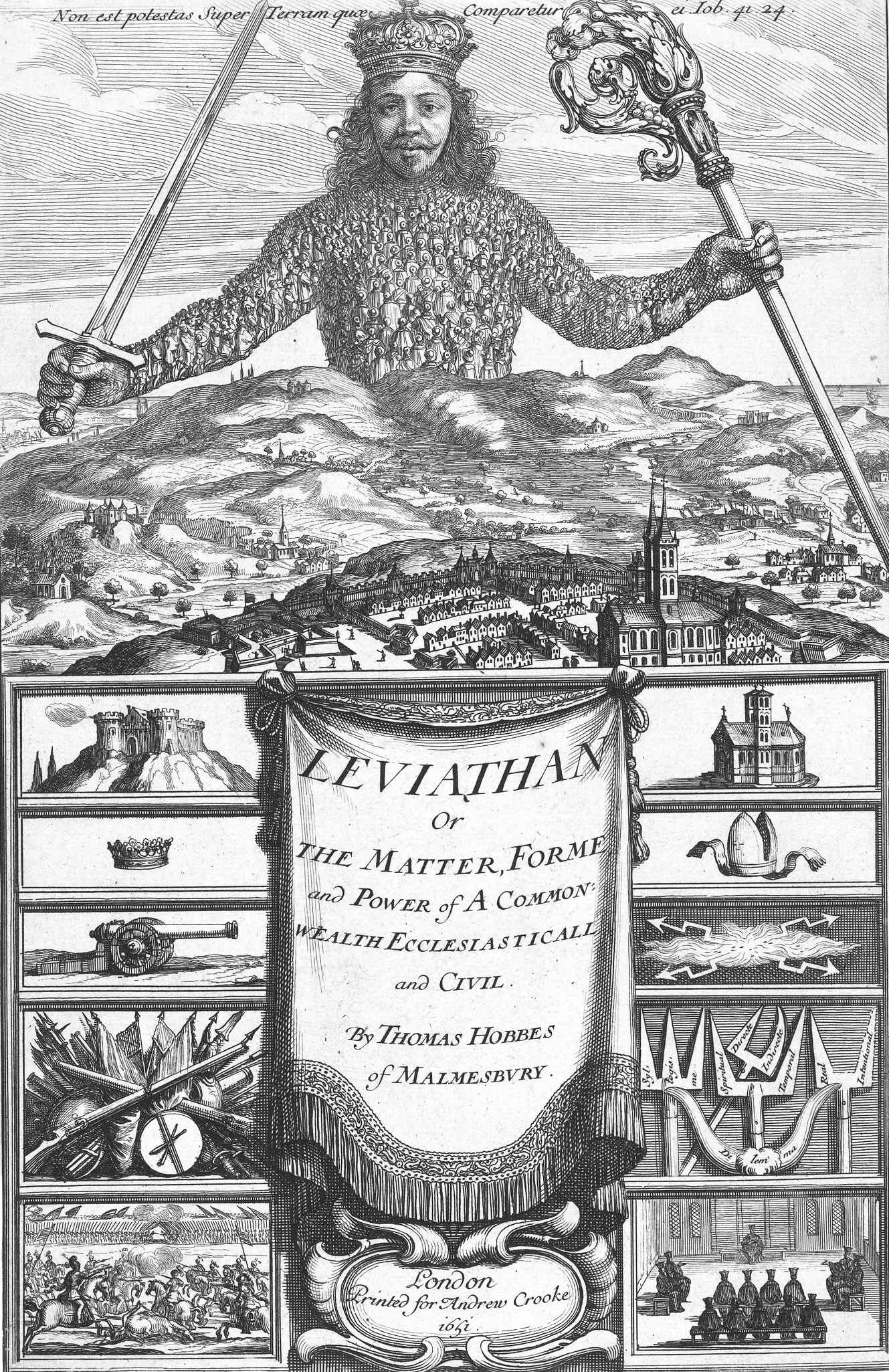
Abraham Bosse's frontispiece for Thomas Hobbes, Leviathan (1651). The body of the sovereign is literally constituted by the bodies of the citizens: an image of consent-grounded legitimacy as visual claim, not just verbal one. Source: British Museum, via Wikimedia Commons (public domain).
Four answers have dominated the modern tradition. Each has a clean version, a famous objection, and a partial fix.
| Theory | Source of obligation | Canonical objection |
|---|---|---|
| Consent (Hobbes, Locke) | Voluntary agreement, express or tacit | Hume: nobody alive consented; "tacit consent" via residence is absurd, like saying a sleeping passenger has consented by failing to leap into the ocean |
| Fair play (Hart, Rawls) | Reciprocity for benefits received from cooperative scheme | Nozick: benefits can be imposed without consent and create no duty |
| Associative (Dworkin) | Membership in a political community, on the family analogy | Licenses obedience to unjust regimes; intimacy of family does not extend to large states |
| Natural duty (Rawls, Waldron) | Universal duty to support just institutions | Particularity problem: why owe special allegiance to my state and not the most just one |
Modern work converges on pluralism: different citizens are bound by different combinations of these grounds, and no single theory does the whole job. Each ground covers some cases (consent fits naturalised citizens who took an oath; fair play fits beneficiaries of public goods; associative duties fit long-settled members; natural duty covers everyone else), and the gaps in one are filled by another.
Liberty
When the same word is doing two different jobs, an argument about it tends to talk past itself. Isaiah Berlin's Two Concepts of Liberty (1958) drew the canonical distinction. Negative liberty is the absence of obstacles imposed by other people: you are negatively free to the extent that no one is stopping you. Positive liberty is the capacity to act on one's own purposes: you are positively free to the extent that you have the resources, knowledge, and self-mastery to do what you would, in some deeper sense, want to do.
The two concepts come apart in cases that have driven politics for two centuries. A factory worker in Manchester in 1850 was negatively free (no one was forcing him to work specific hours) but lacked positive freedom (he could not in practice not work, given his alternatives). A free-tuition university makes its students more positively free (they can pursue what they could not afford otherwise) but constrains taxpayers' negative freedom.
Berlin's worry about positive liberty is that the concept of a "true" or "rational" self the agent ought to follow can be exploited by rulers who claim to know that self better than the agent does, justifying coercion as liberation. Twentieth-century totalitarianism made the worry concrete.
The republican tradition, revived by Philip Pettit, offers a third concept: freedom as non-domination. You are free not when no one is interfering with you, but when no one could interfere with you arbitrarily. A slave with a benevolent master enjoys non-interference but not non-domination; the slave's freedom is contingent on the master's mood, and that contingency is itself the unfreedom.
| Concept | What freedom requires | Standard worry |
|---|---|---|
| Negative (Berlin, Mill) | No one interferes with your action | Treats a passive citizen with no resources as just as free as one with resources |
| Positive (Hegel, Rousseau in some readings) | You have the capacity and self-mastery to pursue your real purposes | Authoritarian abuse via "true self" reasoning |
| Republican / non-domination (Pettit) | No one could interfere with you arbitrarily, even if no one currently does | Demands strong constitutional structure; harder to operationalise |
John Stuart Mill's On Liberty (1859) gave the canonical formulation of the harm principle: the only legitimate ground on which the state or society may coerce an adult against their will is to prevent harm to others. Action that affects only the agent is no business of the state. The principle has done enormous work in arguments about drugs, prostitution, suicide, and consensual harm; the persistent difficulty is that almost no action is purely self-regarding once externalities and dependants are counted.
Democracy
A state can be legitimate in the consent sense without being democratic; a benevolent monarch acting on the unanimous consent of subjects could in principle qualify. So why democracy in particular?
Instrumental answers say democracy is justified because it produces good outcomes. Mill argued in Considerations on Representative Government (1861) that democracy protects citizens' interests because rulers who must face elections cannot ignore the governed; Amartya Sen's Development as Freedom (1999) documented one striking corollary, that no substantial famine has ever occurred in a country with a functioning democracy and a free press. Epistemic versions go further: democratic procedures produce better decisions than the alternatives. Condorcet's Jury Theorem says that if voters are individually slightly more likely than chance to be right, large majorities are nearly certain to be right; the catch is that the theorem assumes independent voters, and real electorates are correlated by media, parties, and shared errors.
Non-instrumental answers say democracy is intrinsically required by some moral principle, regardless of outcomes. The clearest version is the equality argument: when free and equal people disagree about how to live together, only a procedure that gives each an equal say can claim to treat them as equals. Anything else amounts to telling some that their view counts for less.
Both families face the participation problem. Citizens lack time, expertise, and individual influence; rational ignorance is the equilibrium. Schumpeter's elite-democratic answer (Capitalism, Socialism and Democracy, 1942) was that ordinary citizens should choose between competing teams of governors and otherwise stay out of decision-making. Christiano's division of labour answer is that citizens set the broad ends and trust experts and intermediary institutions for the means. Sortition (random selection of representatives, Athens-style) has been revived as a third option, most visibly in Ireland's 2016 Citizens' Assembly on abortion, whose recommendations the legislature accepted and put to referendum.
Power, civil society, and the limits of the state
A state that is democratic in form may still concentrate power in ways that defeat the form's purpose. Two long traditions track this.
The Marxist line (Marx and Engels, The Communist Manifesto, 1848) argues that the apparently neutral institutions of liberal democracy serve specific class interests. Property rights protect those who already have property; the formal equality of citizens before the law masks substantive inequality of resources, which translates into unequal political power. The strong claim, that the state is just an instrument of the dominant class, is contested; the weaker claim, that distributions of wealth and ownership shape political outcomes, is uncontroversial. Empirical work by Martin Gilens and Benjamin Page on US policy outcomes found that the preferences of average voters had near-zero independent influence once the preferences of economic elites and organised interests were controlled for, a finding that fits the weaker Marxist claim without requiring the stronger one.
The liberal-pluralist line, exemplified by Tocqueville's Democracy in America (1835), focuses on the role of intermediary institutions. Tocqueville's worry was that mass democracy could produce a tyranny of the majority in which uniformity of opinion crushes minority views without any law being broken. His preventive was a thick web of voluntary associations, free press, religious communities, and local government, what later writers called civil society, sitting between the individual and the state and giving the individual structural protection.
The two traditions sit uncomfortably together. The Marxist story treats civil society as part of the same machinery of class power; the Tocquevillian story treats it as the antidote to whatever danger the state poses. Both are correct in cases: a chamber of commerce that captures the local regulator looks Marxist, a network of mutual-aid associations that resists an autocratic government looks Tocquevillian.
Free speech
Mill's harm principle, applied to speech, generates the strong default against censorship that the liberal tradition has lived with ever since. The exceptions are familiar: incitement to imminent violence, fraud, defamation, threats. The US Supreme Court's Brandenburg v. Ohio (1969) hardened the incitement exception to speech "directed at inciting or producing imminent lawless action and likely to produce such action", an explicitly narrow Millian carve-out that protects most speech that merely advocates violence in the abstract.
The contemporary debate concerns where to extend the exceptions: hate speech, deliberate misinformation in elections, algorithmic amplification of extremism, speech on private platforms versus public squares. Each case turns on whether harm is doing real work or whether the worry is really about offence, status competition, or institutional quality. Germany's NetzDG (2017) requires platforms to remove "manifestly unlawful" content within 24 hours, treating amplified hate speech as a harm the harm principle reaches; the US tradition treats the same speech as protected. The disagreement is not over Mill but over what counts as harm.
References
- John Locke, Second Treatise of Government (1689). Foundational consent-based account of legitimacy. https://www.gutenberg.org/ebooks/7370
- Jean-Jacques Rousseau, The Social Contract (1762). The general-will alternative to Lockean consent. https://www.gutenberg.org/ebooks/46333
- John Stuart Mill, On Liberty (1859). The harm principle and the case for free speech. https://www.gutenberg.org/ebooks/34901
- John Stuart Mill, Considerations on Representative Government (1861). The instrumental case for democracy. https://www.gutenberg.org/ebooks/5669
- Karl Marx and Friedrich Engels, The Communist Manifesto (1848). The class-power critique of liberal political institutions. https://www.gutenberg.org/ebooks/61
- Alexis de Tocqueville, Democracy in America, vol. 1 (1835). The civil-society response to majority tyranny. https://www.gutenberg.org/ebooks/815
- Amartya Sen, Development as Freedom (1999). The famine-and-democracy claim and the capability framing. https://archive.org/details/developmentasfre00sena
- Martin Gilens and Benjamin I. Page, "Testing Theories of American Politics: Elites, Interest Groups, and Average Citizens", Perspectives on Politics 12(3) (2014). Empirical evidence that organised wealth predicts US policy outcomes and average voters do not. https://www.cambridge.org/core/journals/perspectives-on-politics/article/testing-theories-of-american-politics-elites-interest-groups-and-average-citizens/62327F513959D0A304D4893B382B992B
- Ian Carter, "Positive and Negative Liberty", Stanford Encyclopedia of Philosophy. The standard survey of Berlin's distinction and the republican alternative. https://plato.stanford.edu/entries/liberty-positive-negative/
- Richard Dagger and David Lefkowitz, "Political Obligation", Stanford Encyclopedia of Philosophy. The standard survey of consent, fair play, associative, and natural-duty theories. https://plato.stanford.edu/entries/political-obligation/
- Tom Christiano and Sameer Bajaj, "Democracy", Stanford Encyclopedia of Philosophy. The standard survey of instrumental, epistemic, and non-instrumental defences of democracy. https://plato.stanford.edu/entries/democracy/
- Brandenburg v. Ohio, 395 U.S. 444 (1969). The imminent-lawless-action standard for incitement. https://en.wikipedia.org/wiki/Brandenburg_v._Ohio
- Network Enforcement Act (NetzDG), Germany (2017). The 24-hour removal rule for manifestly unlawful content on large platforms. https://en.wikipedia.org/wiki/Network_Enforcement_Act