216. Political Thought: Bentham to Weber
Learning outcomes
- When a contemporary political argument talks about utility and welfare, individual liberty, mass democracy, class, bureaucracy, or the cultural roots of capitalism, you'll know which nineteenth-century thinker the move comes from, what they actually argued (not the slogan), and the standard line of attack on their position.
Bentham, Mill, Tocqueville, Hegel, Saint-Simon, Marx, Durkheim, and Weber worked between roughly 1780 and 1920, in the wake of two ruptures their predecessors had not had to think with. The Industrial Revolution produced factory cities, mass wage labour, and dislocation at a scale Hume or Smith had only glimpsed. The French Revolution and the Napoleonic Wars destroyed the legitimacy of inherited authority across Europe. The vocabulary of contemporary politics (utility, liberty, class, civil society, bureaucracy, legitimacy, alienation, anomie, charisma) was minted in their attempts to describe what was happening.
Working lifetimes of the eight principal thinkers, against the two ruptures their work tries to come to terms with.
The thinkers
| Thinker | Key text(s) | Central question | Distinctive answer |
|---|---|---|---|
| Jeremy Bentham (1748-1832) | An Introduction to the Principles of Morals and Legislation (1789) | What is the rational ground of legislation? | The greatest happiness of the greatest number, made calculable. Every law and institution (poor relief, criminal punishment, prison design) is to be evaluated by its consequences for aggregate utility. |
| Henri de Saint-Simon (1760-1825) | Industrial-society writings | What political and economic order corresponds to the new industrial society? | Rule by industrialists, scientists, and engineers, organised around productive efficiency rather than dynastic legitimacy or military prestige. The forerunner of modern technocracy. |
| G. W. F. Hegel (1770-1831) | Elements of the Philosophy of Right (1820) | How can individual freedom be reconciled with a substantive ethical community? | Through the rational state. Family, civil society, and the state are three moments of Sittlichkeit (ethical life); freedom is realised when the individual is at home in these institutions, not when set against them. |
| John Stuart Mill (1806-1873) | On Liberty (1859); Utilitarianism (1861); Considerations on Representative Government (1861) | How should liberty be reconciled with utility, and what makes representative government work? | The harm principle as the limit of state and social coercion. Higher and lower pleasures complicate Bentham's flat hedonic calculus. Representative government depends on the competence and character of citizens, not just the franchise. |
| Alexis de Tocqueville (1805-1859) | Democracy in America, vols. 1 and 2 (1835, 1840) | What does the spread of democratic equality of conditions imply for liberty? | Equality is irreversible but not self-equilibrating. Without free associations, federalism, and an independent judiciary, it tends toward soft despotism and tyranny of the majority. |
| Karl Marx (1818-1883) | The Communist Manifesto (with Engels, 1848); Capital vol. 1 (1867) | What is the structural logic of capitalism, and what political form fits its replacement? | Capitalism produces both unprecedented productive capacity and the working class that has the interest and capacity to overthrow it. Class struggle is the motor of history; the value of labour is exploited via the wage relation. |
| Émile Durkheim (1858-1917) | The Division of Labour in Society (1893) | What holds modern societies together once traditional bonds dissolve? | The division of labour produces organic solidarity, the interdependence of differentiated members. Anomie is the pathology when shared norms fail to keep up with the division of roles. |
| Max Weber (1864-1920) | Economy and Society; The Protestant Ethic and the Spirit of Capitalism (1905) | What forms of authority hold modern societies together, and what cultural conditions produced capitalism? | Three ideal-types of legitimate authority: traditional, charismatic, legal-rational. Modernity is the long-run victory of legal-rational rule, embodied in bureaucracy. The Calvinist work ethic is one historical pathway into capitalism, not its cause everywhere. |
What the moves actually look like
Bentham did not stop at the principle of utility. He used it to redesign concrete institutions: a uniform civil and criminal code, a Panopticon prison whose architecture made constant surveillance cheap, a poor-law reform aimed at minimising the public burden of indigence. The strongest objection then and now is that aggregate utility is silent on how it is distributed: a society that is happy on average can still be unjust to its minority.
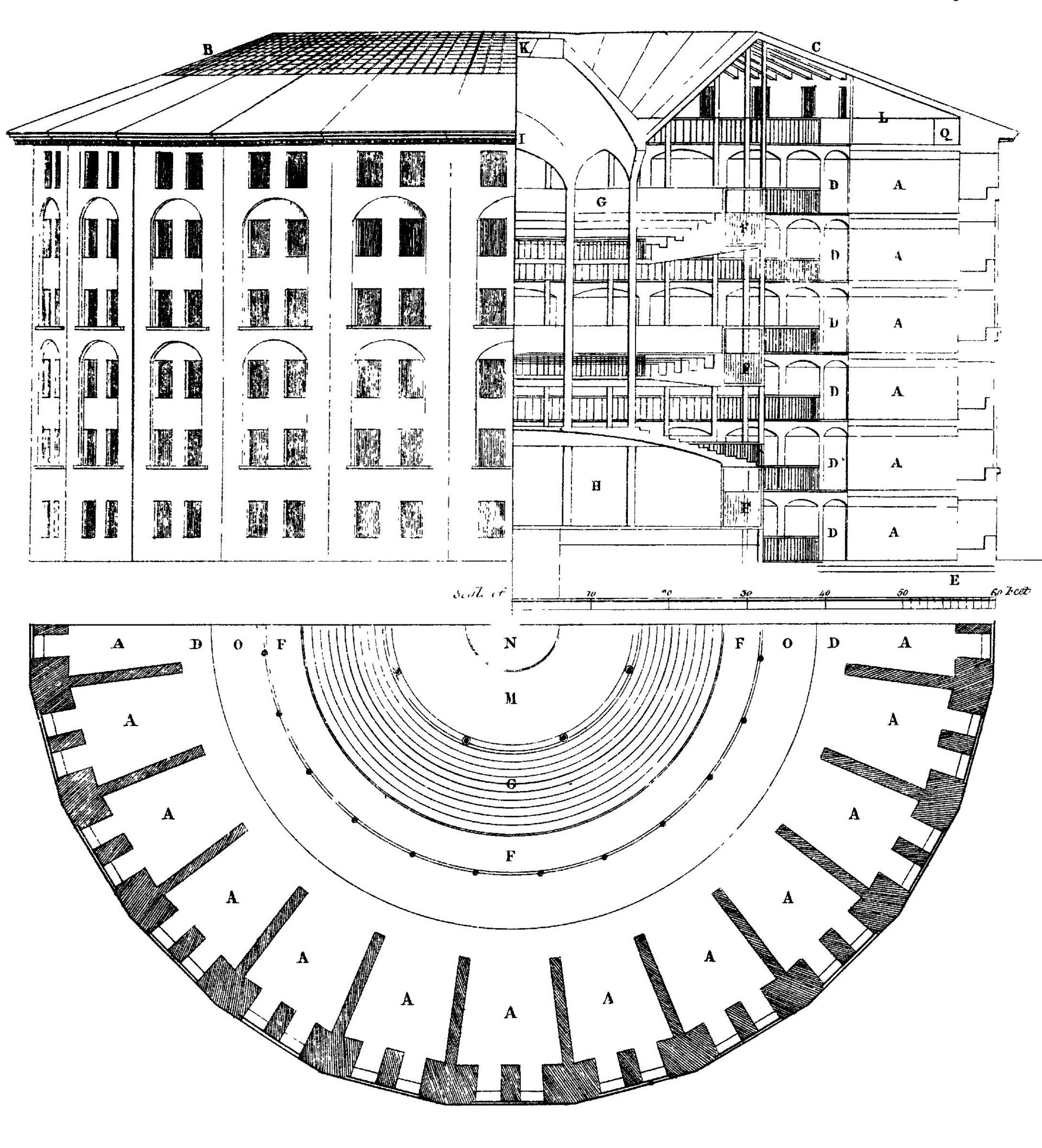
Willey Reveley's 1791 plan, drawn to Bentham's specifications. The geometry is the utilitarian argument: a radial layout reduces the labour of surveillance to one observer at the centre. Source: Wikimedia Commons (CC BY-SA 4.0).

Mill's On Liberty argues that society, not just the state, threatens liberty when it enforces conformity through public opinion ("the despotism of custom"), and that the only legitimate ground for coercion is preventing harm to others. His own example is the regulation of poisons: the state may require that they be sold with a label, but it may not forbid their sale to a competent adult who wants to die. Mill's higher and lower pleasures (poetry over pushpin) are widely read as a retreat from a strict hedonic calculus, and the standard objection is that ranking pleasures by quality smuggles a non-utilitarian standard back in.
Tocqueville's Democracy in America is built around close descriptions, not abstractions. The town meeting in New England, the role of jury service, the layered federalism of state and union, and the proliferation of voluntary associations are his concrete cases for how equality can be made compatible with liberty. His warning is that the same equality that liberates the citizen also lowers their tolerance for inequality of status, and that an administrative state stepping into that levelled space can leave a society "soft" and supervised rather than free.
Marx's argument in Capital vol. 1 is that profit under capitalism comes from surplus value: labour produces more than the wage paid for it, and the difference, appropriated by the capitalist, is the source of accumulation. The mechanism is structural rather than personal, which is why for Marx individual capitalists are not villains but functionaries of a system. The recurring objection is empirical: the labour theory of value has not survived the marginalist revolution in economics, and Marx's predictions about the immiseration of the working class were not borne out in the rich industrial democracies.
Weber's Protestant Ethic is the clearest case where his method differs from Marx's. Where Marx makes culture a reflection of the economic base, Weber treats the Calvinist doctrine of predestination, and the resulting anxious search for signs of election in worldly success, as one causal pathway by which a particular ascetic, accumulating attitude to work and money emerged in northwestern Europe. Weber explicitly says this is a historical pathway, not a universal cause; capitalism in Renaissance Italy or Tokugawa Japan needs different stories. The point is the method: parallel ideal-typical reconstructions of religion, economy, and authority, not a single base-and-superstructure model.
For the working logic of Weber's third authority type and why bureaucracy is its purest form, Iván Szelényi's Open Yale lecture on legal-rational authority (SOCY 151, Lecture 20, about 37 minutes) walks through the rule-bound character of modern administration and its relation to capitalism and socialism in more depth than this page can summarise.
Durkheim, working in a France still scarred by the Commune and the Dreyfus affair, asked what could replace the moral cohesion of pre-industrial communities once the division of labour had pulled people into specialised, interdependent roles. His answer is that interdependence itself, made visible by professional groups and civic morals, produces a new (organic) solidarity. Anomie is what happens when the rate of social change outruns the formation of these new norms, and his Suicide (1897) is the empirical companion: suicide rates rise where the regulating power of the group is weakest.
Hegel and Saint-Simon answer the same modern conditions from opposite poles. For Hegel, freedom is not the absence of constraint but the reflective endorsement of rational institutions; the constitutional monarchy with civil service and organised civil society is where individual will becomes universal. For Saint-Simon, the state's traditional offices are obsolete, and society now needs administration by those who understand production, finance, and science. The two prefigure the long argument between integrative ethical liberalism and technocratic managerialism.
Three live debates the period bequeathed
Utility vs. liberty. The debate between Bentham's principle of utility and Mill's harm principle is not really resolved. It returns in modern arguments about paternalism, consumer regulation, hate-speech law, and the limits of welfare provision. Modern rule-utilitarians, indirect utilitarians, and capability theorists are all attempts to keep something of the utilitarian framework while answering the distributional and rights-based objections that Mill himself was already wrestling with.
Equality vs. quality of public life. Tocqueville's worry that democratic equality might produce conformity and a soft despotism is the seed of the conservative case for civil society and the liberal case for institutional pluralism. Contemporary debates about populism, the public square, and the legitimacy of expert governance run downstream of his analysis, often without crediting it.
Class vs. status. Marx held that economic class (relations to the means of production) is the structurally fundamental cleavage and that other axes (status, prestige, political power) are derivative. Weber held that status (claims to honour, lifestyle, education) and power (capacity to realise one's will against resistance) are partially independent of economic class. The contemporary argument between economic-determinist and culture-first explanations of populist voting is a continuation of the Marx-Weber dispute.
References
- Jeremy Bentham, An Introduction to the Principles of Morals and Legislation (1789; 1823 reprint, archive.org). https://archive.org/details/introductiontopr0000bent
- John Stuart Mill, On Liberty (1859; Project Gutenberg edition). https://www.gutenberg.org/ebooks/34901
- John Stuart Mill, Utilitarianism (1861; Project Gutenberg edition). https://www.gutenberg.org/ebooks/11224
- John Stuart Mill, Considerations on Representative Government (1861; Project Gutenberg edition). https://www.gutenberg.org/ebooks/5669
- G. W. F. Hegel, Elements of the Philosophy of Right (1820; Dyde translation, archive.org). https://archive.org/details/philosophyofrigh0000hege
- Alexis de Tocqueville, Democracy in America, vol. 1 (1835; Project Gutenberg). https://www.gutenberg.org/ebooks/815
- Alexis de Tocqueville, Democracy in America, vol. 2 (1840; Project Gutenberg). https://www.gutenberg.org/ebooks/816
- Karl Marx and Friedrich Engels, The Communist Manifesto (1848; Project Gutenberg). https://www.gutenberg.org/ebooks/61
- Karl Marx, Capital, vol. 1 (1867; Marxists Internet Archive). https://www.marxists.org/archive/marx/works/1867-c1/
- Émile Durkheim, The Division of Labour in Society (1893; archive.org). https://archive.org/details/divisionoflabour00durk
- Max Weber, The Protestant Ethic and the Spirit of Capitalism (1905; archive.org). https://archive.org/details/protestantethics00webe
- Max Weber, Economy and Society (posthumous, 1922; archive.org). https://archive.org/details/MaxWeberEconomyAndSociety
- Thom Brooks, "Hegel's Social and Political Philosophy", Stanford Encyclopedia of Philosophy (2021, rev. 2025). https://plato.stanford.edu/entries/hegel-social-political/
- Sung Ho Kim, "Max Weber", Stanford Encyclopedia of Philosophy (2007, rev. 2022). https://plato.stanford.edu/entries/weber/