211. Politics in the Middle East
Learning outcomes
- When you read about a Middle Eastern crisis (an Arab uprising, an Iranian election, a Gulf monarchy's reform, a coup or counter-coup), you'll know to test the case against the standard frameworks (post-Ottoman state-system inheritance, rentier-state revenue, monarchy versus republic durability, civil-military relations, and sectarian and Islamist mobilisation) before reaching for an essentialist "Middle East exceptionalism" story.
The state system that wasn't designed to last
Most modern Middle Eastern borders date from the 1916-23 redrawing of Ottoman territory by Britain and France. The Sykes-Picot agreement (1916) divided the Arab provinces into British and French zones of influence; the San Remo conference (1920) translated those zones into League of Nations mandates; the Treaty of Sèvres (1920) and its replacement at Lausanne (1923) settled Anatolia on terms Atatürk's republic could accept.
Iraq and Jordan were created as British mandates, Syria and Lebanon as French, Palestine as a British mandate that would later partition into Israel and the West Bank and Gaza. Saudi Arabia and Iran were not redrawn but their borders were adjusted in the same period. The state system was not stable on arrival, and several of its component states have not become so since.
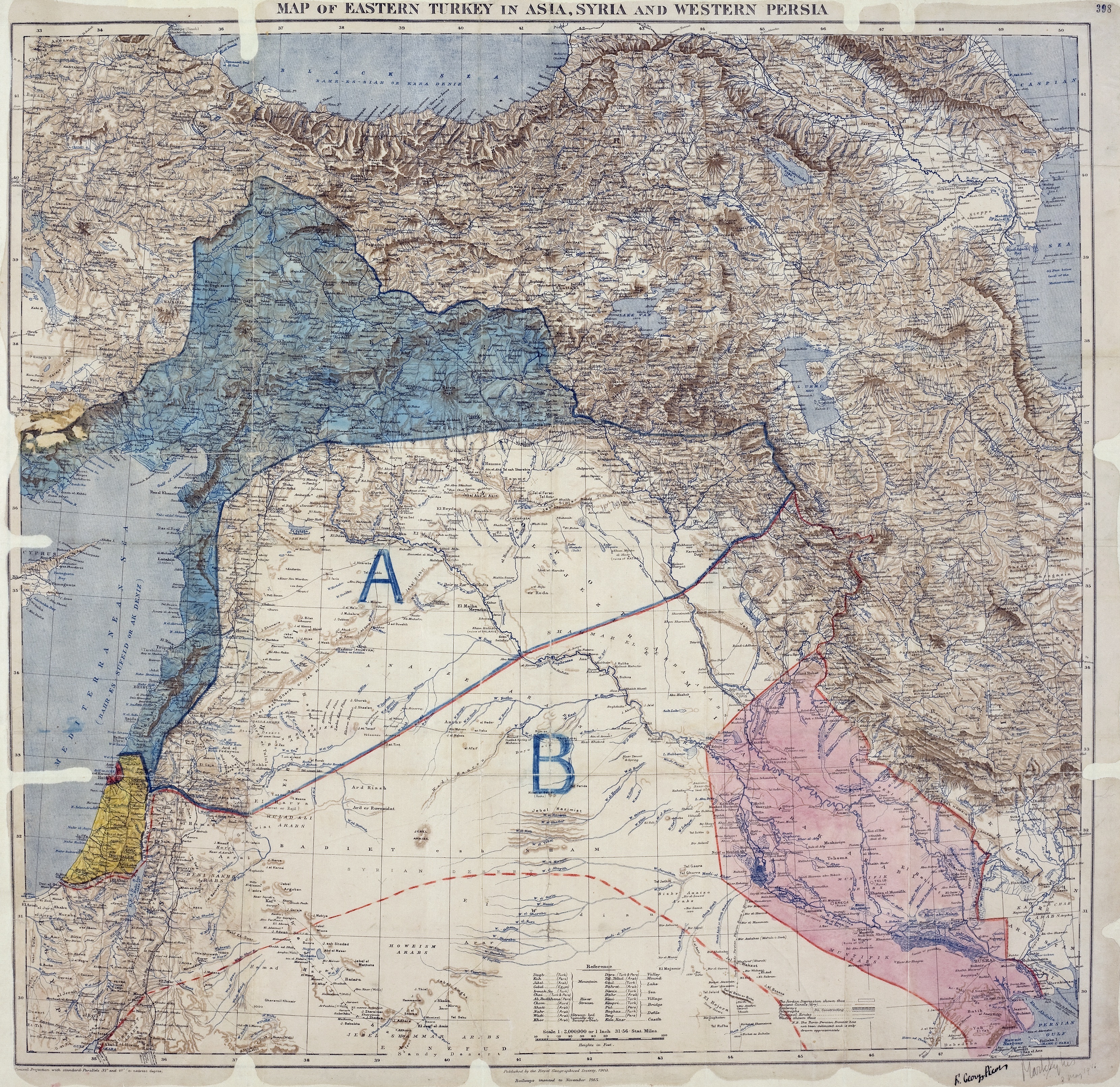
The 1916 map signed by Sykes and Georges-Picot. The coloured zones became the basis for the post-1920 mandates: Britain took the red and light-red south, France the blue and light-blue north, with the purple zone (Palestine) reserved for international administration. Source: UK National Archives MPK 1/426 via Wikimedia Commons, public domain.
The post-1945 wave of Arab nationalism (Nasser's Egypt, Ba'athism in Syria and Iraq, the FLN in Algeria) attempted to build secular republican states with strong militaries and modernising bureaucracies. The wave produced strong states but durably authoritarian ones. The Cold War froze the politics in place, with Soviet support for several republican regimes and US-British support for the monarchies and Israel. The end of the Cold War did not produce regional democratisation as it did in Europe and Latin America.
The resilient-monarchy puzzle
Lisa Anderson's 1991 article "Absolutism and the Resilience of Monarchy in the Middle East" identified the empirical puzzle that has shaped subsequent work. The Arab world's monarchies (Saudi Arabia, Jordan, Morocco, Oman, the UAE, Bahrain, Kuwait, Qatar) have proved markedly more durable than its republics (the late Mubarak's Egypt, Ben Ali's Tunisia, Saddam's Iraq, Assad's Syria, Gaddafi's Libya, the late-period Yemen). The 2010-12 Arab uprisings made the contrast sharp.
The leading explanations combine legitimacy (monarchies can claim traditional and religious authority that republican autocrats cannot), institutional flexibility (a monarch can sack a cabinet or convert to a more ceremonial role without ending the regime), and resource buffer (Gulf monarchies fund welfare and patronage at a scale republican autocracies cannot match, and the GCC bailed out Bahrain, Jordan, Morocco, and Oman during the protests). The thesis is contested. F. Gregory Gause's Kings for All Seasons (Brookings, 2013) argues that Saudi cash and the absence of a coordinating opposition matter at least as much as the regime form.
The rentier state and the resource curse
Hossein Mahdavy's 1970 chapter on Iran introduced the term rentier state: a state whose revenue comes mainly from external rents (oil, gas, transit fees, foreign aid) rather than from taxation of its own population. The political logic is direct: rulers who do not need their citizens' money do not need to bargain with them for it, so the fiscal exchange that historically produced representative institutions in early-modern Europe does not occur.
Public-sector employment, fuel subsidies, and free utilities buy compliance. Coercive capacity is funded without political cost.
Most Gulf states are pure rentier cases. Iran, Iraq, Algeria, and Libya are oil-rentier hybrids. Saudi Arabia derived around 70 percent of government revenue from hydrocarbons in 2023, and its citizens pay no personal income tax.
The empirical regularity (oil-rich states are systematically less democratic than otherwise-comparable non-oil states) is one of the strongest cross-country findings in comparative politics, formalised in Michael Ross's The Oil Curse (2012). The mechanism is contested between rentier theorists, who emphasise the no-taxation-no-representation channel, and modernisation critics, who note that the pattern weakens once one controls for development sequencing.
Civil-military relations and the coup
Outside the monarchies, the central political institution in much of the region is the army. Eva Bellin's 2004 article "The Robustness of Authoritarianism in the Middle East" framed the question. Why did regional militaries, unlike their Latin American or East European counterparts, refuse to step aside in the face of mass protest? Her answer turned on the coercive apparatus: well-funded (often by oil rents or US aid), institutionalised around regime survival rather than national defence, and lacking the corporate incentive to abandon a patron whose fall would expose the officer corps to prosecution.
The 2010-12 uprisings tested the framework. The Tunisian army stood aside and Ben Ali fell. The Egyptian army initially stood aside and Mubarak fell, then returned in the 2013 coup against the elected Morsi government and installed Sisi.
The Syrian army's Alawite-dominated officer corps held with Assad and turned the protest into civil war. The Bahraini royal family used the GCC's Peninsula Shield Force to crush the protest. The army's choice was the first variable in every case.
Islamism, sectarianism, and political Islam
Islamism is the family of movements arguing that Islamic principles should organise political life. The movements differ sharply on means. The Muslim Brotherhood, founded in Egypt in 1928, built mass-membership social services and contested elections where allowed; its short-lived 2012-13 Egyptian government under Mohamed Morsi was the first elected Islamist administration in the Arab world, and was overthrown by the Sisi coup.
The AKP in Turkey emerged from a similar political-Islamist current and chose electoral competition. Salafi-jihadist movements (al-Qaeda, the Islamic State) reject electoral politics entirely and pursue armed transformation. Olivier Roy's The Failure of Political Islam (1994) argued the elected Islamist project would dilute itself once in office; the post-2011 record is mixed, with the AKP entrenched and the Brotherhood outlawed.
The Sunni-Shia cleavage runs across these movements rather than parallel to them. Roughly 85-90 percent of the world's Muslims are Sunni, but Iran, Iraq, Bahrain, and Lebanon have Shia majorities or pluralities, and the regional rivalry between Saudi Arabia (Sunni) and Iran (Shia) frames much of the security politics. The Iran-aligned "axis of resistance" (Hezbollah in Lebanon, Iraqi Shia militias, the Houthis in Yemen, formerly Assad's Syria) and the Saudi-led counter-bloc fought proxy wars in Yemen, Syria, and Lebanon throughout the 2010s. Sectarian framing intensifies during regime crises but is rarely the deepest cause; politicians use it because it mobilises faster than economic or institutional appeals.
Iran, Israel, Turkey: three exceptional cases
Iran has run since 1979 on a hybrid theocratic-republican design. Elected president and parliament operate alongside a Supreme Leader (the velayat-e faqih) and clerical institutions (the Guardian Council, the Assembly of Experts) that vet candidates and hold effective veto power. Reformist and conservative factions compete within the regime; serious opposition outside it is suppressed (the 2009 Green Movement, the 2017-18 economic protests, the 2022 Mahsa Amini protests). The regime has survived four decades of US sanctions and a war with Iraq, on declining popular legitimacy.
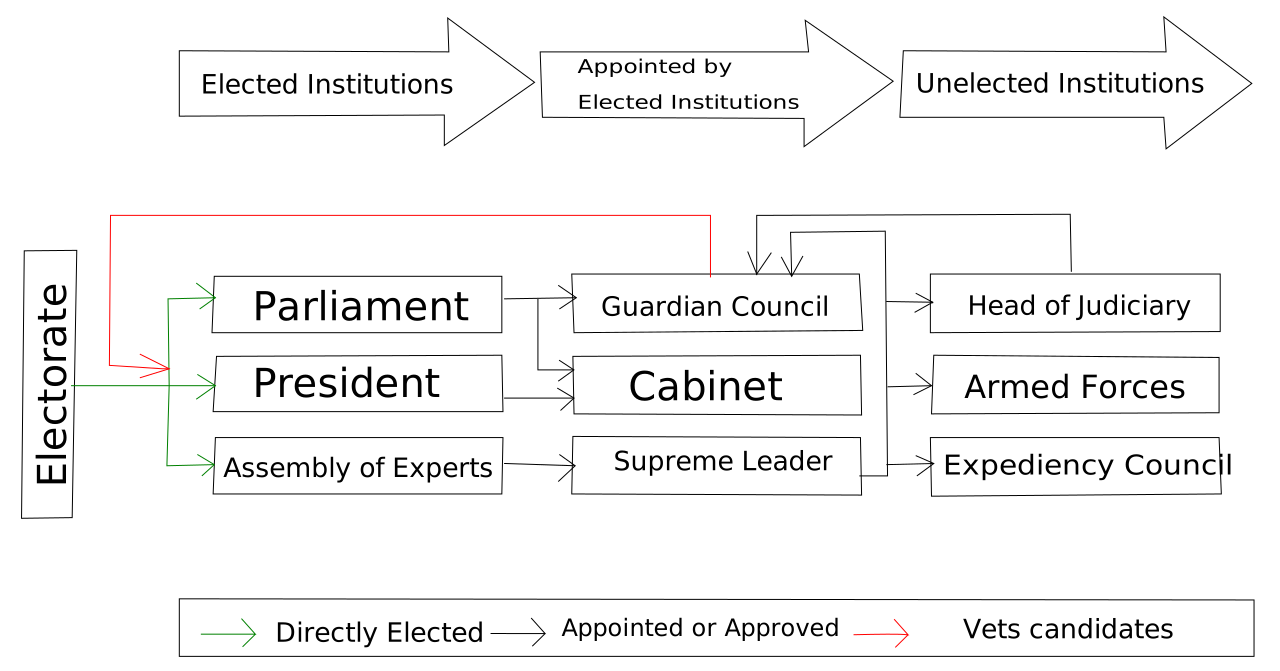
The Iranian system as a layered veto architecture. The Electorate elects Parliament, the President, and the Assembly of Experts. The Assembly of Experts elects the Supreme Leader, who appoints the Guardian Council, the head of the Judiciary, and the Armed Forces command, and whose Guardian Council in turn vets every candidate the Electorate may choose. "Operate alongside" understates the asymmetry: the unelected column appoints itself through the elected one. Source: Wikimedia Commons, CC BY-SA 4.0.
Israel is the region's only consistently liberal democracy and a difficult case for any region-essentialist account. Its democratic core covers Jewish citizens fully and Palestinian-Arab citizens with reduced effective influence; its rule over the West Bank and (formerly direct rule over) Gaza is not democratic and produces the central political tension. The 2023 judicial-overhaul crisis split the country along the question of unconstrained majoritarianism versus a court-checked system; the post-October-2023 war has stress-tested the political system in ways that are still unresolved.
Turkey under the AKP since 2003 has been the region's most-watched test of whether an Islamist-rooted party can govern within a democratic framework. The early AKP period produced economic reform and EU-accession progress. After the 2013 Gezi protests and the 2016 coup attempt, the trajectory turned majoritarian-authoritarian: judicial restructuring, press repression, the 2017 constitutional referendum that moved Turkey from parliamentary to presidential government. V-Dem and Freedom House classify it as electoral autocracy.
The 2010-12 uprisings and after
The wave began in Tunisia with the December 2010 self-immolation of Mohamed Bouazizi, spread to Egypt (Tahrir Square, January-February 2011), and reached Libya, Yemen, Syria, and Bahrain within weeks. Marc Lynch's The Arab Uprisings Explained (2014) traced the regional dimension: rapid spread was facilitated by transnational satellite media (Al Jazeera) and a shared protest vocabulary, even where local conditions differed.
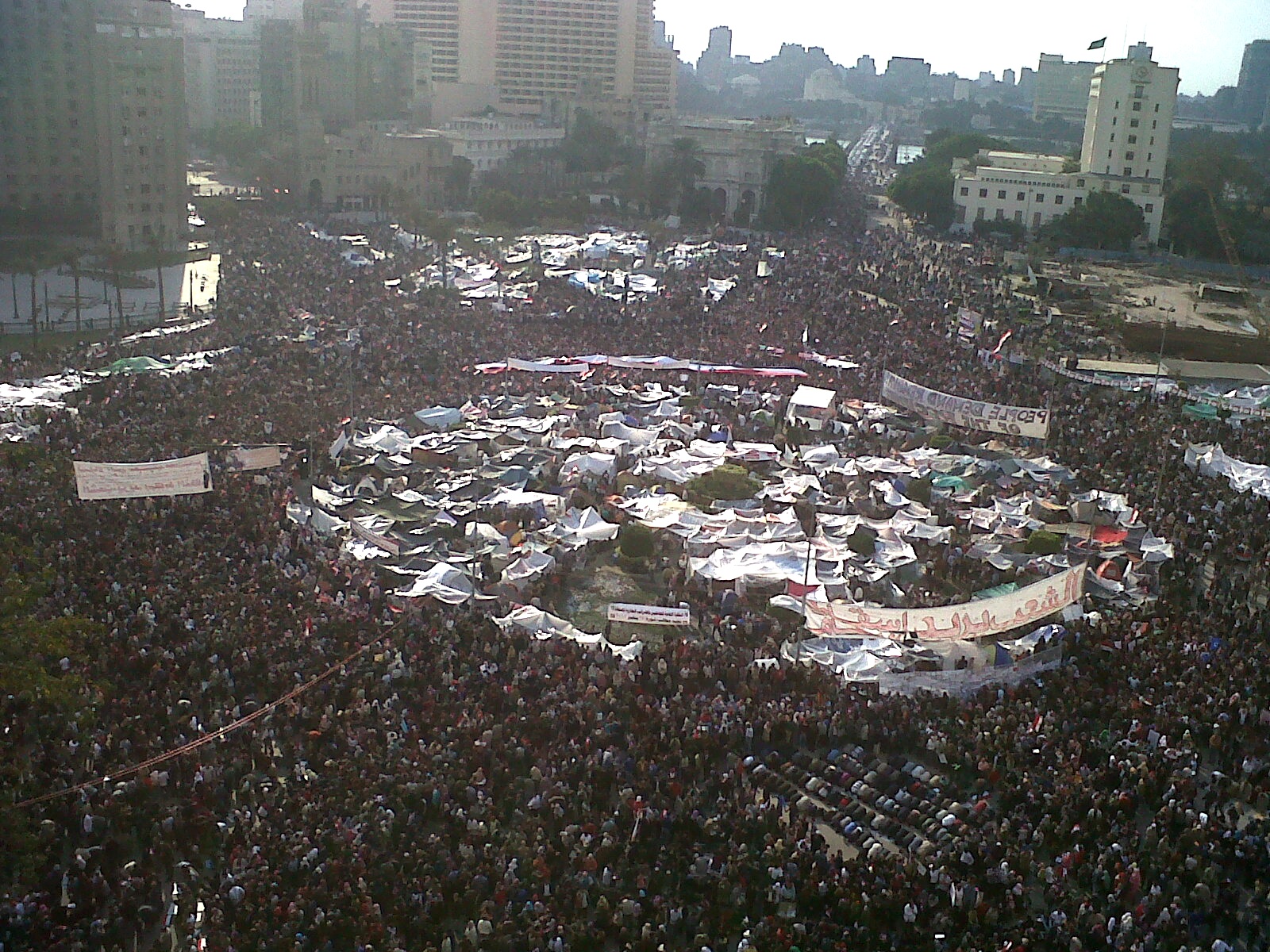
Tahrir Square on 8 February 2011, three days before Mubarak resigned on 11 February. The crowd is the political fact: it held the square for eighteen days against police, plainclothes attackers, and the Battle of the Camels (2 February), and it was the army's reading of this density that produced the decision to ease Mubarak out. Source: photograph by Mona, via Wikimedia Commons, CC BY 2.0.
The outcomes varied sharply. Tunisia produced the only durable democratic transition in the Arab world, though its democracy has eroded since 2021 under President Kais Saied. Egypt democratised briefly under Morsi (2012-13) and then reverted under the Sisi coup to harder authoritarianism than Mubarak's. Libya, Yemen, and Syria collapsed into civil wars that are still partly unresolved. Bahrain's protest was suppressed with Saudi military assistance.
The lesson the field has drawn: institutional preconditions for democratic consolidation, especially the army's incentives and the strength of civil society, matter more than the heroism of the protest moment.
References
- Albert Hourani, A History of the Arab Peoples (Harvard, 1991; updated 2002). The standard one-volume history of the Arab world. https://archive.org/details/historyofarabpeo0000hour
- Lisa Anderson, "Absolutism and the Resilience of Monarchy in the Middle East", Political Science Quarterly 106, no. 1 (1991). The puzzle of monarchy's relative durability. https://academic.oup.com/psq/article/106/1/1/7135426
- Eva Bellin, "The Robustness of Authoritarianism in the Middle East", Comparative Politics 36, no. 2 (2004). The coercive-apparatus account of why regional militaries did not stand aside. https://doi.org/10.2307/4150140
- Marc Lynch (ed.), The Arab Uprisings Explained: New Contentious Politics in the Middle East (Columbia, 2014). The standard scholarly account of 2010-12 and its aftermath. https://cup.columbia.edu/book/the-arab-uprisings-explained/9780231158848
- Michael L. Ross, The Oil Curse: How Petroleum Wealth Shapes the Development of Nations (Princeton, 2012). The leading book-length treatment of the oil-and-democracy regularity. https://press.princeton.edu/books/paperback/9780691159638/the-oil-curse
- Hossein Mahdavy, "Patterns and Problems of Economic Development in Rentier States: The Case of Iran", in M. A. Cook (ed.), Studies in the Economic History of the Middle East (Routledge, 1970). The original rentier-state formulation. https://en.wikipedia.org/wiki/Rentier_state
- Olivier Roy, The Failure of Political Islam (Harvard, 1994; original French 1992). The standard text on political Islam's transformation when it meets state power. https://archive.org/details/failureofpolitic00royo
- Steven Levitsky and Lucan A. Way, "Elections Without Democracy", Journal of Democracy 13, no. 2 (2002). The competitive-authoritarian framework that fits Turkey and Egypt under Sisi. https://www.journalofdemocracy.org/articles/elections-without-democracy-the-rise-of-competitive-authoritarianism/
- Arab Barometer. Cross-country survey of political and social attitudes in Arab states. https://www.arabbarometer.org/
- V-Dem Institute, Varieties of Democracy. Cross-country measures including the post-2013 Turkey reclassification. https://www.v-dem.net/about/v-dem-project/