210. Politics in South Asia
Learning outcomes
- When a South Asian country makes the news for an election, a constitutional crisis, or communal violence, you'll know how to read the event as a product of three things working together (the cleavage being mobilised, the institutional inheritance being used or bent, and the political-economy context behind both) instead of reaching for a pan-regional or culturalist story.
India: a democracy that should not have worked
In 1947 India was poor, mostly illiterate, deeply divided by religion, language, caste, and region, and had no continuous democratic tradition. Modernisation theory predicted it would not last. It has now run nearly eighty years of competitive elections with regular alternation in power.
Sunil Khilnani's The Idea of India (1997) traced the answer to the founding settlement: a strong central state, formally secular and federal, with a constitution drafted under B. R. Ambedkar that combined parliamentary government, an independent judiciary, and reservations for Scheduled Castes and Tribes. Congress under Nehru ran a broad coalition that kept the cleavages from organising into separate national parties. When that dominance ended in 1989, what replaced it was coalition politics, not collapse.
The picture changed after 2014. Under Narendra Modi the BJP centralised power against opposition state governments, abrogated Article 370 in 2019 to strip Jammu and Kashmir of its special status, and passed the Citizenship Amendment Act the same year, fast-tracking citizenship for non-Muslim refugees from neighbouring states. Christophe Jaffrelot's Modi's India (2021) reads this as a regime shift toward "ethnic democracy", not partisan rotation. V-Dem reclassified India as an electoral autocracy in 2021. Whether this is permanent backsliding or a new equilibrium future alternation could correct is contested.
Pakistan: civilian-military oscillation
Pakistan inherited the same Westminster constitutional template as India in 1947, but the institutional balance went a different way. The country has spent roughly half its post-1947 history under direct military rule (Ayub 1958-69, Yahya 1969-71, Zia 1977-88, Musharraf 1999-2008) and the rest under civilian governments operating within constraints set by the army's "establishment". Civilian leaders are no longer usually removed by formal coup. They are pressured, prosecuted, or replaced through judicial intervention while the army denies direct involvement.
The structural drivers compound. Pakistan was conceived as a state for Muslims of the subcontinent but its political identity has never been settled: Bengali secession in 1971 produced Bangladesh, sectarian Sunni-Shia tension persists, the Punjabi-dominant ethnic balance remains contested, and Balochistan and Khyber Pakhtunkhwa have ongoing insurgencies. External security pressure (the Kashmir dispute, the Afghanistan border, the on-again-off-again US alliance) has reinforced the military's centrality. The PML-N-led government formed after the 2024 election, from which Imran Khan's PTI was largely excluded, is one more turn of this cycle.
Bangladesh: development and democratic narrowing
Bangladesh emerged from the 1971 war with weak state capacity and per-capita income lower than most of sub-Saharan Africa. The development trajectory since has been striking: female labour-force participation, child mortality, fertility, and literacy have all moved faster than India's on most measures, partly through NGOs (BRAC, Grameen) operating alongside the state. The garment industry made Bangladesh the world's second-largest apparel exporter.
The political trajectory has been less encouraging. Sheikh Hasina's Awami League dominated 2009-2024 through institutional capture and electoral manipulation in the competitive-authoritarian pattern. The August 2024 student-led uprising forced Hasina from office and into exile. An interim government under Muhammad Yunus has run the country since. The open question is whether the post-Hasina settlement consolidates a more competitive politics or oscillates back toward dynastic-party dominance.
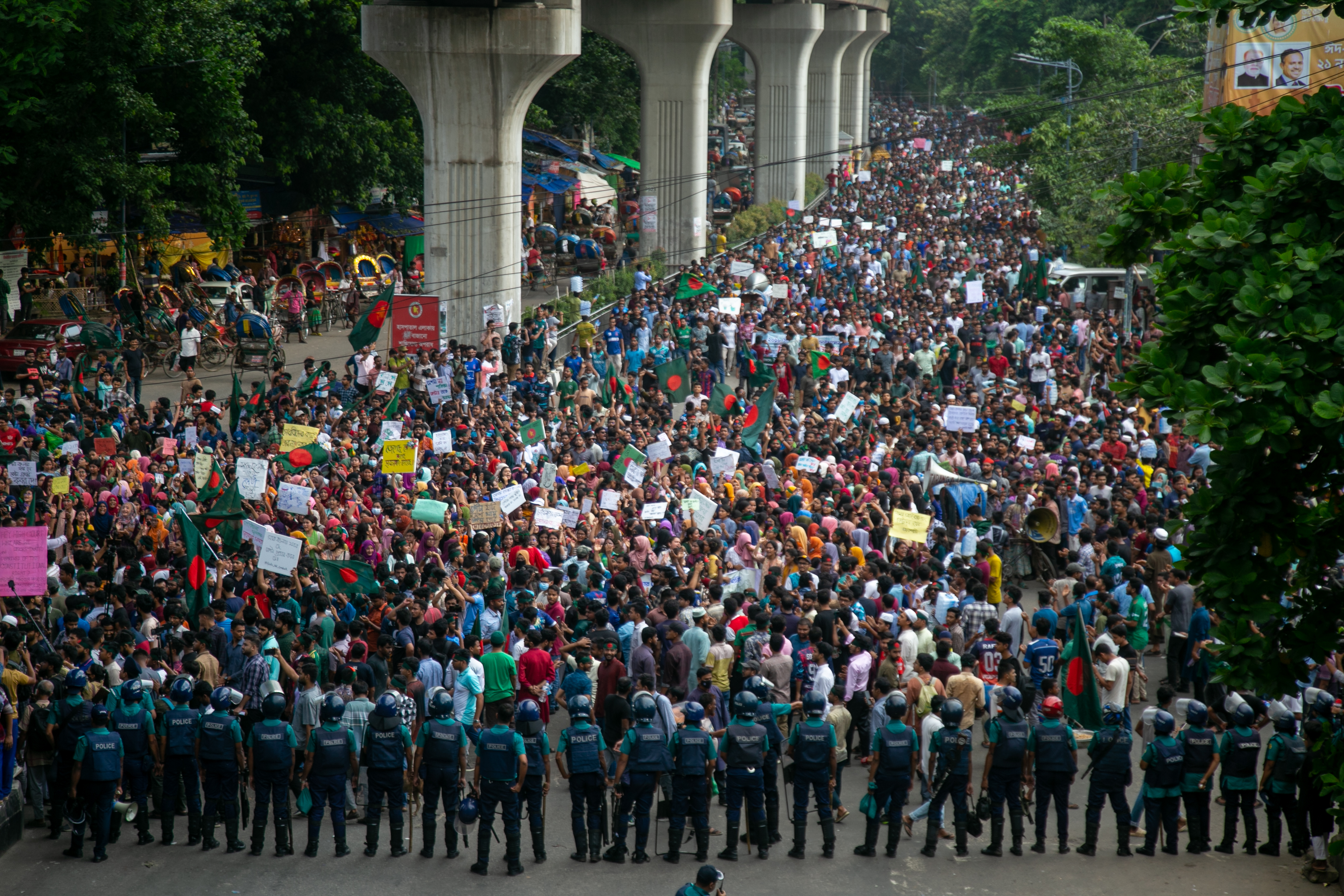
The Bangla Blockade at Shahbag Square, Dhaka, 6 July 2024. Photo: Rayhan Ahmed, Wikimedia Commons, CC BY-SA 4.0.
Sri Lanka and the long ethnic conflict
Sri Lanka inherited a Westminster constitution and a Sinhalese-Buddhist majority alongside a substantial Tamil minority concentrated in the north and east. The 1948 Ceylon Citizenship Act disenfranchised Indian-origin Tamil estate workers; the 1956 Sinhala Only Act made Sinhala the sole official language. These choices, together with the constitutional centralisation of the 1970s, eventually produced the LTTE insurgency, the 1983 anti-Tamil pogrom, and a 26-year civil war that ended with the LTTE's military defeat in 2009 at high civilian cost.
Post-war politics has not resolved the underlying federal question. The Rajapaksa political family dominated the 2010s. The 2022 Aragalaya protest movement, triggered by economic collapse, forced Gotabaya Rajapaksa from office. The 2024 election of Anura Kumara Dissanayake (a JVP leftist on a coalition platform) broke with the Rajapaksa-Wickremesinghe duopoly that had defined two decades. Whether the new government addresses devolution to the Tamil-majority north and east is the next test.
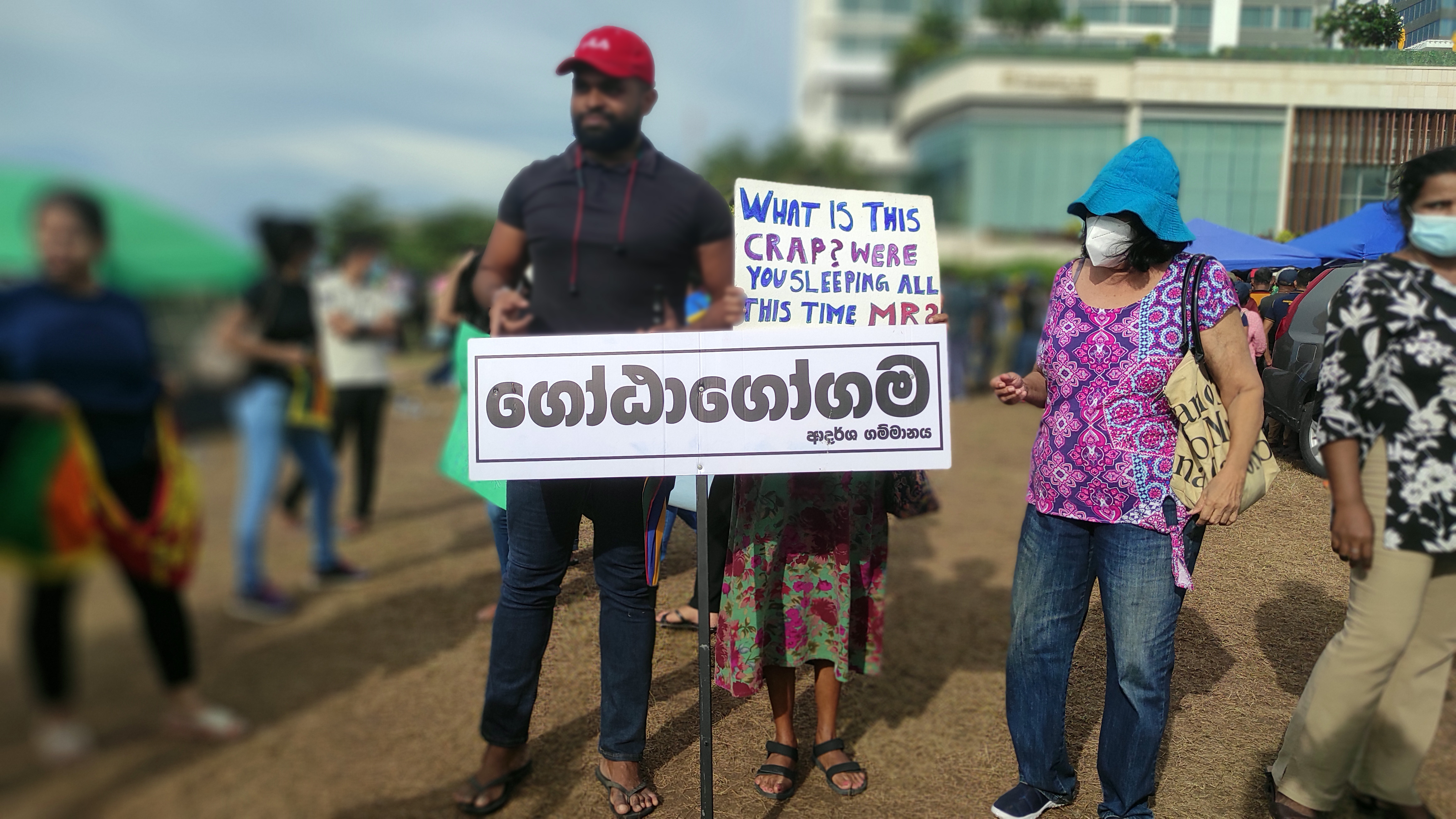
Gotagogama ("Gota Go Village"), Colombo, 13 April 2022. Photo: AntanO, Wikimedia Commons, CC BY-SA 4.0.
Nepal: from monarchy to federal republic
Nepal sits inside the South Asian frame but on a sharply different trajectory. The country was a Hindu monarchy until very recently. A Maoist insurgency from 1996 to 2006 displaced the state across much of the countryside, killed about 17,000 people, and ended in a peace agreement that brought the Maoists into electoral politics. The monarchy was abolished in 2008. A federal secular republican constitution was promulgated in 2015 against opposition from Madhesi groups in the southern plains, who argued the federal map was drawn to dilute their representation.
Nepal's politics now runs through unstable coalitions among three large parties (Nepali Congress, the CPN-UML, and the former-Maoist CPN, now reconfigured several times). External relations are dominated by the squeeze between India and China, with successive governments tilting toward whichever offers the better terms on infrastructure, trade, or border disputes. The constitutional question (how much autonomy the seven federal provinces actually exercise) remains live.
How the five democracies have moved
The Electoral Democracy Index, V-Dem's measure of free-and-fair contestation and inclusive suffrage, gives a single line per country to compare against. The picture is not uniform. India fell from above 0.7 in the 2000s to below 0.4 by the mid-2020s. Bangladesh slid through the Hasina years and again sharply in 2024. Pakistan rose post-Musharraf and has fallen since 2018. Sri Lanka rebounded after the LTTE-era trough and again sharply after 2022. Nepal climbed through the post-monarchy transition and has held relatively high. Reading the region as one story (rising Hindu nationalism, falling democracy) misses Nepal and Sri Lanka entirely.
The cross-cutting political economy
South Asia's political economy has been shaped by three forces. Statist development dominated the first generation: India's planning under Nehru, Pakistan's earlier liberalisation, Sri Lanka's import substitution. Liberalisation from the late 1980s reset growth: India's 1991 reforms, Bangladesh's gradual opening, Sri Lanka's earlier opening. Cross-border integration, especially of supply chains and IT-enabled services in India, produced an export-oriented growth model that pulled hundreds of millions out of extreme poverty without closing intra-regional gaps.
External alignment matters in distinct ways. India is the regional hegemon by size but not by influence: Pakistan, Sri Lanka, Nepal, and the Maldives have each tilted toward China at points, and the Belt and Road Initiative reshaped Sri Lanka's debt position. India's relations with the United States have warmed in the China-balancing era. Bangladesh straddles both. Pakistan remains aligned with China and at odds with the United States since the Afghanistan withdrawal.
References
- Sunil Khilnani, The Idea of India (Penguin, 1997). The classic post-independence reading of India's democratic founding. https://archive.org/details/ideaofindia0000khil
- Atul Kohli, Poverty Amid Plenty in the New India (Cambridge, 2012). On post-1991 Indian political economy. https://www.cambridge.org/core/books/poverty-amid-plenty-in-the-new-india/679FEE501B16C022435F8F59BCE5DDB5
- Christophe Jaffrelot, Modi's India: Hindu Nationalism and the Rise of Ethnic Democracy (Princeton, 2021). The leading account of post-2014 Indian politics. https://press.princeton.edu/books/hardcover/9780691206806/modis-india
- Ayesha Jalal, The State of Martial Rule: The Origins of Pakistan's Political Economy of Defence (Cambridge, 1990). The structural account of Pakistan's civilian-military balance. https://archive.org/details/stateofmartialru00jala
- Naomi Hossain, The Aid Lab: Understanding Bangladesh's Unexpected Success (Oxford, 2017). On Bangladesh's development trajectory. https://academic.oup.com/book/7707
- Paul R. Brass (ed.), Routledge Handbook of South Asian Politics: India, Pakistan, Bangladesh, Sri Lanka, and Nepal (Routledge, 2010). Standard regional handbook covering the five-state frame. https://www.routledge.com/Routledge-Handbook-of-South-Asian-Politics-India-Pakistan-Bangladesh-Sri-Lanka-and-Nepal/Brass/p/book/9780415716499
- Lokniti / Centre for the Study of Developing Societies. Leading public-opinion data source on South Asia. https://www.lokniti.org/
- V-Dem Institute, Varieties of Democracy. Cross-country measures including the post-2014 reclassification of India. https://www.v-dem.net/about/v-dem-project/