213. International Relations in the Era of the Cold War
Learning outcomes
- When you read about a Cold War episode (Berlin, Korea, Cuba, Vietnam, Prague, Helsinki, Afghanistan, 1989), you'll know to ask three questions in order: where the bipolar superpower contest is pushing, what the nuclear stand-off rules in or out, and which regional or domestic actors are using the contest for their own ends.
How the bipolar order formed
The wartime alliance dissolved between 1945 and 1948 over the political fate of Central and Eastern Europe. By 1948 the Soviet Union held effective control of Poland, Czechoslovakia, Hungary, Romania, Bulgaria, and the eastern zone of Germany, and Washington had decided that further Soviet expansion required containment.
George Kennan's 1946 "Long Telegram" and his 1947 Foreign Affairs article (signed "X") supplied the strategic frame: long, patient, firm pressure until the system's own contradictions wore it down. Kennan's claim was descriptive as much as prescriptive. Soviet conduct, he argued, was driven by the need for an external enemy to legitimate internal repression, so the West did not need to provoke the regime; it needed to outlast it.
The institutional architecture that followed was symmetrical. On the Western side: NATO (1949) for collective defence, the Marshall Plan (1948) for reconstruction, the Bretton Woods system for monetary order, and the European Coal and Steel Community (1951) and EEC (1957) for Franco-German reconciliation. On the Eastern side: the Warsaw Pact (1955), COMECON (1949) for economic integration on Soviet terms, communist parties under Moscow's discipline, and the Sino-Soviet alliance until the late 1950s.
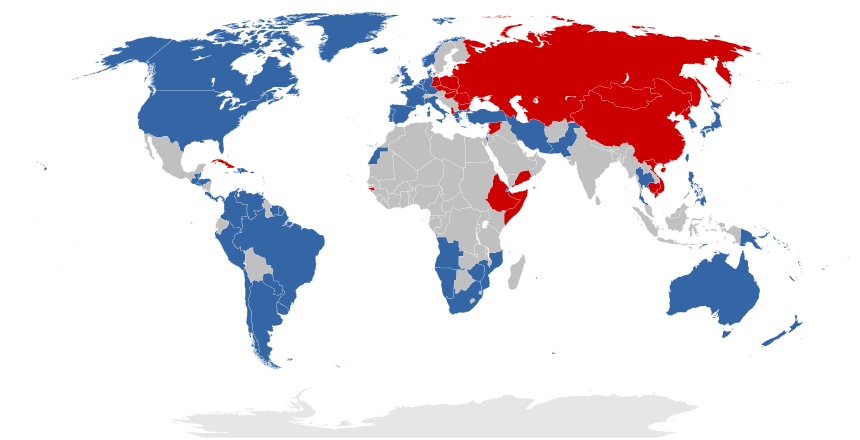
Bloc geography in mid-1975, after détente had fixed the lines but before the late-1970s breakdown. Source: Vorziblix on Wikimedia Commons (CC0).

Berlin concentrated the dispute. The 1948-49 Blockade and Airlift was the first hot test of containment; Berlin's status remained the focal point through the 1958-61 Crisis (which produced the Wall) and into the détente period. The German question, whether and on what terms a unified Germany was acceptable to its neighbours East and West, was the central European question for the whole era.
Nuclear deterrence and the framing of conflict
The Soviet Union's 1949 test ended the American monopoly. By the early 1960s both sides had thermonuclear weapons and the missile delivery to use them, and the doctrine of mutual assured destruction (MAD) followed. MAD imposed a discipline that earlier great-power rivalries lacked: direct US-Soviet war was effectively ruled out, since neither side could credibly threaten escalation without ensuring its own destruction. Robert Jervis later called this the "nuclear revolution", and argued that the leaders who lived under it spent forty years half-acting as if it were not real, building first-strike capacity and damage-limitation plans whose only honest purpose was reassurance.
The discipline operated through proxies. Korea (1950-53), Vietnam (1955-75), the Middle East wars (1948, 1956, 1967, 1973), the Soviet war in Afghanistan (1979-89), and civil wars in Angola, Mozambique, Ethiopia, Nicaragua, and El Salvador were contests for regional influence in which both superpowers supplied weapons and money but rarely committed troops to fight each other. The Cuban Missile Crisis (October 1962) was the closest the bipolar order came to direct nuclear war. Both sides took the lesson. The Moscow-Washington hotline (1963), the Limited Test Ban Treaty (1963), the Nuclear Non-Proliferation Treaty (1968), and the SALT I and Anti-Ballistic Missile treaties (1972) followed; arms control became the diplomatic spine of the relationship for the next two decades.
Eastern bloc revolts and the Sino-Soviet split
Containment was the Western frame. Inside the Soviet sphere, the recurring problem was popular and intra-party challenge to Moscow's discipline. Yugoslavia broke with Stalin in 1948 and pursued a separate path under Tito; East Berlin workers rose in 1953 and Soviet tanks put the rising down.
Hungary's 1956 reform attempt under Imre Nagy (announcing withdrawal from the Warsaw Pact and a multi-party system) was crushed by Soviet intervention, with around 2,500 Hungarians killed. Czechoslovakia's 1968 "Prague Spring" under Alexander Dubček ("socialism with a human face") was ended by Warsaw Pact invasion. Leonid Brezhnev's justification, that socialist states owed the bloc a duty to preserve socialism against counter-revolution, was named the Brezhnev Doctrine and became the licence for further intervention until Mikhail Gorbachev publicly retired it in 1988.
The Sino-Soviet alliance fractured in parallel. Mao Zedong rejected Khrushchev's 1956 denunciation of Stalin and the policy of peaceful coexistence with the United States; ideological polemics through the late 1950s gave way to border clashes on the Ussuri river in 1969. The split mattered because it broke the assumption that the communist world was a single strategic bloc. Richard Nixon and Henry Kissinger exploited the opening: Nixon's 1972 visit to Beijing, and the partial US tilt toward China, gave Washington leverage over Moscow that it used in the same year's SALT and ABM negotiations.
Decolonisation and the Global South
The Cold War overlapped with the decolonisation of Asia, Africa, and the Caribbean, from Indian and Pakistani independence in 1947 to the Portuguese colonies in the late 1970s. The two superpowers competed for influence in the new states. The 1955 Bandung Conference convened the Asian and African states that wanted to escape the bipolar logic, and gave rise to the Non-Aligned Movement under Nehru, Nasser, Tito, Sukarno, and Nkrumah. In practice non-alignment was uneven: some states (India, Yugoslavia) maintained genuine balance, while others (Egypt under Nasser after 1955, Cuba after 1961, Angola and Ethiopia after independence) tilted decisively toward Moscow when local circumstances and superpower offers aligned.
Odd Arne Westad's argument is that the Third World was the primary theatre of the Cold War, not a secondary one. Most of the killing happened there: an estimated 20 million dead in Cold-War-era Third World conflicts, against essentially no direct US-Soviet combat. Local actors used the contest as much as it used them. Castro extracted Soviet protection. The Vietnamese Workers' Party extracted Chinese and Soviet aid against the United States and then, by the late 1970s, against each other.
In the 1970s the Group of 77 used the UN General Assembly to demand a New International Economic Order with fairer commodity terms, technology transfer, and reform of the Bretton Woods institutions. The 1973 OPEC oil shock briefly looked like a Southern leverage moment. The 1982 Mexican default and the subsequent Latin American debt crisis destroyed it. The IMF and World Bank became the de facto governance bodies for indebted developing economies through the 1980s structural-adjustment programmes (currency devaluation, public-spending cuts, trade liberalisation, privatisation), an outcome the New International Economic Order had been designed to prevent.
European integration as Cold War child
The European Economic Community (1957) began as a Cold War device. Franco-German reconciliation was a US strategic priority (defeated Germany had to be re-integrated to anchor the western half of the continent), and the supranational institutions (the High Authority of the ECSC, then the Commission) constrained German economic recovery without preventing it. Western European integration deepened, through the Treaty of Rome and the Single European Act of 1986, inside the security umbrella that NATO provided.
The British position stayed ambivalent. The original 1950s preference for an Atlantic and Commonwealth orientation gave way (EFTA 1960, EEC entry 1973, the 1975 referendum confirming membership), but the deeper question, whether the project aimed at a federal endpoint or a permanent intergovernmental compromise, was left for the post-Cold-War era.
Détente, Helsinki, and the Second Cold War
The 1969-79 decade of détente was the era's high point of explicit superpower management. Willy Brandt's Ostpolitik (German treaties with the Soviet Union, Poland, and East Germany, 1970-72) traded West German recognition of the post-1945 borders for working relations across the Iron Curtain. Nixon and Brezhnev signed SALT I and the ABM Treaty in 1972. The Helsinki Final Act of 1975 gave Moscow what it wanted (Western recognition of the existing European borders) in exchange for a third "basket" of human-rights commitments, which proved load-bearing in ways the Soviet negotiators did not anticipate: groups like Charter 77 in Czechoslovakia and the Helsinki Watch committees inside the Soviet Union used Helsinki language to pressure their own governments.
Détente broke down at the end of the 1970s. The Soviet deployment of SS-20 intermediate-range missiles in Europe (from 1976), the December 1979 invasion of Afghanistan, the 1980 boycott of the Moscow Olympics, and the election of Ronald Reagan re-froze the relationship. Reagan's first term ran a sharper line: a large defence build-up, support for anti-communist insurgencies in the Third World (the Reagan Doctrine), the 1983 Strategic Defense Initiative, and the deployment of NATO Pershing II and Ground-Launched Cruise Missiles to counter the SS-20s. Bruce Cumings and others labelled this stretch the "Second Cold War".
The thaw came faster than anyone expected. The 1987 Intermediate-Range Nuclear Forces Treaty eliminated an entire class of weapons; Reagan and Gorbachev's four summits between 1985 and 1988 prepared the ground for what 1989 became.
How the Cold War ended
The causes of the Soviet collapse stack. Economic stagnation through the 1970s undermined the credibility of central planning, and military spending pushed past 15% of Soviet GDP on most estimates. The Polish Solidarity movement (1980) showed that Eastern bloc societies could mobilise against their own parties at scale, and the Afghanistan war drained Soviet resources and prestige. The 1986 Chernobyl disaster shook the regime's confidence in its technical capacity and in its own propaganda.
Gorbachev's reforms from 1985 (perestroika restructuring the economy, glasnost opening political speech, novoye myshleniye "new thinking" abandoning class struggle as a foreign-policy frame) were intended to revitalise the system inside the Soviet framework. They accelerated its collapse.
The 1989 wave of revolutions in Poland, Hungary, East Germany, Czechoslovakia, Bulgaria, and Romania followed Gorbachev's decision not to use force in defence of communist client regimes (the so-called "Sinatra Doctrine", a public retirement of the Brezhnev one). The Berlin Wall fell in November 1989. German reunification, on terms negotiated by the four wartime occupying powers plus the two Germanies, followed in October 1990.
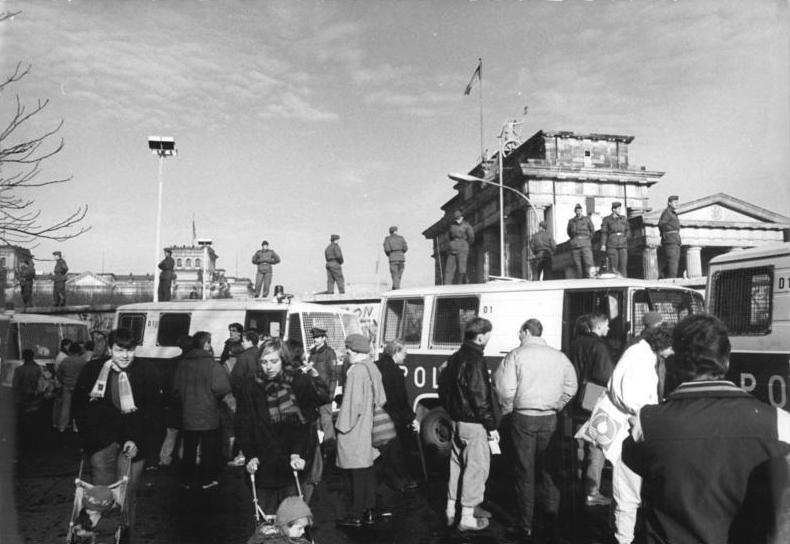
West Berlin police push back roughly a thousand people at the Brandenburg Gate, 11 November 1989. The original Bundesarchiv caption records authorities scrambling to manage what neither government had organised. Photograph by Peer Grimm. Source: Bundesarchiv via Wikimedia Commons (CC-BY-SA 3.0 DE).

The Soviet Union itself dissolved in December 1991 after the August coup against Gorbachev failed and Boris Yeltsin's Russian Federation moved decisively against the Union. The bipolar order ended without the great-power war that almost every IR realist of the 1980s had predicted, an outcome neorealism still does not have a confident explanation for.
References
- John Lewis Gaddis, The Cold War: A New History (Penguin, 2005). The standard contemporary one-volume narrative. https://www.penguinrandomhouse.com/books/293667/the-cold-war-by-john-lewis-gaddis/
- George F. Kennan ("X"), "The Sources of Soviet Conduct", Foreign Affairs (July 1947). Full text on Wikisource. https://en.wikisource.org/wiki/The_Sources_of_Soviet_Conduct
- Odd Arne Westad, The Global Cold War: Third World Interventions and the Making of Our Times (Cambridge University Press, 2005). The Third World as the era's primary theatre. https://www.cambridge.org/core/books/global-cold-war/75870878657DC67E0BC70FA7D2388494
- Robert Jervis, The Meaning of the Nuclear Revolution: Statecraft and the Prospect of Armageddon (Cornell University Press, 1989). On nuclear deterrence and its strategic logic. https://openlibrary.org/works/OL2620296W/The_meaning_of_the_nuclear_revolution
- Mary Elise Sarotte, 1989: The Struggle to Create Post-Cold War Europe (Princeton University Press, 2009; updated edition 2014). On the diplomacy of German reunification and the post-1989 settlement. https://press.princeton.edu/books/paperback/9780691163710/1989
- Wilson Center, Cold War International History Project. Open archive of declassified documents from all sides of the Cold War. https://www.wilsoncenter.org/program/cold-war-international-history-project