208. Politics in Sub-Saharan Africa
Learning outcomes
- When a headline reports on an African election, a coup, or a development failure, you'll know how to read it against the frames the field actually uses (the bifurcated colonial state, neopatrimonial rule, institutionally-produced ethnic mobilisation, the resource curse, external patronage) before settling for the implicit "this country is uniquely broken" story.
The colonial inheritance
The borders of nearly every contemporary sub-Saharan African state were drawn at the 1884-85 Berlin Conference by European powers with no reference to existing political units, ethnic distributions, or geography. Independence movements in the 1950s and 60s inherited those borders almost untouched, partly to avoid territorial wars. The result is the basic constraint of African politics: most states contain several long-standing communities that had no shared political institutions before, and few states correspond to a pre-colonial nation.
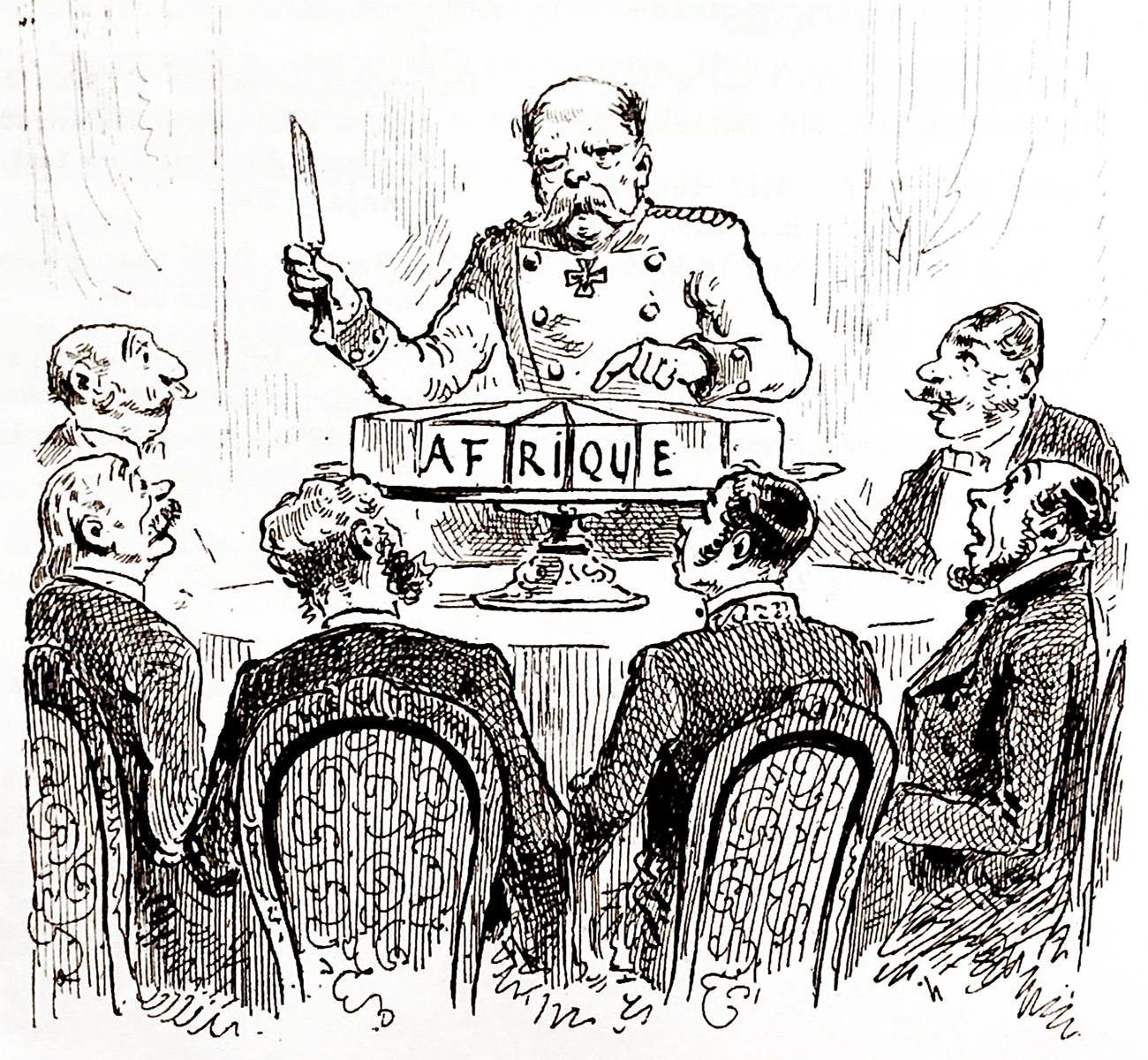
L'illustration, January 3, 1885: Bismarck cuts the Africa cake during the Berlin Conference. The casualness of the contemporary European framing is itself the point. Source: Wikimedia Commons (CC0).
Mahmood Mamdani's Citizen and Subject (1996) named the deeper structural inheritance: the bifurcated state. Colonial powers governed cities through European-style civil law (citizens with rights) and rural areas through the indirect rule of "customary" chiefs whose authority was created or reinforced by colonial fiat (subjects without civil rights). The bifurcation persisted past independence: postcolonial states kept the urban-civil/rural-customary split, which has shaped land tenure, ethnic identity, and the political distance between capitals and rural majorities.
The first generation of postcolonial leaders (Nkrumah in Ghana, Nyerere in Tanzania, Kenyatta in Kenya, Houphouët-Boigny in Côte d'Ivoire) built single-party regimes around the independence movement. Most decayed into one-party authoritarianism or were overthrown by the military, often with Cold War backing. Between 1960 and 1990, the coup was the most common way leaders changed hands: the region averaged roughly four successful coups a year through the 1960s and 1970s.
Neopatrimonialism and the post-1990 opening
The 1990s political opening was driven partly from below (mass mobilisation, especially after Cold War patrons withdrew support) and partly from outside (donor conditionality, especially from the World Bank and IMF). Most sub-Saharan states held multiparty elections by the mid-1990s. The results have been varied: Ghana, Senegal, Botswana, Mauritius, Namibia, and Cabo Verde sustained democratic alternation; Kenya, Nigeria, and Zambia oscillated between democratic and authoritarian phases; many remained electoral autocracies.
The leading framework for understanding the variation is neopatrimonialism, applied systematically to the African transitions in Bratton and van de Walle's Democratic Experiments in Africa (1997). The state appears modern in form (constitutions, ministries, civil-service rules) but runs partly on the personal authority of the ruler and the distribution of state resources to clientelist networks. Mobutu's Zaire is the textbook case: a thirty-year regime in which control of import licenses, mining concessions, and the central bank was the basis of patronage while the formal civil service hollowed out. Daniel arap Moi's Kenya in the 1980s and 1990s is the more typical pattern: a recognisable state with elections and a constitution, governed through ethnically-keyed networks of contracts, jobs, and land allocation.
Neopatrimonialism is not the same as state weakness; some neopatrimonial regimes are coercively strong. It is a particular pattern of authority, and it explains why formal institutional reform often fails to produce the predicted outcomes.
The recent decade has produced two contrasting trajectories. On one side, a wave of breakthroughs: The Gambia's peaceful transfer of power in 2017, Liberia's repeat elections, Ghana's eighth consecutive democratic election. On the other, a concentrated wave of coups across the Sahel and central Africa, often justified by frustration with elected civilian governments and unhappiness with the French security partnership.
Ethnic politics, constructed and contested
The standard popular framing of African politics as "ethnic conflict" is mostly wrong on both halves. Ethnic identity is real but constructed (which language gets coded as which "tribe" partly depended on colonial classifications and missionary literacy), and organised violence is much rarer than competitive political mobilisation along ethnic lines.
Daniel Posner's Institutions and Ethnic Politics in Africa (2005) made the analytic point sharp: which ethnic identities matter politically depends on the size of relevant arena. In Zambia, language-group identity matters at the national level (where four large groups can form coalitions to compete for the presidency); tribe matters at the local level. Switching from a one-party to a multi-party system changes the politically salient identity. The lesson generalises: ethnic mobilisation is institutionally produced, not primordial.
Where electoral institutions exclude or threaten ethnic groups, the politics tends to escalate. Wimmer, Cederman, and Min's 2009 study of a global dataset of ethnic power relations found that the share of the population excluded from central government predicts civil-war onset far better than ethnic diversity itself does. Inclusion through coalition government, federalism, or proportional representation tends to defuse the politics.
Political economy: agriculture, the resource curse, and external actors
A democracy on paper requires a state that can run elections, enforce the law, and deliver public services. African states vary enormously in this capacity, and the variation tracks history more than current institutional choice (the broader political-economy framing is in Practice of Politics).
The first wave of postcolonial development policy turned on the relationship between the state and the rural majority. Robert Bates' Markets and States in Tropical Africa (1981) made the canonical case: African governments depressed farmgate prices for export crops through state marketing boards, taxed the agricultural surplus, and used the proceeds to subsidise urban consumers, the civil service, and politically favoured industries. The result was the predictable hollowing-out of the agricultural sector that funded the bargain. The 1980s and 1990s structural adjustment programmes pushed by the IMF and World Bank dismantled most of those marketing boards, but the underlying urban-rural political economy that produced them is still recognisable in fertiliser subsidies, food-price controls, and land-titling fights.
The resource curse is the empirical regularity that natural-resource-dependent states tend to perform worse on growth, democracy, and conflict measures than otherwise-comparable states. The mechanisms include rentier dynamics (rulers do not need to tax citizens, so do not need to be accountable), Dutch disease (resource booms strangle other tradable sectors), and incentives that make capturing the state more attractive than building productive enterprises. The case is not deterministic: Botswana avoided the curse with diamond revenues; Norway is the high-income exemplar of resource-curse avoidance. The institutional details matter.
External actors remain powerful. Western aid donors have softened conditionality from the structural-adjustment era; China is now Africa's largest trading partner and a major infrastructure financier; Russia (especially via the Wagner Group, rebranded as Africa Corps) has expanded its security role in the Sahel. The triangulation between these external partners is itself an axis of African politics.
Religion in the political mix
Religion runs alongside ethnicity as a mobilising identity, with two patterns worth flagging. Pentecostal and charismatic Christianity has reshaped political vocabulary across Anglophone Africa since the 1980s: Frederick Chiluba declared Zambia a "Christian nation" on taking power in 1991, and Goodluck Jonathan's 2011 Nigerian campaign was anchored in mega-church endorsements. The pattern is that ruling parties trade visibility and policy access for the mobilisation reach of large independent churches, which now reach further into ordinary life than most state institutions do.
In the Sahel and northern Nigeria, jihadist movements (Boko Haram, JNIM, Islamic State Sahel Province) have exploited weak rural state presence to govern territory the formal state cannot reach: collecting taxes, running courts, and conscripting fighters. The security failure they produce is one of the proximate causes of the recent coup wave, since elected civilian governments visibly losing rural ground are easier for officers to displace.
References
- Mahmood Mamdani, Citizen and Subject: Contemporary Africa and the Legacy of Late Colonialism (Princeton, 1996). The bifurcated-state thesis. https://archive.org/details/citizensubjectco0000mamd
- Daniel Posner, Institutions and Ethnic Politics in Africa (Cambridge, 2005). The institutional-construction account of ethnic mobilisation. https://doi.org/10.1017/CBO9780511808661
- Michael Bratton and Nicolas van de Walle, Democratic Experiments in Africa: Regime Transitions in Comparative Perspective (Cambridge, 1997). The neopatrimonialism framework applied to the post-1990 transitions. https://archive.org/details/democraticexperi0000brat
- Nicolas van de Walle, African Economies and the Politics of Permanent Crisis, 1979-1999 (Cambridge, 2001). Why structural-adjustment-era reforms failed to dislodge the political settlements they targeted. https://archive.org/details/africaneconomies0000vand
- Robert H. Bates, Markets and States in Tropical Africa: The Political Basis of Agricultural Policies (UC Press, 1981; updated edition 2014). The classic political-economy account of urban-biased farm pricing. https://www.ucpress.edu/books/markets-and-states-in-tropical-africa/paper
- Andreas Wimmer, Lars-Erik Cederman, and Brian Min, "Ethnic Politics and Armed Conflict: A Configurational Analysis of a New Global Data Set", American Sociological Review 74 (2009). The ethnic-exclusion result on civil-war onset. https://doi.org/10.1177/000312240907400208
- Nic Cheeseman, Democracy in Africa: Successes, Failures, and the Struggle for Political Reform (Cambridge, 2015). Survey of post-1990 African political development. https://archive.org/details/democracyinafric0000chee
- Afrobarometer. The leading public-opinion survey for sub-Saharan Africa. https://www.afrobarometer.org/
- V-Dem Institute, Varieties of Democracy. Cross-country measures of democratic quality, including for sub-Saharan Africa. https://www.v-dem.net/about/v-dem-project/